President Trump described the operation to capture President Nicolás Maduro of Venezuela as a “perfectly executed” display of American military power.
But Mr. Trump’s account of the audacious raid left out key details that spotlit the risk U.S. troops faced as they approached Mr. Maduro’s fortified compound and how close the high-stakes operation came to taking a turn for the worse.
In the early hours of Saturday morning, U.S. Army helicopters skimmed 100 feet above the sea and then over Caracas, Venezuela’s capital, racing toward their target. Their stealthy pathway had been cleared by an American cyberattack that darkened the city, and by radar-evading U.S. fighter jets that pounded Venezuela’s Russian-built air defenses.
Initially, the helicopters, carrying dozens of Army Delta Force commandos, flew undetected.
But as they approached Mr. Maduro’s lair, the aircraft came under fire and shot back. The first helicopter in the assault, a giant twin-rotor MH-47 Chinook, was hit but remained flyable. The flight leader, who also planned the mission and was piloting the Chinook, was struck three times in the leg, said current and former U.S. officials, who spoke on condition of anonymity to discuss sensitive matters.
As the damaged helicopter struggled to stay aloft and deliver its troops to their target, the success of the entire operation, called Absolute Resolve, involving more than 150 aircraft launched from 20 different land sea bases in the region, hung in the balance.
In his second term, Mr. Trump has grown more confident in sending the military on high-stakes missions to achieve complex foreign policy objectives. Asked what he would do if Delcy Rodríguez, Venezuela’s interim leader, resists his administration’s directives, Mr. Trump threatened another raid.
“She will face a situation probably worse than Maduro,” Mr. Trump told reporters on Air Force One this week.
But Mr. Trump’s string of military successes in places like Iran, Syria and now Venezuela, coupled with his tendency to take big risks, dating back to the earliest days of his real estate career and multiple bankruptcies, have obscured the downsides of using force in the manner that has increasingly defined his foreign policy.
“You’re operating on a very delicate wire and the risks of failing are huge,” said Seth G. Jones, a senior national security expert at the Center for Strategic and International Studies. “Sometimes there are factors beyond your control.”
Those risks of a potentially catastrophic outcome were especially evident in Venezuela as the pilots of the damaged Chinook — one of them seriously wounded — fought to complete their mission.
Would these operators from the Army’s elite 160th Special Operations Aviation Regiment, adjust and prevail, as members of the SEAL Team 6 raid to capture Osama bin Laden in Pakistan in 2011 did after one of their helicopters clipped a wall and crashed?
Or would the Chinook plummet into a hostile city and become a deadly echo of the Black Hawk helicopter that was shot down in Mogadishu, Somalia, in 1993 and ignited a fierce battle in which 18 U.S. troops died and 73 were wounded, at the time the deadliest single engagement for American troops since the Vietnam War?
“Failure of one component of this well-oiled machine would have endangered the entire mission,” Gen. Dan Caine, chairman of the Joint Chiefs of Staff, said only hours after the mission was complete.
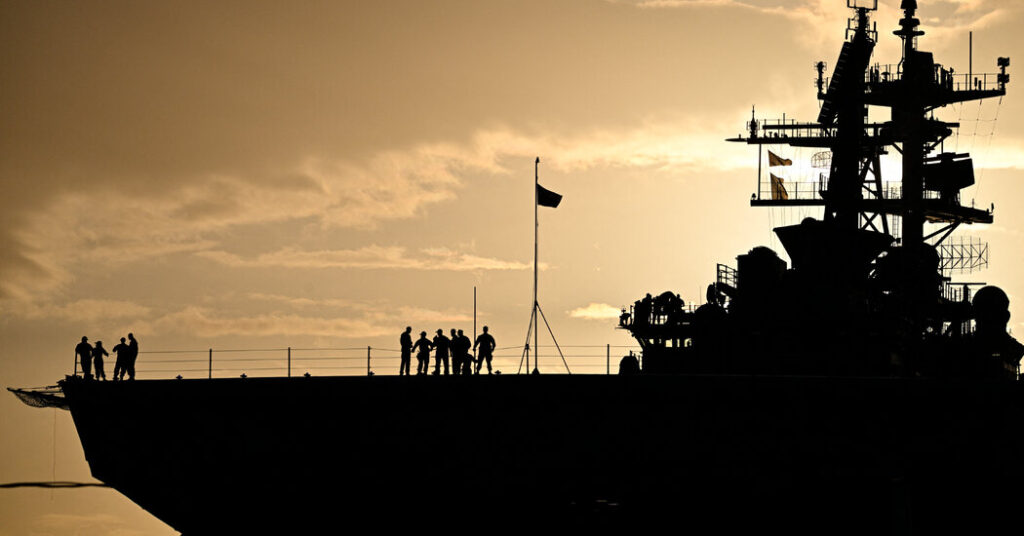
The Chinook did not crash. The flight leader, with the help of a co-pilot, stuck the landing, disgorged the commandos inside and guided the aircraft back to the warship Iwo Jima off the Venezuelan coast, as search-and-rescue teams and quick-reaction forces outside the country stood ready to zoom in, if needed.
By 2:01 a.m. in Caracas, more than 80 Army commandos had piled out of the helicopters, including the damaged Chinook. After an intense firefight with Mr. Maduro’s Cuban security detail, the soldiers blew open a door leading to Mr. Maduro’s bedroom, where they seized him and his wife as they were trying to escape into a steel-reinforced room.
A fresh wave of helicopters whisked the commandos and their prisoners from the compound, fighting through hostile fire on the way out. By 4:29 a.m., the aircraft were back over water, and later delivered Mr. Maduro and his wife to authorities on the Iwo Jima.
The flight leader, whom the Pentagon has not identified for security reasons, suffered serious injuries, but is recovering at a hospital in Texas along with one other soldier, the military said on Tuesday. Five other service members were treated for injuries and released. Military officials described the flight leader’s actions that night as “heroic.”
The mission also resulted in the deaths of about 40 Venezuelans, in addition to 32 Cubans who were helping to guard Mr. Maduro, according to Venezuelan and Cuban officials.
“This was one of the most stunning, effective and powerful displays of American military might and competence in American history,” Mr. Trump proclaimed after the all troops had returned home.
On Wednesday, Defense Secretary Pete Hegseth alluded to the dangers that the U.S. commandos faced. “It was a contested raid, even with the sophistication that went into it,” he told “The Charlie Kirk Show.” “It wasn’t until we saw those birds floating out that any of us could really exhale.”
“Not one piece of military equipment was lost,” he noted. “Not one service member was, more importantly, killed.”
In his news conference announcing Mr. Maduro’s capture, Mr. Trump took something of a victory lap, ticking off his recent military successes. He cited the killing of the Islamic State leader Abu Bakr al-Baghdadi by Delta Force commandos in 2019; the death of Maj. Gen. Qassim Suleimani, Iran’s top security and intelligence commander, in 2020 from a U.S. drone strike; and the targeting of Iran’s nuclear program by B-2 bombers in 2025.
“All perfectly executed and done,” Mr. Trump said.
To Mr. Trump, the military’s past failures were the product of lesser presidential leadership. In his news conference, he alluded to the botched U.S. withdrawal from Afghanistan in 2021 and President Jimmy Carter’s failed attempt in 1980 to rescue the U.S. hostages being held in Iran, which resulted in eight dead U.S. troops.
“You’ve seen some raids in this country that didn’t go so well,” he said. “They were an embarrassment.”
Notably absent from Mr. Trump’s list was the death of William Ryan Owens, a Navy SEAL, on a raid against an Al Qaeda offshoot operating in southern Yemen in 2017. In the aftermath of the mission, some questioned whether it was necessary.
At the time, Mr. Trump seemed to shift blame to his senior military leaders.
This was “something they wanted to do,” he said. “They came to see me, they explained what they wanted to do, the generals — who are very respected, my generals are the most respected that we’ve had in many decades, I believe. And they lost Ryan.”
Mr. Trump quickly soured on many of the military leaders from his first term. “I’ve worked with a lot of generals,” he said after the Venezuela raid. “I worked with some I didn’t like. I worked with some I didn’t respect.”
By contrast, he has described General Caine in glowing terms. “This guy is fantastic,” Mr. Trump said.
In comparison with diplomacy, which has produced slow and unsatisfying results for Mr. Trump in places like Ukraine, military action often produces quick outcomes.
A big question for the military is how an increasingly confident Mr. Trump will react if it loses troops in battle.
Elliot Ackerman, a Marine veteran who served with the C.IA.’s special activities division, reiterated that the U.S. military’s elite units have capabilities that no other nation can match.
“They train meticulously and execute incredibly precise operations,” he said.
But even the best planned and executed military operations hinge on uncertainties and can end badly, with long-lasting consequences.
“The second you have a U.S. soldier killed or captured, it changes the political calculus,” Mr. Ackerman said. “So it’s extremely risky to base a foreign policy around these types of operations. You can’t keep stepping up to the craps table and never expect to throw a losing roll.”
Eric Schmitt is a national security correspondent for The Times. He has reported on U.S. military affairs and counterterrorism for more than three decades.
The post A Close Call for U.S. Commandos and an Emboldened Trump appeared first on New York Times.