Midway through the documentary “Speaking in Tongues,” David Murray lists all the tenor saxophone giants upon whose styles he built his own. From Lester Young, he says, he learned how to play lyrically. From Coleman Hawkins, to play rhythmically. From John Coltrane, to move fluidly across harmonic modes. “And let’s see,” he says. “I learned how to just relax and be cool and play my horn from Dexter Gordon.”
The tall, debonair saxophonist known as the “Sophisticated Giant” had a seemingly effortless power in his playing. And yet beneath it also lay profound sincerity; he wasn’t just one of jazz’s great, surging extemporizers, but also one of its most disarming. In his playing, on ballads especially, he would drag behind the beat so hard he seemed to invert it, dissolving into tiredness, but sneakily turned a listener’s ear backward on itself too.
Gordon grew up in Los Angeles in the Great Depression era, when his father was one of the city’s few Black physicians and counted Lionel Hampton and Duke Ellington among his patients. A 20-something Gordon was the young tenor to beat in the bebop revolution of the 1940s, and from there his sojourns became a part of his legend, along with the sound. He bounced around the country in the bands of Billy Eckstine and Louis Armstrong, and then around New York, before suffering through a difficult, sometimes-incarcerated stretch in the 1950s. He returned to the fore with a triumphant run of now-classic Blue Note recordings in the early ’60s but shipped off for over a decade in Paris and Copenhagen before returning to New York in 1976 to a hero’s welcome.
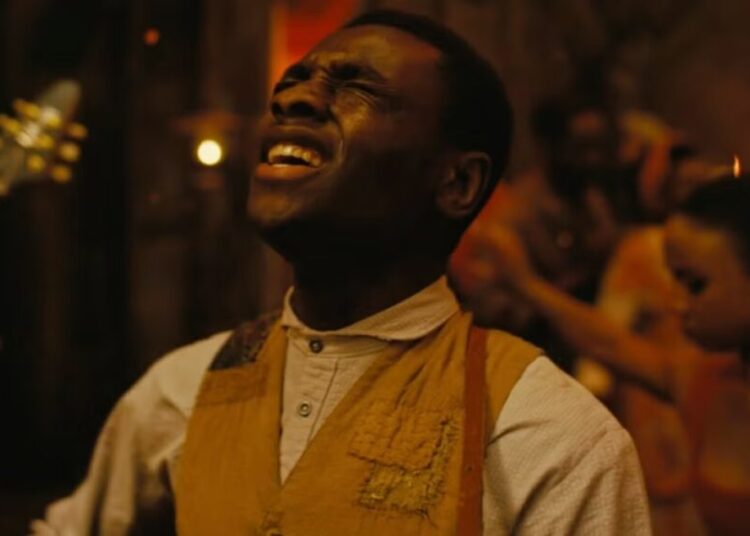
Toward the end of his life, Gordon’s talent found new form when he took a starring role in “Round Midnight,” a film about a musician living in Paris, confronting the bitterness of the music industry and the mixed blessings of a jazz career in Europe. Although it was his first appearance in a major film, that performance proved so understated and sincere that it earned him an Academy Award nomination for best actor.
To hear Gordon’s powers in high definition, read on for the thoughts and insights of writers, poets and fellow musicians, some of whom knew him personally. Check out the playlists embedded below, and if you have a favorite Dexter Gordon track that wasn’t on the list, drop a line in the comments.
◆ ◆ ◆
‘Scrapple From the Apple’
JD Allen, saxophonist
On a regular basis, I have to make sure to check in with Dexter Gordon. For me, it’s important. The song that first got me of his was “Scrapple From the Apple” from “Our Man in Paris. I was probably about 14 years old when I first heard it, and I was really into Albert Ayler, John Coltrane and those cats who were closer to the avant-garde. To hear Dexter Gordon play “Scrapple From the Apple” like this, it brought to my mind that that same intensity shown by Ayler and Coltrane could still take place on a tune that is so-called “bebop,” or that’s by someone of his stature. You know, just his intensity and his phrasing — it was so immediate. He’s really the creator of modern tenor saxophone phrasing, for lack of a better word. We all come from him.
 Listen on Spotify, Apple Music and YouTube
◆ ◆ ◆
‘It’s You or No One’
Rufus Reid, bassist
No matter what register he happened to be in, Dexter’s playing had such great clarity. There weren’t that many saxophone players in his era who actually made people stop and listen quite like that. The thing is, he put so much air in the note. People ask me all the time: Did Dexter talk to you guys in the band about how he wanted you to play behind him? And he never did. He just said, “I love the power underneath me.” You have to be connected to your instrument in order for what your brain is trying to do to really come out. He also really didn’t need a rhythm section — his time was so good, the way he naturally played. With Dexter’s time feeling, you could snap your fingers just by the way he would play his rhythm, the forward motion in his lines. If you put a metronome to us, we would be wrong like a dog — but it wouldn’t feel that way to the listener. His phrasing would be absolute.
Listen on Spotify, Apple Music and YouTube
‘The Chase,’ Dexter Gordon and Wardell Gray
Giovanni Russonello, writer
In 1946, when a 23-year-old Dexter Gordon landed back in his native Los Angeles, he had already made a splash on the rising bebop scene in New York City, where he briefly roomed with Miles Davis and recorded a few widely heard sides for Savoy Records. Now, back home, he stepped up as a leading figure on Central Avenue, where the jam sessions lasted all night. Hitting the studio in 1947 for Dial Records, Gordon brought with him Wardell Gray, a fellow tenor phenom; their wee-hours saxophone battles had become a buzzed-about story on the Central Avenue scene. Together, they recorded “The Chase,” a nearly seven-minute track that managed to bring the energy of those late-night sessions into the studio — and it caught on. Although the unwieldy single took up both sides of a 78-r.p.m. disc, it became an unexpected hit for Dial. While Gray would become one of the music’s immortals in his own right, there is no comparing to the cool-blooded assurance and cocky, tripleted witticisms in Gordon’s playing here. He still had more growing to do as a musician, but 10 years before Sonny Rollins would come to L.A. to make his mark “Way Out West,” Gordon was already there, way out ahead.
Listen on Spotify, Apple Music and YouTube
◆ ◆ ◆
‘Second Balcony Jump’
Camille Thurman, saxophonist
I picked up the tenor saxophone at 14, not by choice but through a summer jazz camp where I was introduced to Dexter Gordon’s music. I felt awkward because the instrument was large and low-sounding, and I was a shy young student unaware of any female role models. My camp instructor played “Second Balcony Jump,” and Dexter’s sound instantly captivated me, eliminating my fears and doubts. His tone was enormous, rich and expressive, with witty, sophisticated lines. I admired his confidence and charm and wanted to emulate them. His solo was the first I ever transcribed, teaching me to be expressive, confident and true to myself as a player.
Listen on Spotify, Apple Music and YouTube
◆ ◆ ◆
‘Driftin’,’ Herbie Hancock
Mark Turner, saxophonist
The album “Takin’ Off,” by Herbie Hancock, is unique in Dexter Gordon’s discography, because I think this is the only record where he’s a sideman getting called at this particular historical moment, when it’s really the beginning of what you could call modern mainstream jazz. I consider Gordon kind of a minimalist player, meaning he never plays too many notes. He plays just the right amount of notes, and everything he says is pertinent, and he never misses. He doesn’t play too loud, he doesn’t play too soft. Everything is right there. And sound-wise, he has a special combination of “wet” and “dry.” I can’t think of any other saxophone player that has that as much as he does. It is wide, and has a punch, but it’s also centered. On “Driftin’,” he takes one masterful chorus, and that’s it. But in some ways, he shows you everything he’s got in that one chorus: He can play on modern tunes, he’s got the tradition, he’s got juiciness and the blues, he’s got dry wit and wisdom, he’s got power, he’s got wistful sensitivity. All that comes out, in one chorus.
Listen on Spotify, Apple Music and YouTube
◆ ◆ ◆
‘What’s New’ (live)
Harmony Holiday, poet
The casual majesty of his vocal timbre predicts Dexter Gordon’s facility on the tenor, but nothing prepares the unassuming ear for his mid-performance recitatives. His voice is part sedative, part startling epiphany, and in it, the mere titles of songs bend into mythologies withheld but evinced by his cryptic, half-grinning cadence. As an orator he is both debonair beyond playfulness and the consummate dandy. He was 6’6” (hence being nicknamed the Sophisticated Giant), born in Los Angeles to a doctor father who died of a heart attack one Christmas during Dexter’s childhood, and he went on the road with Lionel Hampton while still a teenager. You can hear how he straddles privilege, precociousness, austerity and sweet haunted tricksterism in his announcement of the standard “What’s New,” during a 1964 live performance in Holland. In his pitch it’s the retro equivalent of one of those stray texts sent to the one that got away. He chuckles, between “how is the world treating you” and “you haven’t changed a bit,” as if it’s as much compliment as tease. He teases the audience but he’s addressing himself, too, entering a two-way fantasy which he then plays into fruition, becoming a resonator of secret reunion. The song itself becomes jovial and sullen with and for him, his response to his own question, the savoring of a recurring reintroduction to what will always dissolve into riffs.
Listen on YouTube
◆ ◆ ◆
‘Una Noche Con Francis’
Maxine Gordon, wife and biographer
The movie “Round Midnight” is really about the way jazz musicians think, and the way they organize their lives. It’s very honest, and I think it’s very helpful for young people to see them not only interact but play — because all the music in the film is recorded live. From watching the movie, you can tell these musicians had a way of communicating where they didn’t talk a lot. They would laugh. Or someone would just mention a name, and that would make them all crack up. When they were making “Round Midnight” and Wayne Shorter came to the rehearsal, he was playing soprano saxophone at first. It had been a while since Wayne really dealt with the tenor. Dexter said, “Oh no, you gotta play tenor.” So Wayne went to Selmer and got a tenor, and he started practicing in the hotel. They got a lot of complaints because he was practicing all night! Dexter practiced every day, too, the whole time I knew him. You know, he used to say: “Why do they call it playing music? We’re working!” Anyway, when Wayne got the tenor thing together, they rehearsed and then did the two-tenor scene in the movie. No edits, no overdubs. It was like they’d been playing together for years. Dexter loved Wayne. He liked everything about him. He liked his personality. He liked his sound. And he loved that Wayne was so well-informed about movies.
Listen on Spotify, Apple Music and YouTube
◆ ◆ ◆
‘Lover Man,’ Dexter Gordon and Johnny Griffin
David Murray, saxophonist
I met Dexter Gordon and Johnny Griffin at a gig in 1976, I believe. Just seeing Johnny and Dexter, they were like two peas in a pod. These guys would share apartments: While Johnny was in France, Dexter would be there in New York, and then they would switch houses. From then on, whenever I saw Dexter backstage, he would be talking to people; he’d have young guys around him, asking him questions, and he’d be dispensing his Dexterisms. He’d say some wisdom and then put a joke in there. The way he talked was almost like riddles. You’d have to be real hip just to understand what he was saying — and he knew that his wisdom was way ahead of everybody else’s. What I remember most about Dexter’s playing is the balance, and the way he would phrase through the balance. And then after he completed a phrase, he would end the notes that he played by chewing on them — like “dew-w-w-w-uh.” There was a quiver in the end of the phrase that struck me. And the feeling of his playing, it was elevated. It was high-level. I mean, playing a lot of notes was not important to him. He played the melody. Even when he went off the melody, he was still thinking about the melody — all the time. He was just a great individual.
Listen on YouTube
◆ ◆ ◆
‘I’ve Found a New Baby,’ Nat King Cole & Friends
Neta Raanan, saxophonist
Dexter Gordon is an icon of American music, not only because of his heartfelt melodicism and expansive tone. His career is also a profound cross-section of the DNA of jazz. This recording of “I’ve Found a New Baby” roots Gordon in his pre-swing-era influences, through the New Orleans pianist Clarence Williams, who popularized the song in the 1920s. Gordon is a sideman to Nat King Cole on this 1943 performance. He had already been on the road with Lionel Hampton’s band for three years by this point, but he was still only 20 years old. Gordon’s youthfulness can be heard through the strong presence of Lester Young’s style: laid-back phrasing, slight vibrato, and the use of alternative fingerings (repeated tones with variations of timbre and intonation). Shortly after this, Gordon would join Billy Eckstine’s band, where he developed a style more distinct to himself and became one of the original innovators of bebop.
Listen on Spotify, Apple Music and YouTube
◆ ◆ ◆
‘Love for Sale’
Ayana Contreras, writer
“Love for Sale” was reincarnated by Dexter Gordon and his quartet for his 1962 album “Go!” A Cole Porter-penned standard written in 1930, this track toggles effortlessly between a sparkling bossa nova and a swinging post-bop marvel, creating a percolating sensation. The flawless execution of those rhythmic changes are a testament to the rubber-band tightness of his combo at the time: Sonny Clark on piano, Butch Warren on bass and Billy Higgins on drums. Dexter’s solos are a master class in complexity, balancing a relaxed approach with expressive and dynamic rhythmic phrasing. There’s even a hint of humor, as he quotes the “Mexican Hat Dance” at about six minutes in. Though this was recorded at Rudy Van Gelder’s famed studio and not in a nightclub, the vibe is akin to a lively, cosmopolitan party where the gimlets were flowing and laughter served as apt percussion.
Listen on Spotify, Apple Music and YouTube
The post 5 Minutes That Will Make You Love Dexter Gordon appeared first on New York Times.