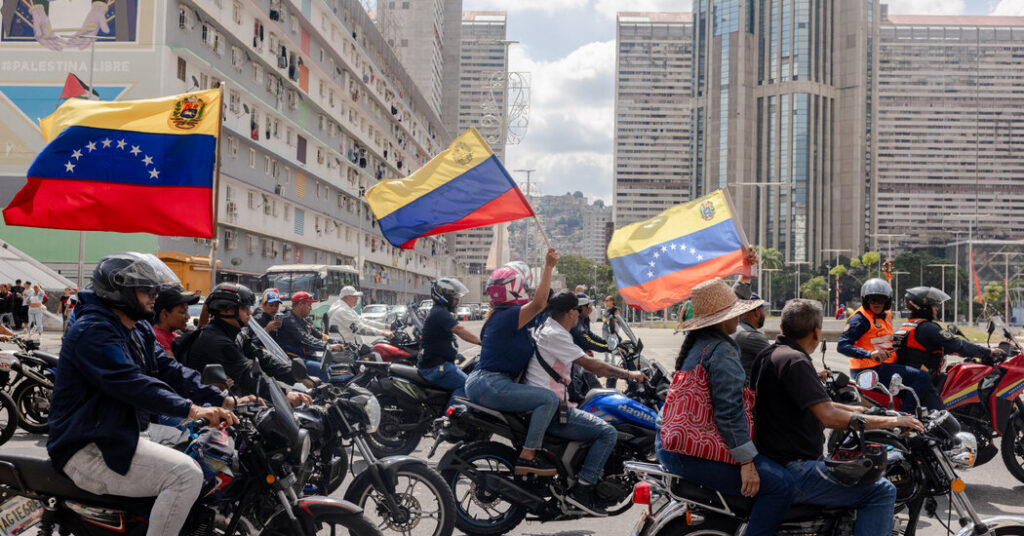
Fiery demands for the return of their captured leader, Nicolás Maduro. Fists in the air and victory signs in a show of defiance. Blistering attacks on President Trump.
Following a weekend of chaos in which the United States carried out airstrikes, killed dozens and seized Mr. Maduro, the Venezuelan National Assembly convened on Monday. It soon left no doubt that the head of the country’s revolutionary movement may have been removed, but his allies remain firmly in place — and in power.
Maduro loyalists are entrenched across the entire government, reflecting decades of ideological indoctrination, scorched-earth crusades against the opposition and purges of institutions that once had a semblance of independence and impartiality.
The Bolivarian political movement controlling Venezuela has prized belligerent rhetoric against the United States since Hugo Chávez rose to power nearly 30 years ago. On Monday, the passions on display in the legislature lay bare the challenge facing Mr. Trump as he demands that Venezuela turn into, in essence, a vassal state:
How can that be possible in a country where those still in power detest any sign of meddling by the United States?
Mr. Maduro’s own son, Nicolás Maduro Guerra, a member of the assembly since 2021, seemed to answer that question when he rose to address fellow legislators. He said his father and stepmother, Cilia Flores, referred to not as first lady but “first combatant,” had been illegally extracted from Venezuela.
“If we normalize the kidnapping of a head of state, no country is safe,” said Mr. Maduro Guerra, who is also named as a defendant in the U.S. indictment against his father. The charging papers refer to Mr. Maduro Guerra as “the Prince,” accusing him of conspiracy to import cocaine and possession of machine guns and destructive devices.
Trump administration officials have suggested that what is said in public by Venezuela’s ruling establishment and its actual dealings with the United States may differ. The country’s interim leader, former Vice President Delcy Rodríguez, has called for peaceful coexistence.
But after deposing the country’s authoritarian leader, the United States is still left to deal with the system he oversaw. And it is one that has ruled through fear, systemic violations of human rights, and a hollowing out of basic pillars of democracy.
It is not just the legislature that Mr. Maduro’s supporters control. They also wield power over the entire judiciary, the armed forces, intelligence agencies, the national oil company and governorships. They have also established a network of grass-roots surveillance groups in which ordinary citizens can denounce neighbors over activities deemed “disloyal” to the government.
Venezuela’s vast state apparatus of repression was once again on display at the National Assembly on Monday. In keeping with a government that has long cracked down on dissent and independent news organizations, security agents detained several journalists who were covering the session, according to Venezuela’s national journalists’ union.
Mr. Chavez’s movement, known as “chavismo,” will not, it appears, disappear easily.
“Trump fails to recognize the enormous difficulties and risks involved in taking over and managing a huge country of 28 million where chavismo has been entrenched for over a quarter century,” said Michael Shifter, a senior fellow at the Inter-American Dialogue, a research institute in Washington.
“To think that Venezuelans will simply follow U.S. instructions about how to organize and manage their country and fall in line, with no significant resistance and opposition, is illusory,” Mr. Shifter said.
With Venezuela’s armed forces humiliated by the U.S. military action, American officials have shown patience with some of the rhetoric coming out of Caracas. Secretary of State Marco Rubio said over the weekend that he would be willing to overlook some of the comments of Ms. Rodríguez, the Maduro loyalist sworn in on Monday as Venezuela’s interim leader.
Still, Mr. Trump, in comments to reporters, reminded Venezuela’s new leader that the United States has an armada of warships near Venezuela ready to act if it becomes necessary.
On Sunday, Ms. Rodríguez seemed to soften her language, extending an invitation to the U.S. government to work together on a “cooperation agenda.” But on Monday, at her swearing-in ceremony shortly after the legislature ended its session, she took a more bellicose tone, saying she was pained by the “illegitimate military aggression” against Venezuela.
The Bolivarian movement lost some of its socialist leanings in recent years as leaders sought to stabilize the economy by exposing it to market forces. But in terms of showing resistance to any outside forces, the legislative session provided glimpses of the political theater that has long been one of the movement’s hallmarks.
There were dramatic moments of applause and shouting as assembly members stood up for Jorge Rodríguez, the president of the assembly and the brother of Venezuela’s new leader, Ms. Rodríguez, when he appeared.
Legislators shouted in unison, “Esto no es paja, es la verdad, este es el pueblo que defiende a Nicolás!”, a chant which roughly translates as, “This isn’t bullshit, it’s the truth; these are the people who defend Nicolás!”
At almost precisely the moment Mr. Maduro and Ms Flores sat in prison jumpsuits during their arraignment in New York, Mr. Rodríguez called up Mr. Maduro’s son to join him. Then they pulled a red cloth from a photograph on a pedestal, revealing a smiling Mr. Maduro and Ms. Flores.
One pro-Maduro legislator, Timoteo Zambrano, singled out Mr. Trump for some political browbeating.
“We always had a clear idea who Mr. Trump was,” he said. “We knew that he came to destroy the world, to liquidate the international order based on rule of law. .But we never envisioned that he would violate his own Constitution — that he could effectively establish a dictatorship in the very nation that served as the democratic model for the world.”
In another speech, one legislator sent an “abrazo” — a hug — to the families of the 32 Cubans reported killed in the U.S. attacks in Venezuela, including military and intelligence personnel — a rare public signal of Cuba’s importance to Venezuela and the Maduro government.
At other times, those assembled appeared restless, fidgeting and speaking among themselves or looking at their phones, much as legislators do in chambers elsewhere in the world. Some who spoke did call for peace and tranquillity, highlighting the need for maintaining stability in the country.
The divisions characterizing Venezuela’s opposition were also on display on Monday.
Of the 285 legislators in the assembly, only 32 belong to opposition parties; those who do have legislative seats are generally known by others in the opposition as “alacranes”: scorpions. They are viewed as collaborators of the Maduro government.
The opposition figures who spoke at the session mostly delivered anodyne speeches consisting of broad platitudes, avoiding mentions of Mr. Maduro or of Mr. Trump’s expectation that the United States will “run” Venezuela. Some of them asked the government to release political prisoners.
“Consensus is not a surrender,” said Stalin González, a former student activist who is now an opposition legislator.
Emma Bubola contributed reporting from Buenos Aires.
Simon Romero is a Times correspondent covering Mexico, Central America and the Caribbean. He is based in Mexico City.
The post Venezuela’s Legislators Offer Scorn as Trump Demands Obedience appeared first on New York Times.