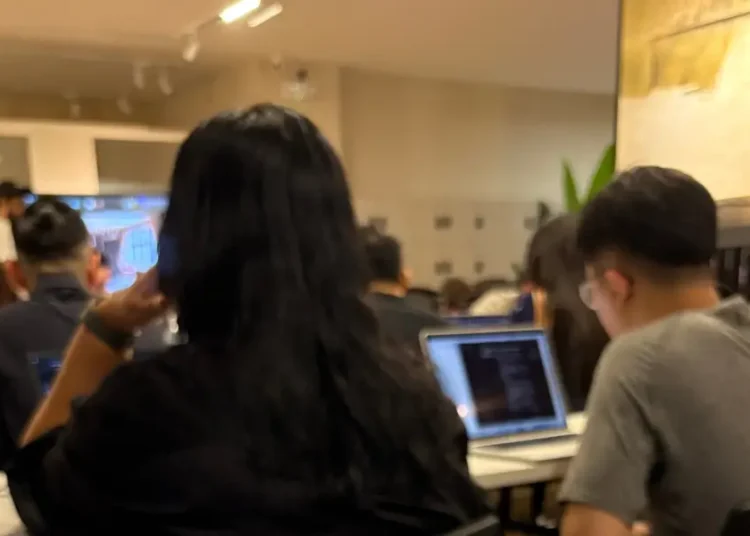
Venezuelan authorities detained at least 14 members of the news media on Monday as they were working inside or outside the National Assembly building in the capital, Caracas, according to the country’s main union for journalists and media employees.
Most are employees of global news organizations, Venezuela’s National Press Workers’ Union said in a statement, and at least one works for a Venezuelan television network.
By Monday afternoon, all 14 had been released, the union said, adding that one of the reporters had been deported.
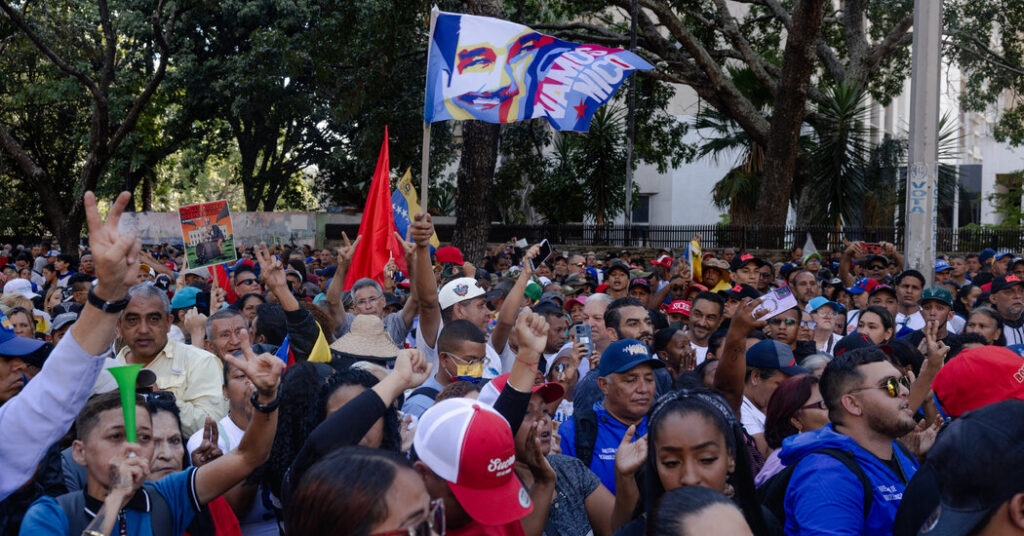
The reporters were covering the first meeting of the Venezuelan legislature since the U.S. raid that left dozens of dead, ousted President Nicolás Maduro and took him out of the country to face prosecution in the United States.
Legislators condemned the capture of Mr. Maduro and demanded his return.
Mr. Maduro’s former vice president, Delcy Rodríguez, was sworn in as the interim president of Venezuela.
“I come with sorrow for the suffering inflicted upon the Venezuelan people following an illegitimate military aggression against our homeland. I come with pain for the kidnapping of two heroes,” she said, referring to Mr. Maduro and his wife, who was also seized.
Members of the media at the National Assembly were told not to record, take photos or livestream the session, the union said in a statement.
At some point, military counterintelligence officers approached three journalists and took them away, the statement added. A person with knowledge of the events told The New York Times that at least two, a photographer and a videographer, were working for The Associated Press.
“Officials searched their cellphones, demanding access codes to inspect their photos, contacts, conversations, voice notes, Instagram accounts, emails, and cloud-stored files,” the union said.
The union identified only one reporter by name, Daniel Álvarez, a Venezuelan journalist who works for Televen, a private television network based in Caracas. The group said he “lost custody of his phone while the officers left the room where he was being held before eventually releasing him.”
“This type of action not only violates privacy and the protection of sources but also forms part of a pattern of criminalizing the practice of journalism,” the union said.
On Sunday, Luis Carlos Vélez, a reporter with Univision, said that he and his team had been detained by Venezuela’s internal intelligence agency shortly after entering the country from Colombia. After a lengthy questioning, he said, an official erased some videos the team had recorded and ordered them to return to Colombia.
A free press has not existed in Venezuela for more than two decades, according to Freedom House, a nonprofit that assesses each country’s degree of political freedoms and civil liberties.
Government suppression, censorship and, more recently, a massive surge in detentions have forced dozens of Venezuelan journalists into exile.
A systematic crackdown on the news media followed an election in July 2024, in which Mr. Maduro was declared the winner despite overwhelming evidence that he lost decisively. Since then, the government has arrested journalists and held them for days or months before their release, often as a warning to others, according to the National Press Workers’ Union. Others are still in custody.
According to the union, 23 members of the media arrested in the immediate aftermath of the presidential election remain detained. At least 13 journalists were charged with terrorism, criminal conspiracy or incitement to hatred, according to a recent report by the Venezuelan Institute for Press and Society, a group that monitors and defends press freedom in the country.
“It is impossible to move toward a democratic transition as long as political persecution, censorship, arbitrary imprisonment, and the systemic violation of fundamental rights persist,” the press union said on Monday.
The group added it was monitoring the “possible detention” of two foreign reporters on the border between Venezuela and Colombia.
Emma Bubola contributed reporting.
Emiliano Rodríguez Mega is a reporter and researcher for The Times based in Mexico City, covering Mexico, Central America and the Caribbean.
The post Venezuela Detained and Deported Members of the Foreign Press appeared first on New York Times.