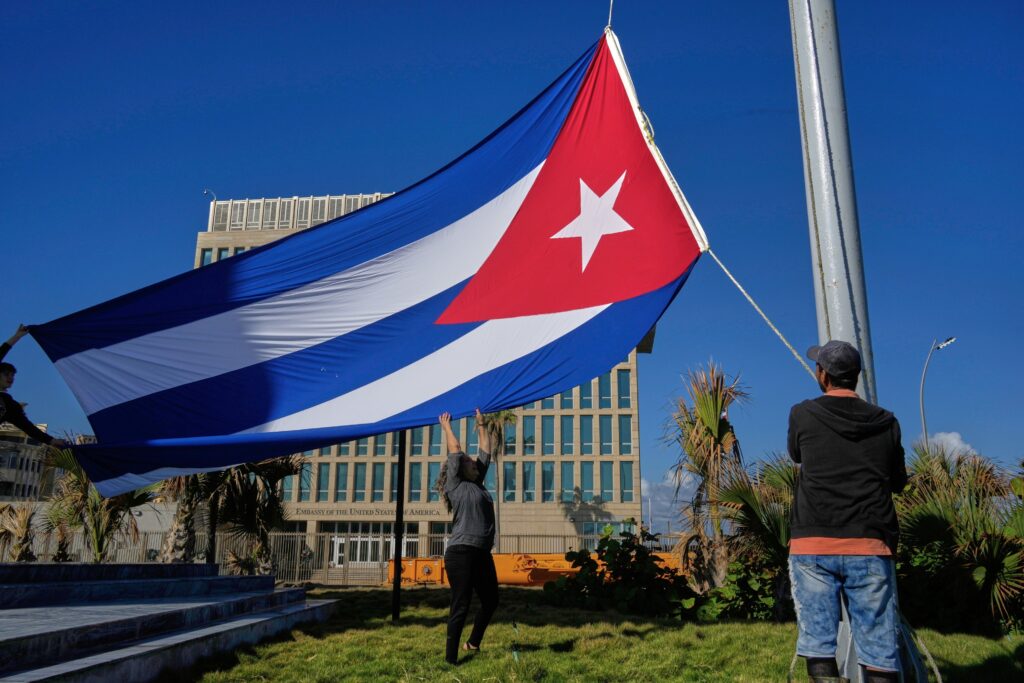
No place was hit harder than Cuba by the shock waves that Saturday morning’s U.S. military seizure of Venezuela’s Nicolás Maduro sent throughout Latin America and the world.
Within hours of the operation — long before the government in Havana acknowledged it — phone calls and texts across the island spread the news that dozens of elite Cuban security forces had been killed guarding Maduro.
But by the time it finally released a statement late Sunday saying that 32 of its military and security personnel were dead in Caracas, the Cuban government had bigger problems on its hands.
Both President Donald Trump and Secretary of State Marco Rubio made clear over the weekend that the collapse of Cuba’s communist government was not only a likely side benefit of Maduro’s ouster but a goal.
“I don’t think we need [to take] any action,” Trump said as he flew back to Washington from his extended Florida holiday break. Without Maduro and the oil supplies Venezuela provided, he said, “Cuba looks like it’s ready to fall.”
Rubio went further, indicating that the United States might be willing to give it a push. “I’m not going to talk to you about what our future steps are going to be,” he told NBC’s “Meet the Press” on Sunday. But, he added, “If I lived in Havana and I was in the government, I’d be concerned.”
Their words resonated with many in the Miami-centered exile community, where the struggle to free Cuba from communist rule has dominated politics for decades. On Saturday, South Florida Cuban exiles — some wearing red Trump hats and Cuban flags as capes — joined hundreds of revelers at spirited, impromptu celebrations from Little Havana to Doral, a city nicknamed “Doralezuela” because of its large population of Venezuelans. Cuban American leaders, most of them Republican, issued statements as Venezuela coverage dominated local TV stations.
Cuba is the “root” of problems with Venezuela, Nicaragua and other leftist regimes in the region, said Dariel Fernandez, Miami-Dade County’s elected tax collector. “Now the time has come … for the Castro communist and socialist assassin regime to be held accountable as well, and for the Cuban people to finally be free.”
Absent direct U.S. intervention, however, Cuba experts here and on the island were less certain.
“If you’re asking if the Cuban government will just collapse on its own because the economic pain is bound to increase” without shipments of Venezuelan oil, “I’m very skeptical,” said Michael J. Bustamante, associate professor of history and director of the Cuban studies program at the University of Miami.
To keep the lights on and cars running, Cuba has long been dependent on Venezuelan oil supplies, for which it has exchanged security and medical personnel in a sympathetic contract with leftist allies in Caracas.
“I could very well be proven wrong, but Cuba has been here before” and survived, Bustamente said, referencing what is known in Cuba as the “special period” that began in 1991 with the abrupt cutoff of outside assistance after the demise of the Soviet Union.
Juan Gonzalez, who served as Western Hemisphere director on the Biden administration’s national security staff, said that “cutting off the oil deliveries is going to put a huge squeeze on the humanitarian situation” in Cuba, which is already suffering regular electricity blackouts and food scarcities. “But I don’t think the regime is going to cry uncle.”
Aside from an economic uptick during the Obama administration, when the resumption of diplomatic relations between Washington and Havana led to increased tourism and slender openings for private ownership and outside investment, the Cuban economy has never really recovered from the Soviet fall.
The nation has been on a steady slide into economic chaos for years, owing to U.S. sanctions and what even many of its supporters see as mismanagement by a sclerotic Cuban Communist Party.
Some chose to see opportunity in the darkness following Maduro’s ouster. Carlos Alzugaray, a retired career Cuban diplomat reached by phone at his Havana home, said, “There is of course an increase of the threat, a very bad thing.”
But it was possible, he said, that Cuba’s allies in Russia and elsewhere would help, “and just maybe the government will … open up the economy and do what the economists have been telling them for a long time and they have refused to do.”
Venezuelan support under Maduro’s predecessor, Hugo Chávez, in the early 2000s helped Cuba emerge from the special period and the weight of decades-long U.S. sanctions. Since then, Havana has weathered the death of revolutionary leader Fidel Castro, covid, Trump’s dismantling during his first administration of the limited Obama opening and furious street protests in 2021.
But the emboldened second Trump administration presents an entirely new threat to Cuba’s leaders.
At various points over the years, Cuba’s own government economists have advised overhauling the economy and have been urged to do so by allies in China, Vietnam and Russia.
Raúl Castro, who took over from his ailing brother, Fidel, in 2006, warned of needed reforms in a lengthy 2010 speech to the Cuban parliament. “We are playing with the life of the revolution,” he said. “We can either rectify the situation, or we will run out of time walking on the edge of the abyss, and we will sink.”
But his plans to expand the role of the private sector and reduce state ownership were seen as contradictory and insufficiently implemented, ultimately resolving few of Cuba’s systemic problems. Other pushes for change have run into similar roadblocks over the ruling party’s refusal to allow private businesses and farms to sell their goods directly for market prices, its rejection of currency reforms, heavy government investments in a failing tourism industry and the growing power of GAESA, the military-controlled conglomerate that runs vast swaths of the economy.
At their peak of about 100,000 barrels a day, Venezuelan oil shipments allowed Cuba to serve its own energy needs and sell refined petroleum products overseas for desperately needed cash. But as Venezuela dealt with sharp drops in output, due to U.S. sanctions and mismanagement, shipments dropped to about 30,000 barrels last year.
Those cuts, along with Cuba’s aging refineries, failing infrastructure and the occasional hurricane, led to at least five island-wide blackouts last year.
“They have to realize they can’t depend on foreign help anymore,” Alzugaray said. Russia and Mexico have supplied some oil, although Mexican President Claudia Sheinbaum is likely to come under increasing U.S. pressure to cut off aid to Havana. China, which holds major Cuban debt, has shown little interest in helping.
Reforms have been approved “on paper,” Alzugaray said. “The problem is they don’t do it. The essence is opening to market economics, allowing expansion of the private sector, and eliminating or selling socialist state enterprises that don’t produce. They have to do it, and they have to do it fast. They have lost too much time.”
Few Cuba watchers have much confidence that reforms will happen, at least under the party government of President Manuel Díaz-Canel and the current power structure.
“There are reformers inside the regime,” said Gonzalez, the Biden administration official, who had extensive dealings with the Cuban government. “They have a vision, but they don’t have the wherewithal and the influence to have it done.”
Even if they did, he said, “it won’t be enough” for Rubio, whose parents fled the island before Fidel Castro’s 1959 takeover, and Cuban American lawmakers and power brokers, he said. “They’re going to want big change.”
Opposition on the island is diffuse and leaderless since arrests following the 2021 street protests.
“People who aspire to be opposition leaders are either in Miami or in Madrid or in jail,” said William LeoGrande, a specialist in Latin American affairs at American University. A Venezuela-like removal of even a handful of individuals is unlikely to rattle the multilayered, entrenched party and military power centers to the point of collapse, he said.
As for Cubans themselves, Alzugaray said, “I wouldn’t think that people are so desperate that they will welcome an American intervention or a group of Miami Cubans taking over. What people want is the Cuban government to change,” he said, “but in Cuban terms, not imposed by the outside.”
Ovalle reported from Miami.
The post Trump team puts a target on Cuba, with threats and oil blockade appeared first on Washington Post.