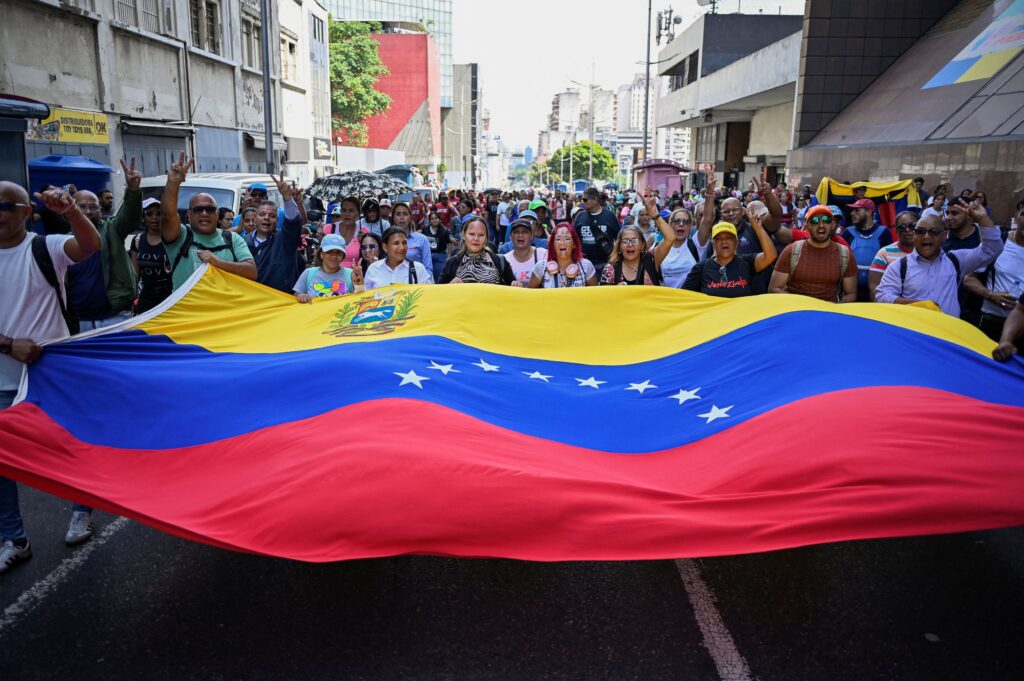
Nothing is more intense for a president than using America’s awesome military capabilities. You could hear the exhilaration in President Donald Trump’s voice Sunday night as he talked to reporters about the previous day’s operations in Venezuela.
But this sense of raw power carries with it a hubris that has destabilized nearly every presidential administration for three decades. It’s a slippery slope, especially for a leader like Trump who believes he’s smarter and tougher than his predecessors. He seems convinced that he can take what he wants — presidents, countries, resources — without paying a price. The world doesn’t work that way.
After the stunning special-forces operation that snatched President Nicolás Maduro from his bunker early Saturday morning, Trump talked as if his power has no limits. Cuba “looks like it’s ready to fall.” Colombia is “run by sick man, not going to last very long.” He loves Mexican President Claudia Sheinbaum, but “cartels are running Mexico,” and he wants to send in U.S. troops. As for Greenland, territory of NATO ally Denmark, he wants it, but he says he can’t talk about it for 20 days.
The presidency is seductive. It leads even cautious politicians to overreach, and Trump is the opposite of cautious. He is seeking to reorder the world, at home and abroad, top to bottom. It’s easy to say that this kind of thinking is delusional, or narcissistic, or dictatorial. But Trump seems convinced that he’s on a roll, and most other countries — China and Russia are the notable exceptions — haven’t figured out a strategy for containing him.
Venezuela illustrates one often overlooked fact about Trump. He launches his campaigns with the bravura of Teddy Roosevelt, but his follow-through is sometimes weak and disorganized. The strange truth is that despite America’s stunning display of military power, there hasn’t been regime change in Caracas. The same group of narco-traffickers and left-wing political operators still run the country, albeit without its former kingpin.
That’s either the best aspect of this operation or the worst, depending on your perspective. Yes, Maduro is sitting in a federal prison in Brooklyn. But the Trump administration is advertising the fact that it’s working with his handpicked successor, Delcy Rodríguez, who said Sunday night, “We invite the U.S. government to collaborate with us on an agenda of cooperation.”
The Trump administration has been talking quietly with Rodríguez about a post-Maduro transition in Venezuela for months, according to a report Monday in the Financial Times. The paper quoted an assessment by Ali Moshiri, a former Chevron executive who’s now hoping to invest in Venezuelan oil projects: “She is very well qualified, knows the oil business well, and also the flexibility that investors need. She could lead a transition administration, but she needs help from the U.S., especially on sanctions relief.”
Rodríguez has power, nominally, and the ear of Secretary of State Marco Rubio, dubbed the “Viceroy of Venezuela” by The Post. But the boots on the ground in Venezuela still belong to Defense Minister Vladimir Padrino López and Interior Minister Diosdado Cabello. Both were named as co-conspirators in a 2020 drug trafficking indictment of Maduro and other officials. Padrino was dropped in the superseding indictment unsealed Saturday that triggered the arrest of Maduro and his wife.
Trump must hope he can intimidate these narcos into cooperation by the threat of what he calls a “second wave” from the U.S. military. But are they really going to be America’s partners in transition to what may be distant democratic elections? Are Trump and Rubio really consigning the democratic opposition headed by María Corina Machado to a spectator’s role? That seems like a misuse of American power.
“My sense is that they made the decision wrongly that the opposition was not competent to run the country and they were better off working with Rodríguez. To what end is unclear to me,” says Elliott Abrams, who oversaw Latin America policy during the Reagan administration and is now a senior fellow of the Council on Foreign Relations.
Jack Devine, a former senior CIA officer for Latin America, supports Trump’s Venezuela policy but told me that true regime change there would have required more time and extensive coup planning and an ability to win over a decisive force within the military. He foresees a “strained but necessary transition phase” until eventual elections.
“We don’t have the power to put the democratic opposition in power immediately, but the military and security forces don’t have the power to resist Trump,” he argues. For now, he says, “we’re playing the cards day by day, but the current government will fold under continued pressure.”
The most unrealistic aspect of Trump’s policy may be his expectation that Venezuela’s vast oil reserves can be quickly taken by U.S. companies. Several experienced oil executives told me that ignores how long and costly it will be to boost Venezuela’s battered industry — and how few companies will want to take on this challenge.
The Trump administration has already begun contacting oil companies to urge them to invest in Venezuela. And the administration is said by one industry executive to have given Rodríguez a deadline of a few days to rewrite Venezuela’s petroleum law to provide favorable access.
But a former industry CEO cautioned me Monday that given the instability, “boards of directors can’t responsibly approve investment in Venezuela.” Trump may offer military protection for oil companies, but CEOs aren’t likely to approve any plans that put their employees at risk, he noted.
Trump has launched a violent process of change in Venezuela that will have repercussions he can’t control. In New York, his actions were condemned at U.N. Security Council by some U.S. allies, including France.
Nicolo Machiavelli, the supreme realist, observed that “people may go to war when they will, but cannot always withdraw when they like.” That’s a precept written in blood in Iraq and Afghanistan, and Trump had proclaimed it as a cornerstone of his foreign policy. But he seems fated to learn the lesson for himself.
The post Trump might have his hubris checked in Venezuela appeared first on Washington Post.