Many of us want to live in a haunted house. It’s not that we harbor a secret desire to be ambushed while folding laundry or spooked by a spirit in the bathroom mirror. On some level, we just want our homes to hold a story or two. Or we know that they already do, and we wish we knew them.
My evidence comes from my guilty pleasure. For fun, I research the buildings where my friends live, digging up old photos, financial papers and other documents. Each time I’ve presented someone with a news clipping about a former occupant, a blurry black-and-white image from decades past or a detail about their home’s construction, I’ve always been asked for more information.
I first dabbled in this kind of digging while living in a small brick townhouse that I shared with too many roommates in Brooklyn. I learned about a large family, the father a baker, who predated our stay by 90 years. We wondered which of the apartment’s few rooms the half-dozen children slept in, how they may have decorated, if they had used our long-defunct fireplace and which of the neighborhood’s churches they may have walked to on Sundays. Our mismatched living room suddenly seemed animated by their presence rather than cluttered by ours.
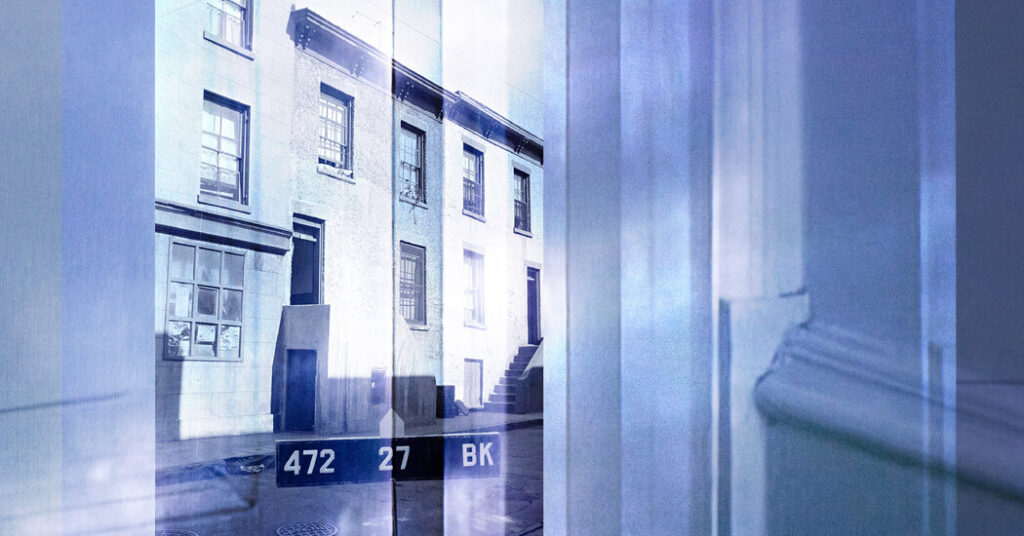
My job as a tenant organizer sent me only further into the archives. Trained to find dirt on bad landlords, I quickly realized New York’s bounty of housing records could be repurposed toward a broader range of discovery. City and state housing departments host rental histories and digitized versions of century-old handwritten building-inspection forms for many apartments, revealing previous occupants. Easily accessible property records can reveal taxes gone unpaid or permits taken out for alterations; it can be both comforting and infuriating to know that the same leaky roof has been plaguing your building for years. Of course, many buildings were constructed more recently. For that, municipal archives contain photos of every lot in the city, taken in the 1940s and again in the 1980s. I can never decide what I find more beautiful: the places that have vastly changed over time, with modern structures and transformed streetscapes, or the historic homes that have endured for a century.
Like much of my millennial cohort, I grew up doing my fair share of casual cyberstalking — sleuthing through an old friend’s digital footprint, or snooping on a distant acquaintance’s social media profile. (When it comes to socially discouraged activities, this behavior is only slightly less common than picking your nose or lying.) Today, scant biographic information and a handful of clicks can conjure up someone’s educational background, full employment history and recent beach selfies.
But unlike the surface-level information we find about each other online, home histories enmesh us in a broader web of connections, something deeper than ourselves. Our homes are the sites of the everyday acts that make up our days and of the most special events that transform them. They don’t just contain our lives, but embody them. As the French philosopher Gaston Bachelard put it, the home “would appear to have become the topography of our intimate being.” And not just ours — they hold countless strata of these personal stories, like so many coats of a landlord’s white paint. These archives remind us that everything we do and feel there is just the latest layer.
Diving into this information can turn up stories both humorous and hair-raising. While I once discovered that my childhood home in California was robbed for “three bricks of ice cream and a platter of cake” a century before I was born, I also found an ex-girlfriend’s Brooklyn apartment was built on the ashes of a building incinerated by unattended children. She was less pleased about her lot’s past than another ex was about hers, that apartment having belonged to a midcentury beauty queen. A friend in Queens lives in a building once home to a prizewinning cat and has taken to having guests compare its grainy old photo to his own tabby’s looks. Another friend in Missouri lives in a former mob hangout, and immediately forwarded an old clipping I shared to her upstairs neighbor; they discussed installing a commemorative plaque.
These archives don’t track the whole of life, of course. They instead tend more toward various regularities: births, weddings, crimes, obituaries, advertisements. They are also socially blinkered, disproportionately covering wealthier areas and whiter people. But all historical documents are incomplete, and what we can glean from them still teaches us something about the infinite details left uncovered. They remind us that people are born, they fall in love, they transgress, they die, they try to sell furniture. And they did so in the same rooms where we do those things now, and where others will after us.
Knowing that people lived where we do, experiencing the same slate of life’s emotions, we also remember that the quiet, passing rituals we perform every day are what make up our lives — not the digital detritus that supposedly describes who we are. Our living spaces are lined with these histories, like ornate parquet flooring trapped under gray laminate tiles. All it takes to uncover them is a little research, a process I’ve come to think of as a digital séance — coaxing out ghosts from behind walls and between floorboards and letting them live among us. Yes, pondering the past of your home can feel like a bit like being haunted. It can also feel like having company.
Charlie Dulik is a tenant organizer in New York City.
Source photograph for illustration above: Municipal Archives, City of New York.
The post The Revealing (and Alarming) Exercise of Cyberstalking Your Own Home appeared first on New York Times.