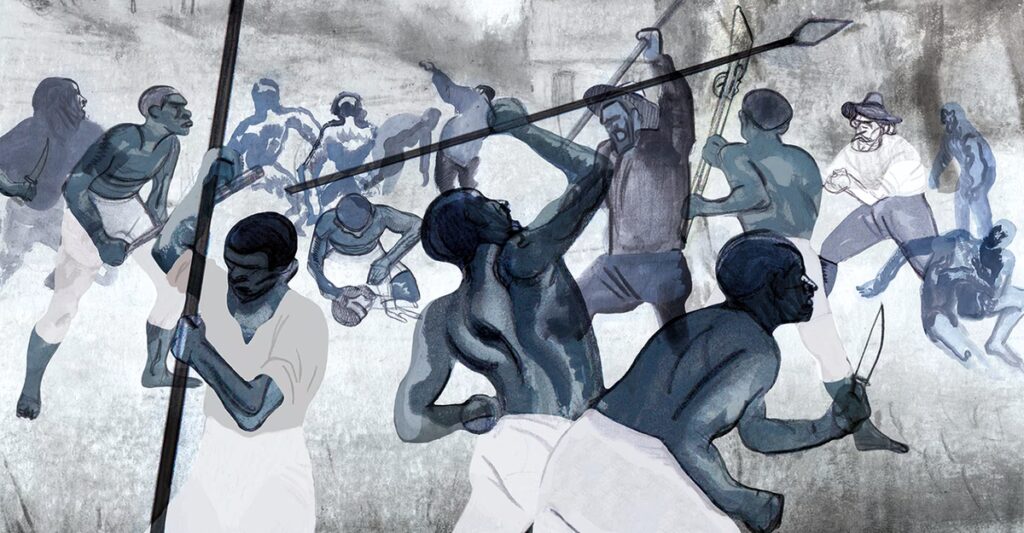
In 1812, Spanish officials in Havana, searching the house of a man named José Antonio Aponte, discovered a wooden box hidden in a clothing trunk, opened it, and were stunned by what they found inside. “It was unlike any book they had ever seen,” Carrie Gibson writes in The Great Resistance: The 400-Year Fight to End Slavery in the Americas, “filled with Biblical and historical images, with many black faces, as well as cut-out bits of paper and handwritten words.” Aponte, a freeman who had once served in the local militia, was part of a group that had sought to launch an uprising among the enslaved. The goal was to overthrow slavery and make Cuba independent, but the rebellion had been quickly suppressed.
Put on trial, Aponte was questioned for three days about what his interrogators called his “book of paintings.” In Daring to Be Free: Rebellion and Resistance of the Enslaved in the Atlantic World, Sudhir Hazareesingh emphasizes the global sweep of Aponte’s portraits, among them versions of Abyssinian royalty and, as Gibson notes, the Greek philosopher Diogenes the Cynic, believed to have once been a slave himself. One element particularly alarmed the Spanish: scenes of Black soldiers vanquishing white troops, evoking the victories of Haitian revolutionaries against the French a decade earlier. During meetings at his house, Aponte had shown them to fellow insurrectionists as proof that they, too, could win a war against slavery.
When he was asked to explain why he had chosen to include what he did, his answer was simple: “For reasons of history.” Aponte was executed after his trial, and his book disappeared. All that is left are Aponte’s descriptions of the work, page by page, at his trial. But that testimony has allowed contemporary historians and artists to reconstruct his visionary awareness that, in seeking to change his world, he first had to compile his own history of what had come before.
In their ambitious histories of slave resistance, Gibson and Hazareesingh are working in the tradition of Aponte, offering a new intellectual and political perspective on the emergence of freedom in the modern world. A generation ago, foundational works on the history of antislavery movements tended to focus on political thinkers and prominent abolitionists, figures who left ample written records behind. But over the past several decades, scholars have made headway in piecing together the ideas and actions of resistance leaders such as Aponte, as well as of the enslaved themselves. This is challenging work: The system of slavery frequently barred access to literacy, and most accounts of enslaved resistance come from people who were not just hostile to the venture but actively seeking to suppress it. By gathering second- and thirdhand traces and elusive sources and data, historians have illuminated communities in the forests of the Kongo region, the deltas of West Africa, the mangroves of Cuba, and the swamps of the Carolinas.
[From the November 2025 issue: The Black loyalists of the American Revolution]
The Great Resistance and Daring to Be Free synthesize this growing body of scholarship to offer detailed accounts that stretch from the 15th century, when enslaved people from West Africa were first imported to Iberia, through the abolition of slavery in the United States, Cuba, and Brazil in the late 19th century. Gibson builds on her own earlier wide-ranging history of the Caribbean, Empire’s Crossroads (2014), and Hazareesingh branches out from Black Spartacus (2020), his biography of Toussaint Louverture, a leader of the Haitian Revolution.
The story of resistance begins in Africa, where the slave trade itself originates. There, Hazareesingh argues, lie the foundations of a long and influential tradition of antislavery activity that continued into resistance efforts throughout the Americas. He assembles evidence of what he calls an “African fugitive politics”: people on the continent threatened by enslavement taking concerted action in collective ways, intent on self-determination. In many different regions, groups seeking sanctuary from raids by slavers created new settlements during the 17th and 18th centuries. Many of them exist to this day, their founding histories preserved and celebrated in oral traditions.
The Tofinu took refuge in the lagoons along the Bight of Benin, a core area of the slave trade, venturing forth in canoes with harpoons, javelins, and swords to fight off raiders from powerful nearby kingdoms. In present-day central Nigeria, the Eggon created fortified positions in the hills from which they launched stones, spears, and even beehives against would-be enslavers. The focus on living in freedom nurtured a nonhierarchical approach to politics, Hazareesingh writes, and he describes an ethos rooted in honor and consensus. Settlements were named to convey their fugitive origins. “Here where no one can reach them anymore,” one was called; another was “the village of free people.”
Millions couldn’t escape the raiders on the continent. But the remarkable SlaveVoyages database—which both Gibson and Hazareesingh draw on—has transformed our knowledge of resistance at sea. An open-access digital project, it has documented the scale of the slave trade originating on the continent, compiling data on roughly 35,000 voyages that carried at least 10 million people across the Atlantic from Africa. It has also found references to 465 shipboard revolts. Using the database, one study suggests that open resistance may have occurred in as many as 10 percent of slave voyages. The majority of the revolts date back to well before Joseph Cinqué’s carefully plotted rebellion on the Amistad in 1839, the most famous of them and one of a small number that succeeded in securing freedom for those aboard.
Historians are also indebted to written documents left behind by Islamic and Catholic thinkers in Africa who developed religious critiques of slavery. Both Gibson and Hazareesingh single out a Kongolese man named Lourenço da Silva Mendonça, who in the 17th century articulated a particularly powerful attack. He was born into the Ndongo royal lineage in the Kingdom of Kongo, where many had adopted Catholicism. In 1671, he and his family were forced out of the kingdom by the Portuguese and sent to the colony of Brazil. Having seen the ravages of slave-raiding in his homeland, he now witnessed the system of slavery into which many of his people had been sold. He then traveled to Portugal and took up residence in a monastery where several others from the Kongo, as well as Indigenous Brazilians, lived and studied.
Convinced that slavery went against the teachings of Catholicism, he wrote a brief denouncing the institution, which he brought to the Vatican in 1684. “Humanity is infused with the spirit of God,” he argued, and racial differences, an “accident of nature,” are in no way grounds for enslavement. As he pressed his case at the Vatican, Mendonça gathered a dossier that included firsthand accounts from Africans in Portugal.
Along with his own experiences, that evidence fueled his eloquent denunciation of “the unjustified methods used to enslave” people in Africa, “from which results the loss of countless Souls,” as well as the “cruelties” practiced against the enslaved in the Americas. Torture with hot wax and tree sap appalled Mendonça; some of the torments, he observed, were worse than those visited on the early Christian martyrs, and all the more shocking because they were meted out by Christians against other Christians. Mendonça also advocated on behalf of the “New Christians,” among them Jews who had converted to Catholicism but were often still pursued by the Inquisition.
Pope Innocent XI responded by calling on Spain and Portugal to at least curtail the cruelty of slavery. But the profitable slave trade continued, crucial to the colonial order that the leaders of these and other European kingdoms had decided to build. Mendonça’s singular legal case lay buried in the Vatican archives for centuries. Now recovered, his story is an example of the constant cross-Atlantic transmission of information and ideas that Gibson and Hazareesingh highlight as integral to the far-reaching struggle for abolition.
During his time in Brazil, Mendonça had contact with the residents of Palmares, a network of nine jointly governed maroon communities, many of whose members were formerly enslaved refugees from the Kongo. (In the 16th century, the Spanish used the term cimarrónes—originally applied to untamed animals—to describe people who escaped from plantations; other colonial powers adopted versions of it, including the English term maroon.) Probably the largest of all such settlements in the Americas, Palmares thrived through much of the 17th century, its population numbering as many as 10,000 or perhaps even 20,000 residents at one point, and it wielded clout on a different scale than smaller fugitive communities in Africa did.
Under a leader named Gana Zumba, Palmares signed a peace treaty with the Portuguese guaranteeing its freedom. It established alliances with Indigenous Brazilians in the area, and its inclusivity extended to people who weren’t enslaved but were fleeing colonial society, including Jews persecuted for their religious beliefs. African culture, language, and religious practices undergirded community life, but a Catholic priest performed baptisms in a church in Palmares adorned with statues of Jesus, the Virgin Mary, and Saint Blaise, an Armenian martyr whose story of taking refuge from persecution in the Cappadocian mountains resonated with the maroons.
Gibson recounts the trajectory of Palmares as just one part of a much longer history of people seeking freedom and sanctuary in the midst of colonial societies. In Spanish Santo Domingo, the first slave society in the Americas, Africans on a sugar plantation owned by Christopher Columbus’s son rebelled on Christmas Day 1521. They escaped into the hills and allied with an Indigenous group fleeing Spanish control, led by a man named Enriquillo. After 15 years, Spanish troops dispersed the settlement—which had grown to 4,000, and had its own cavalry—but subsequent maroon groups forced colonizers to sign treaties with them.
As the plantation colonies of the British and French Caribbean grew in the late 17th and 18th centuries, escapees formed maroon enclaves there as well. The region also saw a series of mass revolts against slavery. In the 1760s, enslaved organizers in Jamaica launched an uprising that was later known as Tacky’s Revolt. It was, as Gibson writes, “not a small, local eruption, easily snuffed out. Rather, this resistance was akin to a multisite, decentralized guerrilla war, not against a particular king or ruler, but against a social and economic system.”
And then in 1791, the largest such uprising in history took shape in the nearby French colony of Saint-Domingue. It led to the abolition of slavery by France in 1794 and, when Napoleon Bonaparte sought to reenslave the population, to Haiti’s independence from France on January 1, 1804, when the island was rechristened with the original Indigenous name for the territory. Hazareesingh and Gibson emphasize the revolution’s role in articulating a radical idea of universal rights and cultivating new forms of democratic participation. (As the notes in The Great Resistance and Daring to Be Free indicate, the close-knit field relies on scholarly interchange; both authors draw on my work on Haiti, and I gave Hazareesingh feedback, reading suggestions, and a blurb.)
The Haitian Revolution’s success in overthrowing slavery and then establishing a new nation gave rise to a very different archive, including writings by and about its most recognized leader, Louverture, and Haiti’s founder, Jean-Jacques Dessalines. These offer us a personal understanding of the influences that shaped their lives and ideas. Dessalines, for instance, acknowledged his deep debt to the woman he considered his “second mother,” Toya Montou, one of a number of women who participated directly in combat. She taught him about his African roots and during the revolution led her own unit of insurgents.
[Read: The island nation whose history reflects America’s]
The dramatic victory in Haiti nourished the imaginations of enslaved people across the hemisphere, helping create what Hazareesingh describes as a “popular encyclopaedia” that was “embedded in songs, music, images, and artefacts, and stories, tales, and myths about the revolution’s heroic leaders and the achievements of the Haitian people.” Brazilian authorities were alarmed in 1805 when they found Black officers in the local militia wearing “miniature portraits of Dessalines around their necks.” Parishioners in Black churches in Philadelphia celebrated the anniversary of Haitian independence, if quietly. In Louisiana, a man named Charles Deslondes led a two-day revolt in 1811, the largest in U.S. history, and almost certainly inspired by the Haitian Revolution. Two decades later, Nat Turner planned his (ultimately thwarted) 1831 rebellion in Southampton County, Virginia, to begin on the 40th anniversary of the Haitian Revolution’s start.
[From the August 1861 issue: Nat Turner’s Insurrection]
The events of the Haitian Revolution reshaped the history of North America: Napoleon’s defeat there prompted him to sell Louisiana—which he had reacquired from Spain as part of his plan to build a French empire in the Americas—to the United States in 1803. The purchase doubled the country’s size, enabling the U.S. to become a bleak outlier: During the next decades, while slavery was being abolished in newly independent Latin American republics and in the British Caribbean, the U.S. expanded slavery into the recently acquired territory.
With the Louisiana Purchase, a huge domestic slave trade got under way, supplying labor to cotton and sugar plantations. Though only roughly 5 percent of the total number of enslaved Africans brought to the New World from the 16th century through the start of the 19th ended up in North America, by the time of the Civil War, the enslaved population had grown to approximately 4 million, mostly native-born. All of their efforts at rebellion in the 19th century were swiftly and brutally suppressed.
Still, other powerful forms of resistance surfaced. Escapes to the North were organized by figures such as Harriet Tubman. Some who had won their freedom, among them Frederick Douglass, wrote powerful autobiographies that were also devastating critiques of slavery. And abolitionist materials produced in the North traveled south. A Mississippi plantation manager complained in 1847 about an enslaved woman named California who had “an idea that she is free” and was passing that idea on to her children. In an echo of Aponte, she had decorated the walls of her cabin with antislavery prints, which were often circulated along with pamphlets.
[From the December 1866 issue: Frederick Douglass’s ‘Reconstruction’]
When the Civil War began, as many as 500,000 enslaved men and women escaped toward Union lines. After the Emancipation Proclamation, the involvement of 200,000 Black soldiers in the war proved crucial in the Union victory. Some African American recruiters invoked the earlier history of the Haitian Revolution in their pitch, recalling how Black troops in Haiti had secured and protected abolition: Like those forebears, new “black Toussaints” could strike “blow after blow for freedom,” and bring liberation to all of those still enslaved in the South.
As Aponte knew, the way you look at the past shapes your hopes about the present and future. In the U.S., debates about how to understand our experience of slavery and its ultimate demise are as intense as ever, and will continue to be at the core of broader questions about how to narrate our national story. But Hazareesingh and Gibson invite us to see ourselves as inheritors of something much broader too: a powerful history of political thought and on-the-ground resistance—in many forms, always against seemingly insurmountable odds—that stretched across continents and centuries.
This article appears in the February 2026 print edition with the headline “The New History of Fighting Slavery.”
The post The New History of Fighting Slavery appeared first on The Atlantic.