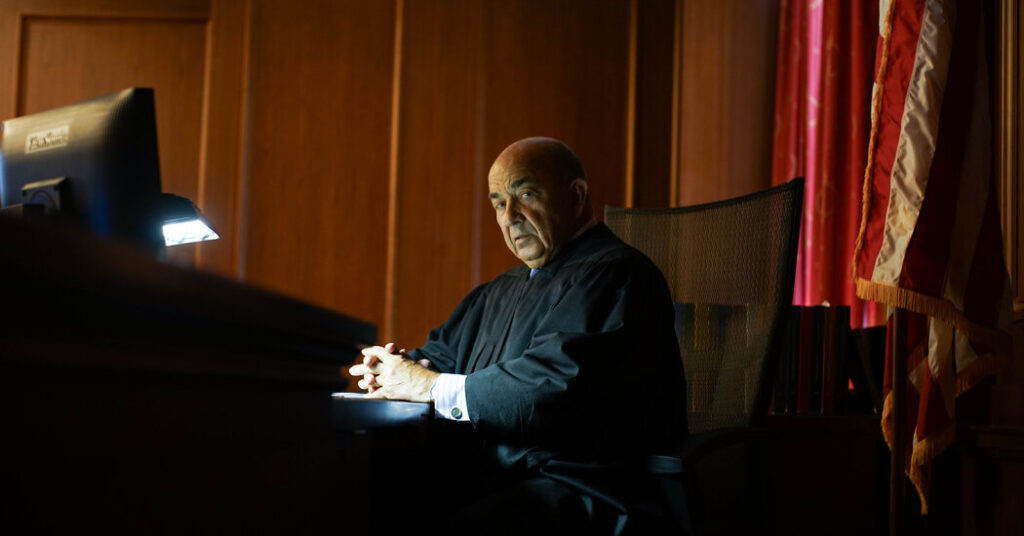
Alvin K. Hellerstein, the judge assigned to conduct the trial of Nicolás Maduro, the ousted leader of Venezuela, has long been a widely admired member of the federal bench. The best way for him to honor the system to which he has devoted decades of his life would be to withdraw from the case because, at 92, he is simply too old, in my view, to preside over a matter of this magnitude.
On Monday, Judge Hellerstein conducted a brief arraignment of Mr. Maduro and his wife, Cilia Flores, in the federal courthouse in Manhattan, where they pleaded not guilty to a wide-ranging indictment on drug trafficking and other charges. This routine proceeding will be followed by pretrial hearings that will require Judge Hellerstein to decide a host of complex and even never-before-seen issues, including Mr. Maduro’s potential immunity as a head of state, the legality of the seizure of the two defendants in Venezuela, and the state of their health and ability to stand trial.
The case is so complicated that Judge Hellerstein did not even schedule the next conference, at which the parties will begin to address the hearing schedule, until March 17, more than two months from now. It’s almost inconceivable that a trial will begin until 2027, when Judge Hellerstein will be 93. The trial itself will then last many months, with the judge called upon to decide additional highly consequential issues under enormous public scrutiny.
President Bill Clinton appointed Judge Hellerstein to the federal bench in 1998, and he has been a distinguished jurist of the Southern District of New York. In his early years, he handled several important civil cases that emerged from the attacks of Sept. 11, 2001. In 2011, when he was 78, he could have retired at full pay, like all federal judges of his age and tenure, but, to his credit, he continued to assist his colleagues by hearing cases and conducting trials. As they do for all mortals, the years appear to have taken their toll on Judge Hellerstein.
Last year, the judge presided over the six-week trial of Charlie Javice, the chief executive of a start-up who was convicted of defrauding JPMorgan Chase of $175 million. The defense has sought a new trial in the case in part because, “during trial, at least one newspaper article reported that the presiding judge was sleeping, at times, during the proceedings.”
According to one person familiar with the case, prosecutors and defense lawyers conferred during the trial about how to address Judge Hellerstein’s episodes of sleep, especially during the afternoons, but they jointly decided, ultimately, to do nothing, out of fear of offending him. How will the American legal system look to the international audience following the Maduro case if the presiding judge starts to nod off in the afternoons?
To be sure, recent news reports have repeated the customary praise that sitting judges invariably receive from practicing lawyers, but the fact remains that 92 is 92 — and counting. It is true, too, that some federal judges, like Jack Weinstein in Brooklyn, served effectively into their 90s. But there is no precedent for a judge of such an age presiding over a case as complex, lengthy and high profile as Mr. Maduro’s.
There is no simple procedural mechanism for lawyers, or the public, to challenge the fitness of judges. A culture of deference — and the fear, especially among active lawyers, of courting retribution — limits most inquiries into the abilities of aging judges. The parties can ask a judge to recuse himself for bias, but that is not the issue here. What tends to happen, rather, is that peers tend to step in informally and gently encourage a judicial colleague to step aside. The chief judge of the Southern District of New York, Laura Taylor Swain, should make such an overture to Judge Hellerstein if he does not himself recognize the need to face reality.
If Judge Hellerstein were to withdraw now, the case would then be randomly assigned to one of the 30 or so eligible judges in the Southern District, who could start from scratch. If Judge Hellerstein were to keep the case, but then become unable to continue during the long run-up to trial — or during the trial itself — it would force a replacement judge to come up to speed on the many complexities of the case and probably cause a delay or even a mistrial.
The nation has recently seen the consequences of an important governmental leader refusing to recognize the realities of aging. President Joe Biden, who is nine years younger than Judge Hellerstein, initially chose to run for re-election when he was no longer fit to do so, with epic consequences for his party and the country.
For Judge Hellerstein to hang on to the Maduro case when he will be well into his 10th decade would be a disservice to himself, to the parties in court, and to the cause of justice in America.
The Times is committed to publishing a diversity of letters to the editor. We’d like to hear what you think about this or any of our articles. Here are some tips. And here’s our email: [email protected].
Follow the New York Times Opinion section on Facebook, Instagram, TikTok, Bluesky, WhatsApp and Threads.
The post The 92-Year-Old Judge in the Maduro Case Must Step Aside appeared first on New York Times.