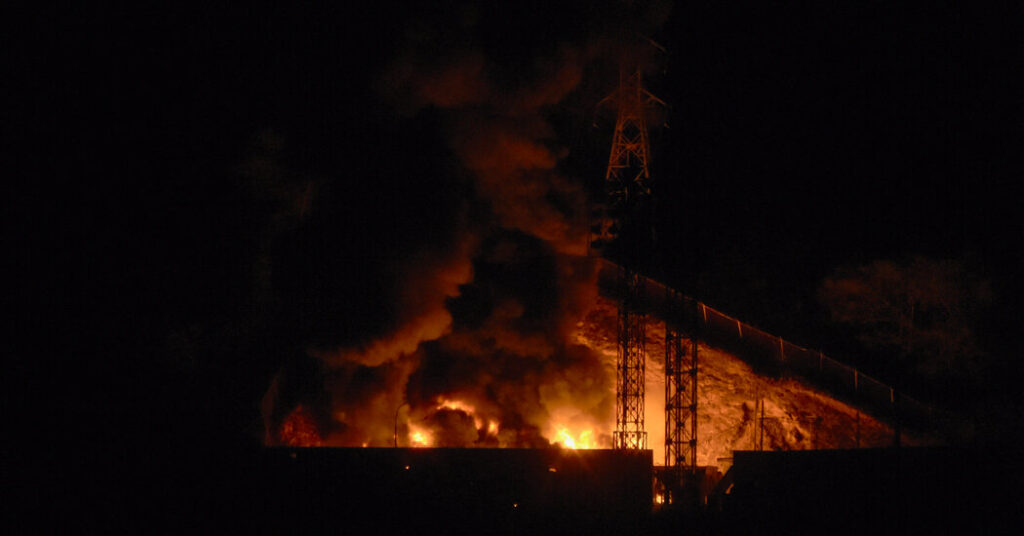
Over the weekend, the United States captured the Venezuelan president, Nicolás Maduro, and took him to New York to face criminal charges, the stunning culmination of a monthslong campaign by the Trump administration to oust the authoritarian leader. The United States would “run the country” until a proper transition of power could be arranged, President Trump said hours later, raising the prospect of an open-ended commitment. He acknowledged the potential for entanglement: “We’re not afraid of boots on the ground.”
What does this military action mean? How does it fit into a long history of U.S. intervention in Latin America? Is it legal under U.S. or international law? How will it affect Venezuela and its people? In this lesson plan, we provide a curated selection of free New York Times articles, along with questions for writing and discussion, to help students understand and analyze these complicated events.
Why should you teach it? We can’t make the case any better than David Cutler, a U.S. history and government teacher, does in his essay “Teachers, if we don’t teach Maduro’s capture in Venezuela, TikTok will. Here’s my plan.” He writes: “If you teach any subject touching on power and law, this is your curriculum. Not next week. Tomorrow.”
Below, some possible ways in. Please keep in mind, however, that this is a developing news story. You can follow along here for the latest updates.
What Happened? The U.S. Campaign Against Venezuela.
A good place to start learning about what happened in Venezuela is by watching the three-minute news analysis video above. Another option? This PBS NewsHour video, which explains the events in just under five minutes.
Ask students what they have heard about the operation, where they have obtained their information and what questions they have about it.
Then, have students read “Venezuela, Democracy and Oil,” a Sunday edition of The Times’s The World newsletter, which explains how the operation unfolded, what is next for Venezuela and the Trump administration’s rationale for the pressure campaign against the country in recent months. The newsletter begins:
It wasn’t a surprise, exactly.
Trump had been telegraphing for months that he was planning to take action against Venezuela. The administration called President Nicolás Maduro a narco-terrorist and carried out dozens of lethal strikes on small boats near the Venezuelan coast. More recently, it began seizing tankers carrying Venezuelan oil.
But the form that action took — special forces seizing Maduro and his wife from a military compound in a nighttime operation, and taking them to New York, where Maduro now sits in a Brooklyn jail — was still brazen enough to be shocking.
For a deeper look at the operation and its implications, students can explore the following resources:
-
This episode of “The Daily” podcast about the raid that extracted Mr. Maduro
-
Maps, videos and photos that show how the capture unfolded
Questions for writing and discussion
-
What happened over the weekend?
-
How have tensions been escalating for months between the United States and Venezuela?
-
What are the Trump administration’s goals in its military action in Venezuela?
-
What are the possible benefits of this U.S. involvement?
-
What are the possible risks — for Venezuela and for the United States?
What’s the Historical Context? A History of U.S. Intervention in Latin America.
The operation in Venezuela is not the first time the U.S. government has intervened in Latin America. Indeed, The Times reports, “The United States has a long and, often sordid, history” of such action, dating to the Monroe Doctrine, an 1823 policy from President James Monroe that Mr. Trump has cited to justify his intervention in the region.
To learn about this history and how it connects to the Trump administration’s recent actions against Venezuela, have students first read about the Monroe Doctrine. Then, in the article “Trump’s Cartel Order Revives Bitter Memories in Latin America,” which was published in August before Mr. Maduro was captured, they can read about how the policy, and past presidents’ citations of it, have evolved. It begins:
Just a decade ago, the era of U.S. wars, coup plots and military interventions in Latin America seemed to be ebbing when the Obama administration declared that the Monroe Doctrine, which long asserted U.S. military supremacy in the Americas, was dead.
Now this cornerstone of foreign policy is roaring back to life, resurrecting fears over U.S. military interference in the region after President Trump ordered the Pentagon to use military force against certain Latin American drug cartels.
For more, students might explore the following resources:
-
An article about a long history of U.S. military actions in Latin America, from the Spanish-American War to operations in Haiti
-
An article about the C.I.A.’s involvement in Latin America, including plots to overthrow governments, kill high-profile leaders or arm dissident groups
-
A news analysis on Mr. Trump’s bid to control the Western Hemisphere, or what many observers are calling the “Donroe Doctrine”
Questions for writing and discussion
-
What are some examples of U.S. interference in Latin American politics? How would you describe this history?
-
What is the Monroe Doctrine? What role has it played in U.S. intervention in Latin America throughout history? Is it playing a role today?
What Comes Next? Legal Issues and Global Responses.
As of Tuesday, Mr. Maduro is being held in a detention center in Brooklyn, and Delcy Rodríguez, previously Venezuela’s vice president, is the interim leader.
Mr. Trump suggested that the United States would be involved in Venezuela for the foreseeable future, telling NBC News on Monday that the country was not ready to hold elections and naming some of his top aides to oversee the next steps.
How has the world reacted to these events? The two-minute video above shows what some supporters, protesters and global leaders have said. Below is a summary of some additional reactions:
-
On Monday, the United States was condemned at an emergency meeting of the United Nations Security Council for what even its staunch allies called a violation of international law in the capture of the Venezuelan president and the military incursion into a sovereign state. The Times reports:
The deputy French ambassador denounced the assault and Mr. Maduro’s apprehension, saying it “chips away at the very foundation of international order.”
The U.N.’s top official, Secretary General António Guterres, said the Trump administration had violated the U.N. charter.
Colombia’s ambassador said it was reminiscent of bygone eras of American interference in the region and that the United States was undermining “international peace and security.”
Russia and China demanded the release of Mr. Maduro and his wife, and called for a halt to any further military action by the United States.
-
Mr. Maduro was a deeply unpopular leader in Venezuela and was accused of stealing the election in 2024. Those in Venezuela and abroad had mixed reactions, The Morning newsletter reports:
Two Venezuelas. Maduro’s supporters demanded his — and the first lady’s — return, and they staged protests and rallies, which were broadcast on Venezuela’s state-run TV. Some who opposed Maduro hesitated to celebrate while the future remained uncertain. “The first thing on my mind isn’t, ‘We are free and I’m so happy,’” a man named José told The Times. “It is, ‘What will happen tomorrow?’” Fearing the chaos to come, Venezuelans flocked to supermarkets to stock up.
In South Florida, members of the Venezuelan diaspora celebrated Maduro’s capture. Some blared music or honked their car horns. Many danced at impromptu parties.
-
In the U.S. Congress, Democrats largely criticized the operation, while Republicans largely defended it. The newsletter continues:
Liberal shock. Democrats criticized the operation. “The American people have been very clear: They do not want to be occupiers again and they do not want to be the world police,” Senator Ruben Gallego of Arizona said in an interview on Fox News. New York’s new mayor, Zohran Mamdani, posted a message on X saying the military action was “a violation of federal and international law.” He called Trump to register his objection.
Conservative division. Elected Republicans were supportive. Speaker Mike Johnson called the operation “decisive and justified.” But some on the right didn’t understand why the “America first” president had deposed a foreign leader and promised to run his country. “This is what many in MAGA thought they voted to end,” Representative Marjorie Taylor Greene, a former MAGA stalwart, wrote on social media. “Boy were we wrong.”
For more, students can explore the following resources:
-
An explainer about whether Washington can legally “run” Venezuela after Ms. Maduro’s capture
-
More reactions of support and condemnation from Congress, world leaders, U.S. residents and Venezuelans
-
Reporting on this story from other news sources, both in the United States and worldwide, and from a variety of perspectives. For example, you might compare how sources like CNN, Fox News, the BBC, El País, Al Jazeera and others are covering these events and their implications.
Questions for writing and discussion
-
Why might this operation be considered illegal under U.S. and international law? To what extent is legality important to consider in this situation, and why?
-
What responses from leaders and citizens around the world stood out to you? Why?
-
What questions do you have about where things stand and what might happen next?
What’s Your Reaction? A Forum for Student Discussion.
Students can post their responses to the questions below in the comments section of our related Student Opinion question.
-
What is your reaction to the audacious U.S. military raid in Venezuela and the capture of Mr. Maduro this past weekend? What are you thinking and feeling?
-
What have you read, seen or heard about what is going on in Venezuela? How much have you been following the story and the escalation between the United States and Venezuela over the past few months? How do these events affect you, your family and your community?
-
What questions do you have about what has happened? For example, what are you confused about? What are you wondering?
-
Mr. Trump at a news conference after the raid called Mr. Maduro an “illegitimate dictator” and a “terrorist” who had caused great suffering to the people of Venezuela. Do you think the U.S. actions to remove the Venezuelan president and bring him to the United States to stand trial were justified? Why, or why not?
-
Some countries, including Mexico and China, along with many congressional Democrats, expressed outrage at the U.S. military action. Colombia’s president called it an “aggression against the sovereignty of Venezuela and Latin America.” Brazil’s president labeled it an “extremely dangerous precedent for the international community.” Do you agree or disagree?
-
What are the larger implications of one country capturing and arresting another country’s leader, and then taking control of that country, as the U.S. president declared he was doing in Venezuela? Do you think the United States, or any other country, should have the right to do this? If yes, under what circumstances? If no, why not?
Natalie Proulx is an editor at The Learning Network, a Times free teaching resource.
The post Teaching About the U.S. Military Operation in Venezuela appeared first on New York Times.