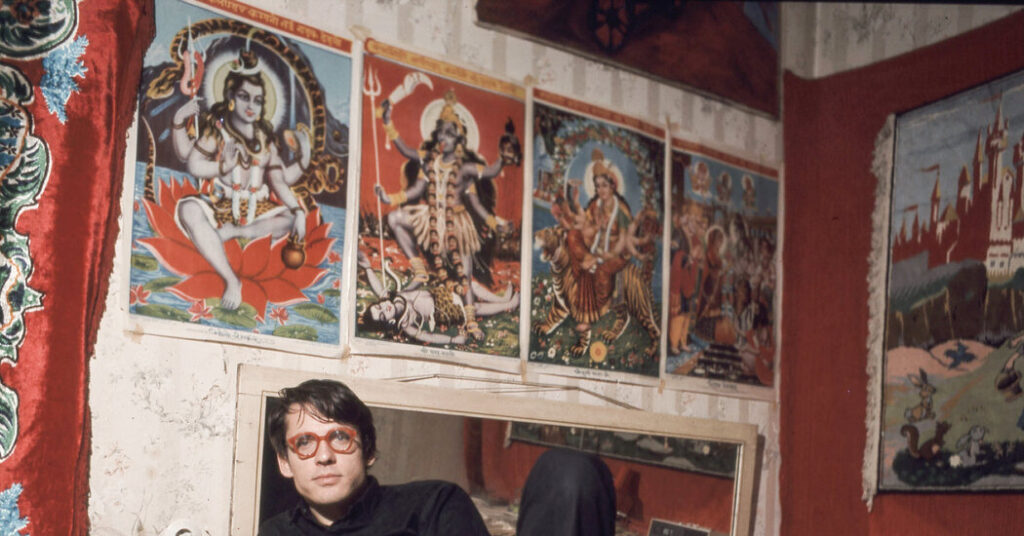
Rosa von Praunheim, an avant-garde filmmaker whose scores of movies and documentaries brought attention to gay life in Germany, none more so than his 1971 feature “It Is Not the Homosexual Who Is Perverse, but the Society in Which He Lives,” which helped jump-start the country’s gay rights movement, died on Dec. 17 at his home in Berlin. He was 83.
His death was first reported by Stern magazine. He had recently announced that he had an inoperable brain tumor.
Alongside filmmakers like Rainer Werner Fassbinder, Werner Herzog and Wim Wenders, Mr. von Praunheim was a leading figure within the New German Cinema movement, which used novel narrative techniques to examine West German society of the late 1960s, as the country was beginning to push against the social conservatism of its early postwar years.
He made his name with “It Is Not the Homosexual Who Is Perverse,” his first full-length feature. The film was noteworthy not only in its unblinking representation of gay life but also in its fierce criticism of how gay men in West Germany sought to conform with mainstream culture.
Many critics derided the film as didactic, and even homophobic, in its depiction of gay life as superficial.
But it had an immediate and enormous impact. Dozens of gay-rights groups in West Germany and elsewhere in Europe sprung up in response. Today, it is widely considered Germany’s “Stonewall moment” — a reference to the 1969 gay-rights uprising in New York — and one of the most important gay films ever made.
“I don’t think it would be an exaggeration to say that he is the most significant figure in the West German gay and lesbian movement,” Samuel Clowes Huneke, a professor of German history at George Mason University in Virginia, said in an interview. “His film really is the starting pistol for that movement.”
It was just the beginning of Mr. von Praunheim’s prolific career. In subsequent decades, he wrote, directed and produced some 150 shorts, documentaries and feature films, focusing on topics like women’s rights, the German counterculture and his own experiences as an artist and a gay man.
He made extensive trips to the United States, where he made several films, including “Survival in New York,” a 1989 documentary about three young German women trying to get by in Manhattan. It became his most commercially successful film.
It was also an outlier: While many of his fellow filmmakers in the New German Cinema movement eventually edged closer to the mainstream and developed international audiences, Mr. von Praunheim remained adamantly low budget and anti-commercial.
“Mr. von Praunheim’s films look cheaply made and more or less pasted together, which works in their favor and is very much part of their conscious style,” Vincent Canby wrote in The New York Times in 1987. “Technical niceties would only dilute the savagery of his social satire.”
With Andy Warhol’s Factory as a model, Mr. von Praunheim relied on a coterie of amateur actors, models, drag queens and sex workers to populate his films, though unlike Mr. Warhol’s movies, his work always had a sharp political edge. Mr. Canby called them “armed camp.”
Among the many subjects Mr. von Praunheim explored was his own complicated origin story.
He was born on Nov. 25, 1942, during World War II, in a prison in German-occupied Riga, Latvia, where his mother, Edith Radtke, was serving a sentence for an unknown crime.
Put up for adoption, he was taken in by a German couple, Edmund and Gertrud Mischwitzky, who named him Holger Bernhard Bruno Mischwitzky.
Edmund Mischwitzky was a Nazi Party member and an engineer with the electrical equipment company AEG, which operated a factory in Riga using forced labor from a nearby concentration camp. Gertrud Mischwitzky kept the home.
The family later fled Latvia ahead of Soviet forces pushing westward and settled in Berlin. In 1953, they fled again, leaving communist East Germany for Frankfurt am Main, in West Germany.
Mr. von Praunheim did not learn about his birth mother until 2000, when Mrs. Mischwitzky told him the truth. He spent years trying to find Ms. Radtke, finally discovering that she had died of starvation in a Berlin psychiatric ward in 1946. He traced that search in a 2007 film, “My Mothers,” widely considered one of his best documentaries.
He studied art at the Offenbach University of Art and Design, outside Frankfurt, and at the Berlin University of the Arts, but left before completing his degree.
He adopted his pseudonym, Rosa von Praunheim, in 1967. “Rosa,” or pink in German, was a reference to the pink triangle that gay men were forced to wear under the Nazis, and “von Praunheim” referred to the Frankfurt neighborhood in which he grew up.
Not all of his films centered on gay themes. His second feature, “The Bed Sausage” (a reference to a type of pillow), also released in 1971, was a caustic, campy sendup of working-class aspirations as seen through a star-crossed relationship between a secretary and a small-time thief.
Mr. von Praunheim continued to court controversy during the 1980s, when he became one of the first Germans to raise awareness of the AIDS crisis.
He helped found the West German wing of ACT UP, an AIDS awareness group, and he made a series of pioneering films about the disease, including the 1986 satire “A Virus Knows No Morals,” in which he played a bathhouse owner, and the documentary “Silence = Death” (1990), with appearances by the artist Keith Haring, the poet Allen Ginsberg and the playwright Larry Kramer.
But he drew criticism for seeming to scold gay men about the risks of casual sex, and in 1991 he outed two German celebrities as gay, the comedian Hape Kerkeling and the talk show host Alfred Biolek. He insisted that his actions were necessary to push prominent gay Germans to take action against AIDS.
On Dec. 12, five days before his death, Mr. von Praunheim married his longtime partner, Oliver Sechting, in a ceremony that was covered widely in the German news media. Mr. Sechting is his only survivor.
In a measure of just how significant Mr. von Praunheim had become in German culture, Mr. Sechting received a note of condolence from the German president, Frank-Walter Steinmeier.
“Without his work, the history of homosexual emancipation in Germany would be very different,” he wrote. “Many people have Rosa von Praunheim to thank, even if they have never seen his work.”
Clay Risen is a Times reporter on the Obituaries desk.
The post Rosa von Praunheim, 83, Dies; Captured Gay Life in Germany on Film appeared first on New York Times.