The Wyoming Supreme Court ruled on Tuesday that abortion must remain legal in that state, despite a 2023 law seeking to ban it. The case is known as State v. Johnson.
Wyoming is America’s reddest state — President Donald Trump won Wyoming by 46 points in 2024, a wider margin than in any other state — so it is more than a little surprising that abortion is legal there. It turns out, moreover, that abortion is legal in Wyoming entirely because of a largely performative state constitutional amendment enacted in 2012 to undercut the Affordable Care Act, the landmark health care legislation often referred to as Obamacare.
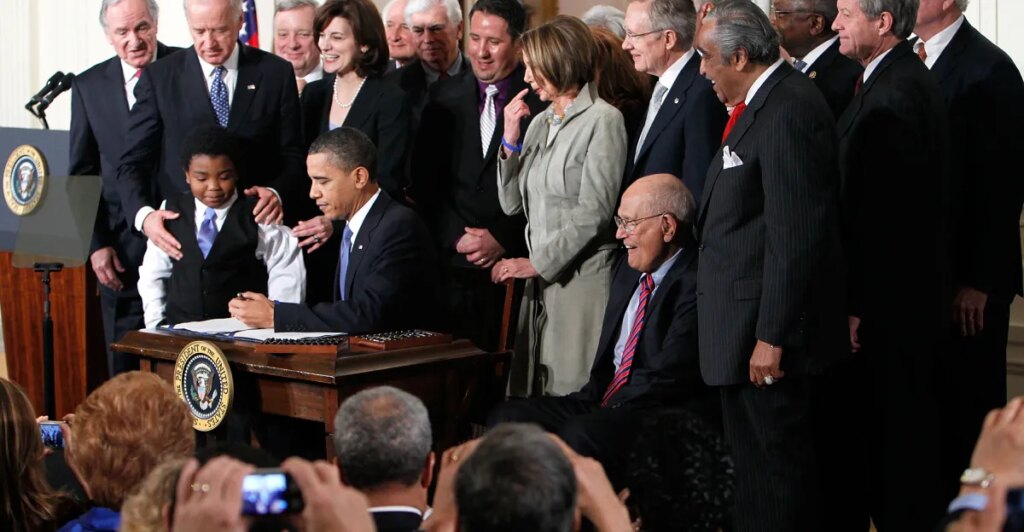
The legislative fight to enact Obamacare was one of the most contentious, and most partisan, congressional battles of the last several decades. Republican opponents of the law argued, often in hyperbolic terms, that the Affordable Care Act amounted to a “government takeover of health care” that would strip many Americans of their ability to make health care decisions.
In the wake of these attacks on President Barack Obama’s signature legislative accomplishment, Wyoming was one of a few states that enacted state laws or constitutional amendments purporting to protect patient choice. Wyoming’s amendment provides that “each competent adult shall have the right to make his or her own health care decisions.”
These patient choice laws were almost entirely symbolic, at least to the extent that they sought to undercut Obamacare. The US Constitution provides that, when a state law is at odds with an act of Congress, the federal law prevails. So, even if Obamacare did restrict patient choice, and even if a state constitution forbids those restrictions, the federal Affordable Care Act supersedes any state law that conflicts with it.
Yet, while Wyoming’s 2012 amendment did nothing to halt Obamacare, it is written in very broad terms and its language has clear implications for Wyoming state laws that seek to ban any medical procedure — including abortion.
As Chief Justice Lynne Boomgaarden writes in Johnson, though the 2012 amendment “was put to the voters in response to the Affordable Care Act, with no discussion of abortion care,” that historical reality “does not change the fact that the plain language of the amendment the voters ratified went beyond addressing concerns with the Affordable Care Act and granted ‘[e]ach competent adult’ ‘the right to make his or her own health care decisions.’”
Thus, so long as a patient seeking an abortion is an adult and is mentally competent to make health decisions, they have a right to terminate their pregnancy. (The 2012 amendment also provides that health decisions regarding minors or people who are not mentally competent shall be made by their “parent, guardian or legal representative,” and not by the state.)
So the upshot of the Johnson decision is that a symbolic effort to repudiate the Democratic Party’s signature health care initiative instead wound up sabotaging one of the Republican Party’s key health policies — a ban on abortion.
The Johnson decision may leave some room for the state legislature to enact a new abortion ban
All of this said, the state supreme court did not rule that Wyoming may never, under any circumstances whatsoever, enact any law that restricts abortion. Instead, the court held that state laws targeting abortion must survive “strict scrutiny,” a test that courts often apply to laws that tread upon fundamental constitutional rights.
Strict scrutiny is typically the most skeptical test that a court can apply to a law that is allegedly unconstitutional. As Boomgaarden’s opinion explains, a law fails strict scrutiny unless it advances a “compelling interest” and it uses the “least restrictive or onerous” means to advance that interest.
Although Boomgaarden assumes in her opinion that “protecting unborn life” is a sufficiently compelling goal, she points to several features of Wyoming’s anti-abortion law which place greater restrictions on patients seeking abortions than are necessary.
One provision of the law, for example, permits physicians to perform abortions if “there is a substantial likelihood of death of the child within hours of the child’s birth,” but it does not permit an abortion if the baby would live slightly longer if born. As Boomgaarden writes, the evidence in Johnson showed that “physicians can know that certain anomalies are lethal, but they may not know whether a pregnancy will result in a live birth, and if so, whether it is substantially likely the child will die within hours or days.”
Thus, she argues, the law needlessly prevents physicians from performing an abortion on “a fetus with an unquestionably fatal condition” if the doctor is not able to determine in advance the precise length of a very short life span. Such a law, Johnson concludes, “unduly restricts a woman’s right to obtain an abortion even when it will not serve the State’s interest in protecting unborn life.”
Similarly, the state law permits an abortion when “necessary to preserve the woman from an imminent peril that substantially endangers her life or health.” But this exception applies only to patients with a “physical condition” that endangers their health, and not to patients with similarly dangerous mental conditions.
As Boomgaarden writes, “it is obvious that, if a pregnant woman dies from a mental health condition,” perhaps because that condition results in suicide, then “the unborn child is very likely to die, too.” Thus, by not permitting women with life-threatening mental health conditions to obtain an abortion, the law places excessive restrictions on the right to an abortion that are not narrowly tailored to protect fetal life.
These are fairly narrow objections to the state’s abortion ban, however, so it is possible that the state legislature may enact a new law that prohibits most abortions but that provides broader exceptions — and then the constitutionality of this new law would have to be litigated all over again. Wyoming remains a very red state, so it is also possible that it will amend its constitution again to remove or limit the 2012 amendment protecting health care choice.
For the moment, however, abortion remains legal in the state of Wyoming — all thanks to a failed attempt to spite President Barack Obama.
The post Republicans accidentally protected abortion while trying to kill Obamacare appeared first on Vox.