BALTIMORE — Shreya Hessler’s students said they felt trapped in a phone prison.
One student picked up her device 190 times a day. Another had downloaded 55 games. A third learned from an app that, at his current pace, he’d spend 32 years of his life staring at the screen in his pocket.
Then they took Hessler’s digital detox psychology class at Loyola University Maryland, and the numbers began to drop. The pickups fell, often to three a day. The 55 games were gone. The app later said the third student was now projected to spend just 24 years of his life on his phone.
“It really is the damn phone,” senior Jack Cardon said in a final class presentation in mid-December. Like his 21 classmates, he wanted to be less dependent on his cell but worried the progress he’d made the past few months would be hard to sustain after the course ended.
The class — part experimental, part research, part group play — aimed to address the worsening phone dependency that psychologists say is eroding young people’s ability to focus, sleep and regulate their emotions.
Despite growing evidence of a broad anti-phone pushin schools, barsand other social settings, colleges have largely avoided mandates that force students to disconnect — though some professors have begun making their classrooms phone-free. That gap motivated Hessler, a practicing psychologist, to create the class at Loyola this fall, which she believes is one of the only of its kind in the country.
“This cohort of young adults is getting missed,” said Hessler. “They need opportunities to get off their phones.”
Those opportunities began on the first day of class in August. Hessler told students the classroom would be completely analog. Many assignments would be, too. No phones. No computers. No tablets. Just a pen and paper.
Students were anxious at first. What if they missed a call or text? What if a parent or friend needed them right away?
She told her students to make a plan with loved ones and allowed them to have phones in their backpacks in case something happened.
Over the course of the semester, students performed digital fasts, requiring them to give up an app or their phone for 24 to 48 hours. They studied the psychology of play, discussed how their attention spans are broken by constant notifications and tried to reclaim time they said their devices had swallowed.
One day they played football outside during class. On another, they navigated a hike without a phone. Hessler also taught students how to have a conversation — with no glances at their screens — after some vented about rarely feeling they had a friend’s full attention.
“Conversation is a dying form of communication,” she told her students during that November class. “But conversation is what makes us the most human.”
Many students said they were relearning how to be bored — to let their mind wander without being fed constant stimuli on social media.
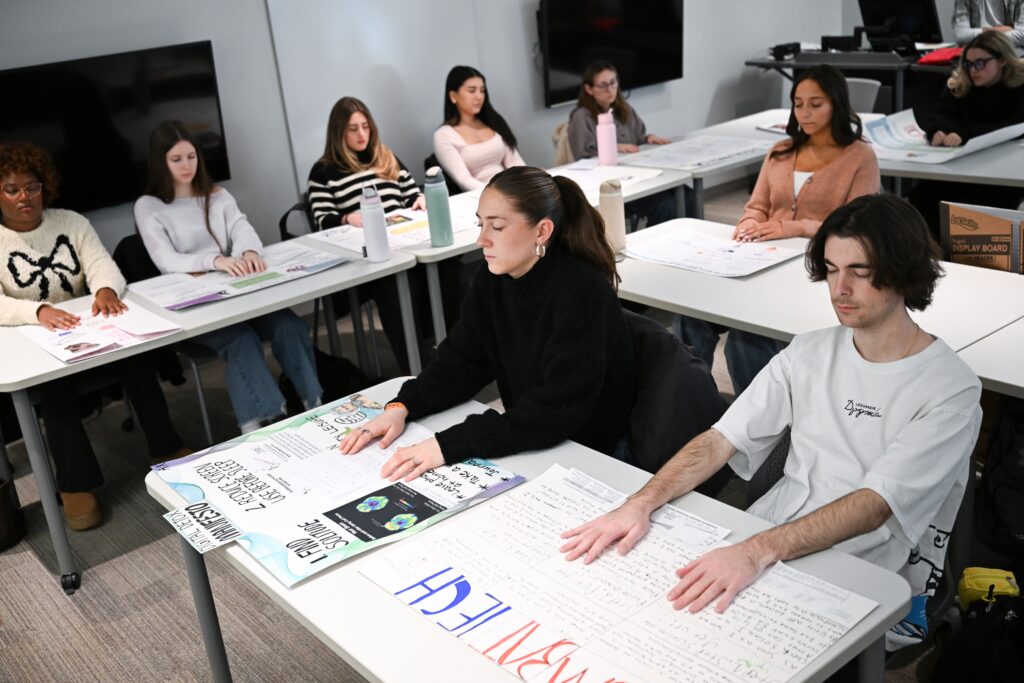
On the day of their final presentations, each unveiled a “digital manifesto,” a poster-sized pledge outlining how they planned to use technology after the class ended. They cited research that showed Gen Z often treats their devices like a baby treats a pacifier. They talked about wanting to have more in-person conversations and pledged to call people on their birthdays, not just text.
Patrick Spychalla, the student who was initially projected to spend 32 years on his phone, told the class he turned to the device as a way to decompress. He would sit down when he returned home, intending to scroll for just 15 minutes.
“But then three hours go by,” he said, as many in the room nodded. “I need to recalibrate.”
Spychalla said he doesn’t see technology as the enemy, just a time sink, a view held by many classmates and experts who nonetheless consider the smartphone to be a tool to make life easier. Spychalla used to enjoy reading, but now struggles to finish a few pages without reaching for his phone. He planned to use an app to help limit his screen time — which is often 7 hours per day — and pledged to avoid Instagram and TikTok from 9:30 a.m. until 4:30 p.m. on class days.
Others said their phone habits had disrupted sleep and crowded out hobbies.
Ava King, a senior student-athlete, said she often lets her phone die, but that when it’s charged, she’s on it. And as a result, she sometimes only sleeps only three hours a night.
Through the class, she realized she rarely does anything without listening to music.
“That leaves no time for me, or for my mind to stop moving,” she said.
Citing research from the course, King pledged to turn off her phone well before bed and make space for “high-quality leisure.” She said she wants to go on more walks with her friends, or by herself, so she can soak up the remaining months she has on campus.
Among the students in the class were three roommates: seniors Nykeria Street and Makenzie Atkinson and junior Jackie Volpe. They did not plan to take the class together, but said doing so made the whole thing more impactful.
On the day of their digital fast, the trio bought baking and arts supplies, made monster cookies, drew, played board games and went out for ice cream.
It was one of the most relaxing days of college, they said.
Experts say today’s college-aged young people are among the most socially isolated, despairing generation in a century, in part because of the digital saturation. Nationally, six in ten adults under 30 say they are constantly online, a Pew Research survey found, the most of any age group.
Colleen Hanycz, who has seen this shift as president of Xavier University, said Hessler’s class reflects that college-aged young people may want to change their behavior and may be more likely to do so with formal support. Hanycz likened the class to an Alcoholics Anonymous meeting.
“This has not been widely recognized as an addiction,” Hanycz said, about smartphone dependency. “Students are having signs of withdrawal.”
Hessler hopes to run the class again next fall, this time with hopes of collecting quantitative data from her students on their phone and technology usage before, during and at the end of the course. She wants to eventually build out a curriculum for universities to use across the country.
Cardon, the senior who said his phone is driving so much of the challenges in his life, told the class the day he went without it for 24 hours was the most productive of his life.
He pledged to leave his device in his bag while working and use an app-blocker to help him to stop reaching for it the moment he woke up.
For Anthony Marchese, the mere presence of his phone makes it hard for him to focus. As he’s applying to graduate school for physical therapy, he doesn’t want to waste time he knows will soon be scarce.
“I want to tap into my inner child again,” he told the class. “I want to be able to just stare at a picture and let my thoughts wander.”
The post Phones ruled their lives. A new college class helped them break free. appeared first on Washington Post.