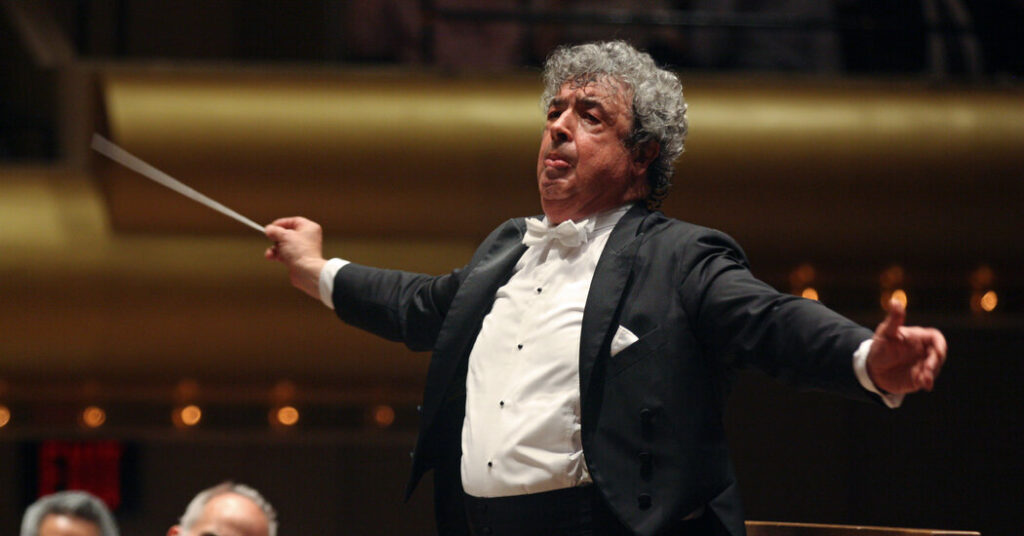
The Soviet-born American conductor Semyon Bychkov has been appointed as the Paris Opera’s next musical director, the opera said on Tuesday, more than two years after the surprise resignation of the star conductor Gustavo Dudamel from the position.
The appointment will be a chance for the company’s orchestra to perform more symphonic repertoire during a period when its two main performance spaces will be closed for renovations, with a potential to add symphonic seasons in the same manner as La Scala or the Berlin State Opera, Bychkov said in a telephone interview.
“This time, Paris has really got things right after the Dudamel appointment,” said John Allison, the editor in chief of Opera Magazine. “Semyon is one of the few great conductors around, and he works as happily in opera as in the orchestral world.”
Bychkov, 73, was born in St. Petersburg and emigrated to the United States in 1977. For about the last 40 years, he has been based in France, where he lives with his wife, the pianist Marielle Labèque.
He will become Paris Opera’s music director designate on Aug. 1 and will take on the full position at the start of the 2028-29 season, with a mandate that runs through the end of the 2031-32 season, according to the company.
He is currently chief conductor and music director of the Czech Philharmonic, and will continue to hold that position through the 2027-28 season, the end of his term.
“The appointment of Semyon Bychkov as music director continues a long association with the Paris Opera, marked by memorable artistic encounters and a common desire to work together,” Alexander Neef, the opera’s general director, said in a statement. “I have complete confidence in his ability to commit fully to this role.”
Rumors had long circulated about a potential replacement for Dudamel, with the Spanish conductor Pablo Heras-Casado considered a likely candidate at one point, according to Le Figaro newspaper.
Asked at a news conference on Tuesday why it had taken so long to announce a successor, Neef said that it had been important to find the right person to refocus the company’s orchestra during forthcoming renovations to both the Palais Garnier, which will close from 2027 to 2029, and the Opéra Bastille, which shuts from 2030 to 2032.
Bychkov said that after Dudamel left the opera, “there were vibrations coming out of the house towards me,” but that he had been about to start his second mandate at the Czech Philharmonic and felt unable to pursue the position.
Last August, he added, he attended a Paris Opera concert in Saint-Jean-de-Luz, and the musicians approached him at a dinner afterward and asked him to head the ensemble. In October, he met with Neef, telling him that the orchestra’s one gap was the symphonic repertoire, which there was a historic opportunity to develop during the renovations.
Bychkov said that he had insisted on a musicians’ vote before accepting the position. They voted overwhelmingly in his favor. “They weren’t lying to me at dinner,” he said.
Bychkov began studying music at age 7, when he entered the Glinka Choir School, part of the Leningrad Conservatory, training as both a choral singer and a pianist. He later studied conducting at the same school under Ilya Musin, and in 1975 won the conducting section of the prestigious Rachmaninoff Competition.
But because Bychkov is Jewish and refused to join the Communist Party, he was denied the expected professional opportunities that otherwise would have been likely to follow.
At 24, he emigrated to the United States and quickly established a successful career as a freelance conductor, with engagements over the next decades at major ensembles including the New York Philharmonic, the Berlin Philharmonic, the Vienna Philharmonic and the London Symphony Orchestra.
He also became a major presence as an opera conductor, performing at La Scala, the Royal Opera House in London, the Bayreuth Festival in Germany and the Metropolitan Opera in New York.
For the new Paris Opera posting, he said that it was important to him that the orchestra retained its identity.
“Every orchestra is a child of its country, its nation,” Bychkov said. “They are a French orchestra with their way of thinking, their body language, their culture, with enormous imagination, spontaneity, reactivity to beauty. That creates a sound and a temperament that makes them unique.”
“In a homogenized world, this is an enormous advantage,” he said, “and it will be my job to care for and protect that.”
The post Paris Opera Takes On a Noted Conductor, Aiming to Expand Its Symphonic Offerings appeared first on New York Times.