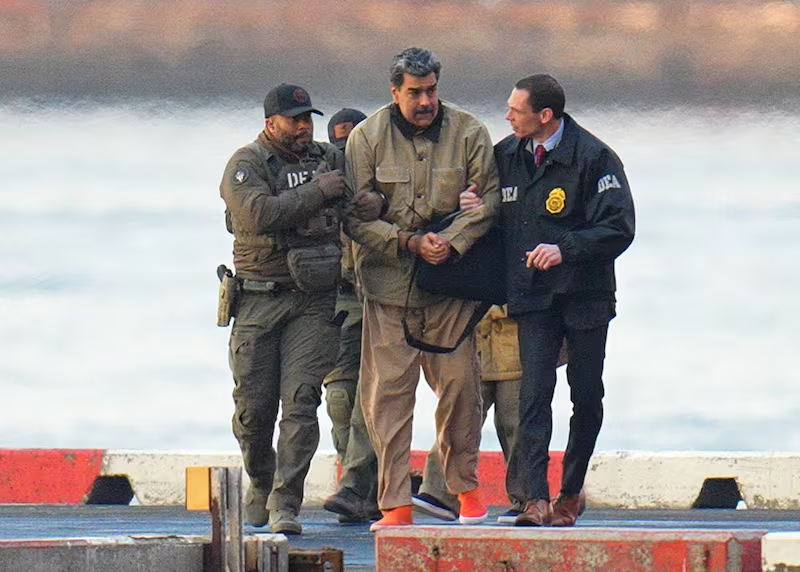
Had President Donald Trump’s weekend invasion of Caracas been about freedom more than oil, Lady Liberty’s torch would have shone even brighter on Monday morning, as a helicopter carrying ousted Venezuelan president Nicolás Maduro passed her on the way from a Brooklyn jail to his first appearance in Manhattan federal court.
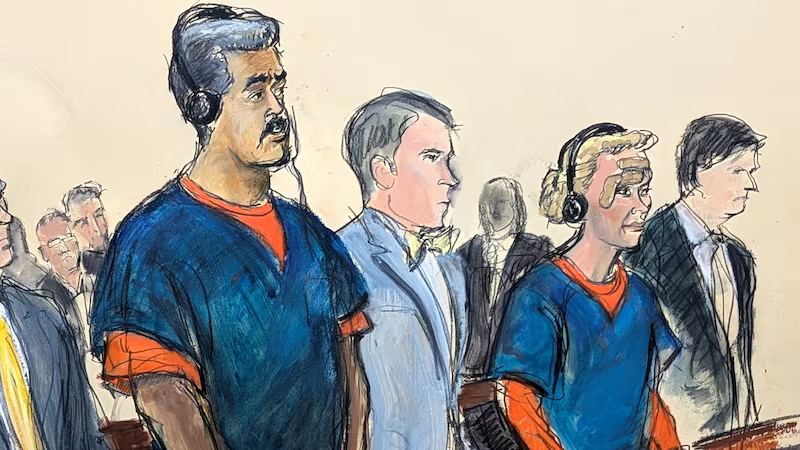
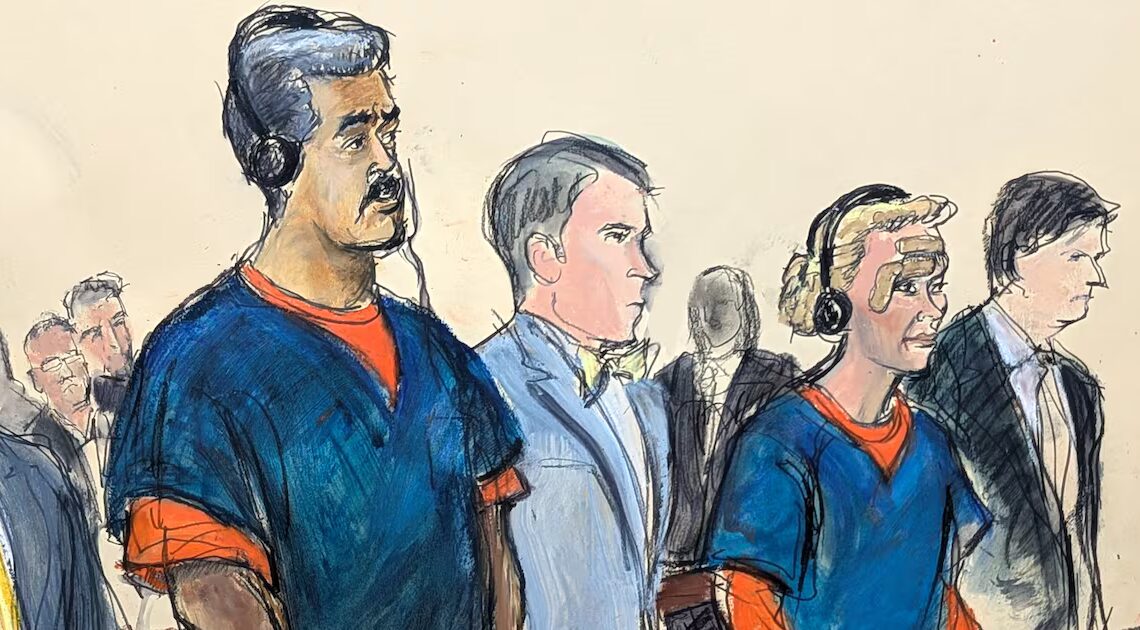
The Venezuelan dictator, who has served as president for nearly 13 of his 63 years, entered courtroom 26A with his bullyboy swagger restricted by shackles. He tried to play it off as if the start of 2026 had not forever altered his whole reality.
“Happy New Year,” he said to a group of reporters who occupied the jury box during the arraignment.
Maduro then settled into the same seat that Sean “Diddy” Combs occupied for nearly two months during the rap mogul’s summer trial for racketeering and sex trafficking. Maduro then responded just as Combs had when the clerk called out a command: “All rise!”
The supposed strongman immediately obeyed.
“U.S. versus Nicolás Maduro Moros,” the clerk then announced.
However powerful Maduro, 63, may have imagined himself to be in Venezuela, he now stood meekly obedient in downtown Manhattan. He wore a short-sleeved navy blue top, and the prison uniform that peeked out from underneath was the same orange as his sneakers.
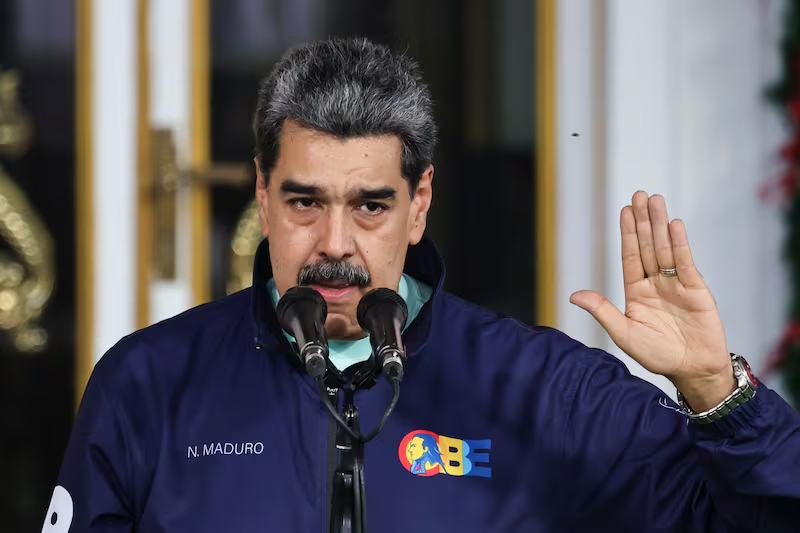
“My name is President Nicolás Maduro Moros,” he said in Spanish. “I am president of the Republic of Venezuela and I am here, kidnapped, since January 3rd, Saturday. I was captured at my home in Caracas, Venezuela.”
Maduro spoke grandly, as if he were a rightful ruler; not a criminal, but a victim.
“There will be a time and place to go into all of this,” Judge Alvin Hellerstein, who has a lot of experience moving things along, replied. “At this time, I only want to know one thing: Are you Nicolás Maduro?”
A translator relayed the question through the headphones Maduro had donned. He replied in the affirmative and the 92-year-old judge proceeded to inform him of his Miranda rights, elements of justice absent under the dictator’s rule.
“I did not know of these rights,” Maduro said. “Your honor has informed me of them now.”
The judge asked how he pleaded to the charges of narco-terrorism conspiracy, cocaine importation conspiracy, possession of machine guns and destructive devices, and conspiracy to possess machine guns and destructive devices.
“I am innocent,” Maduro said in Spanish. “I am not guilty. I am a decent man. I am still president of my country.”
Pedro Rojas, a 33-year-old Venezuelan anti-regime activist, called out in Spanish from among the spectators seated toward the back of the courtroom.
“Jamas!” he said, meaning “Never!”
Maduro’s attorney, Barry Pollack, ignored the outburst and rephrased his client’s grandiose plea in the language of everyday criminal justice.
“Just for the record, Mr. Maduro is pleading not guilty,” Pollack said.
Maduro added in Spanish, “I am the constitutional president of my country.”
“Very good,” the judge said.
The judge asked Maduro if he understood the proceeding.
“I’ve been taking notes,” Marudo replied. “I understand everything completely.”
He had indeed been intently writing on a legal pad, as if it all had historic importance.
“I would like to ask that my notes be respected and I be allowed to keep them,” he asked the court.
Bail was not even a possibility, and the hearing—which had started around noon—ended just before 12:40 p.m. A U.S. Marshal briefly inspected Maduro’s legal pad, then handed it back to him.
The anti-regime activist again called out, in Spanish, to Maduro.
“On behalf of Venezuela, you’ll pay for what you’ve done,” Rojas said.
The former despot who had stood in submission at the start of the hearing tried to stand defiant before his young opponent in a confrontation Rojas would describe as “face to face.”
“I’m a man of God,” Maduro told him in Spanish.
“Me, too,” Rojas replied.
A short time later, an armed escort led Maduro from the courthouse. He was loaded into an armored vehicle just down from Immigration Court, where Venezuelans may begin experiencing more difficulty applying for asylum. Their longtime oppressor is now facing trial two blocks away.
Then again, Venezuelan asylum seekers may argue that there is not so much change in this particular regime change.
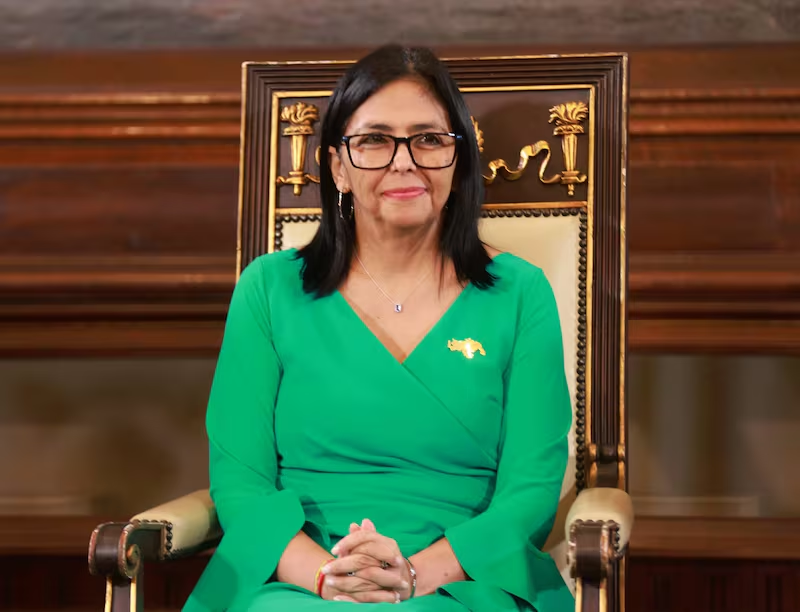
Monday’s hearing had come within an hour of Delcy Rodríguez, Maduro’s vice president, being sworn in as Venezuela’s interim leader. And Trump has so far chosen her over the hugely popular opposition leader, María Corina Machado, who was awarded this year’s Nobel Peace Prize for keeping “the flame of democracy burning amid a growing darkness.”
Machado dedicated the prize to Trump, in a Monday interview with Sean Hannity on Fox News, the 58-year-old even offered to share the prize with the American president. But he still has not forgiven her for accepting an honor he feels should have gone to him.
From a helipad at the tip of Manhattan, Maduro was flown off across the harbor, back toward to Brooklyn’s Metropolitan Detention Center.
Had Nobel envy not prevented Trump from installing Machado, Lady Liberty’s torch would have shone a little brighter. As it is fueled by freedom, not oil.
The post Opinion: How Nicolás Maduro Turned a Courtroom Into a Political Theater appeared first on The Daily Beast.