The New York Times urged the U.S. District Court in Washington on Monday to rule in its favor in a case that the company brought last month against the Pentagon and that is now on track to be heard by a judge in March.
The Times has said restrictions imposed by the Pentagon in October infringe on the constitutional rights of journalists. The company largely echoed those arguments in a filing late on Monday, saying the Defense Department’s policy “aims to suppress independent journalism that seeks to report any information beyond what the department has approved for public release.”
The Times’s lawsuit is on a fast track because the two sides filed a joint motion on Dec. 17 seeking to skip discovery proceedings and set up a schedule for summary judgment. The case is headed for oral arguments on March 6 in front of Judge Paul Friedman.
David McCraw, The Times’s top newsroom lawyer, said the company did not think discovery, often a time-consuming phase, was necessary in this case. “We think that it’s so obvious that the policy as written — the words on paper — constitute a constitutional violation that we don’t think there is a need for the court to engage in further fact-finding,” Mr. McCraw said in an interview.
The Pentagon declined to comment on active litigation. The department previously called the restrictions a “common sense” measure. “It is about preventing leaks that damage operational security and national security,” the Pentagon said in an October statement.
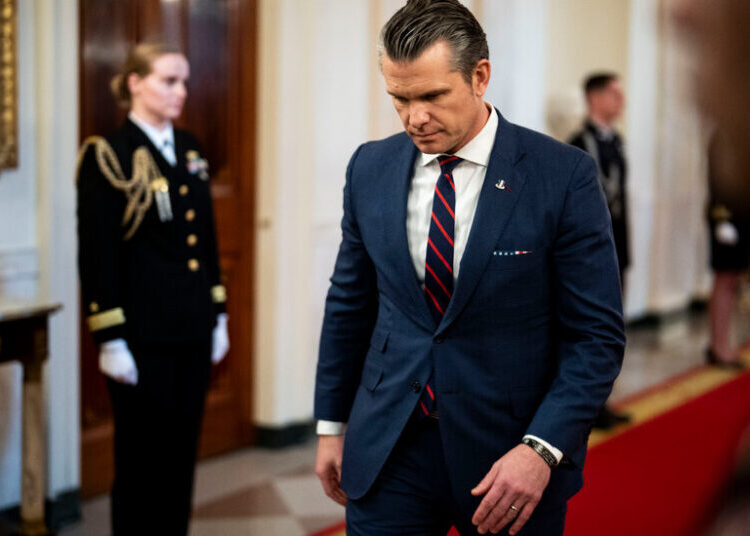
Pete Hegseth, the defense secretary, has championed measures to claw back access and privileges that Pentagon reporters had enjoyed for years. Rather than sign on to the new restrictions, dozens of journalists handed in their press passes. They have continued covering the military from outside the building.
The Defense Department responded by ushering in a new Pentagon press corps, including many members with a history of cheerleading for the Trump administration. Department press officials held a briefing for the new corps in early December, a session that covered many topics with minimal tension.
Asked whether the briefings would continue on a regular basis, Kingsley Wilson, the Pentagon’s press secretary, responded: “We’d love to. It’d be great to get everybody in here.”
Some Pentagon reporters criticized the department for failing to properly brief journalists on the beat after last week’s capture of President Nicolás Maduro of Venezuela.
“The silence from Pentagon officials since this operation began last night is staggering,” Konstantin Toropin, a reporter for The Associated Press, wrote on social media.
Sean Parnell, the chief Pentagon spokesman, responded by noting that Mr. Hegseth “held a globally covered press conference with President Trump,” as well as the secretary of state, Marco Rubio, and others at Mar-a-Lago.
“Immediately after the press conference,” Mr. Parnell continued, “Secretary Hegseth gave background interviews with mainstream media outlets to discuss the operation in Venezuela.”
The post New York Times Case Against Pentagon Will Move Quickly appeared first on New York Times.