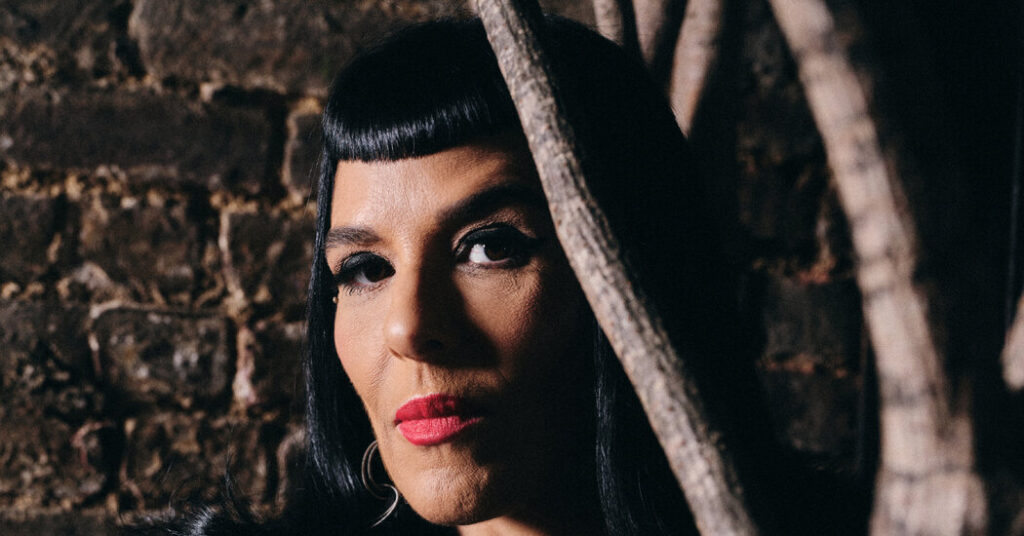
It sounds so simple in retrospect: Beth Morrison wasn’t seeing the kind of opera she wanted to see, experimental music theater that resonated with contemporary life. So, she told herself, “I guess I have to start my own thing.”
But building opera from scratch is easier said than done. To make a new work requires assembling a large team of artists who dedicate years of their lives to developing, rehearsing and bringing it to the stage. That takes money. A lot of it.
Twenty years ago, Morrison had nothing in the bank. Just ambition, a belief in opera as theater and a high-flown goal to “change this art form.” Still, she founded Beth Morrison Projects. Since then, she has worked nearly around the clock to shepherd dozens of new operas into existence. It hasn’t become easier, but she’s also not getting tired.
“I’m an artist,” she said in an interview. “I have very strong opinions on the kind of art I want to make, and it’s always been clear that no one was going to give me a job to do that. So I have made a career of finding like-minded people who have become the village it takes to make a real movement.”
Her village has only grown. She expanded Beth Morrison Projects to include programs for educating young impresarios and composers. And, 13 years ago, she was a founder of Prototype, a festival for new opera that has become essential, providing a home for mostly chamber-size works with an edgy sensibility. Unpredictably diverse in its programming, and almost guaranteed to present artists worth watching, it returns on Jan. 7, fully under Morrison’s control for the first time.
In an age when most news about opera is bad, as institutions suffer with unwieldy expenses and desperate attempts to broaden audiences, Morrison has slowly and determinedly polished a bright spot for herself, as a tenacious generator of work that pushes the field forward. Perhaps she has changed this art form after all.
THERE WERE SIGNS that Morrison had the spirit of an impresario as a child. Growing up in Auburn, Maine, she and her brother would perform the musical “Oliver!” at home. She basically ran the operation: directing, even acting like a producer in wrangling a copy of the cast album.
Morrison wanted to perform on Broadway, and in high school she joined the summer music program at Tanglewood in Massachusetts. She wasn’t much familiar with classical music, but she saw performances by Jessye Norman and Kathleen Battle, and concerts conducted by Seiji Ozawa and Leonard Bernstein. She changed course and decided to be an opera singer, studying voice in college before returning to Tanglewood as a teacher.
Not long after that, she found herself leading Tanglewood’s vocal program while living in Boston, where she spent her free time seeing a lot of experimental theater. It felt so different from the opera she was coming across. Then she looked closer at who was in charge. “Primarily,” she said, “they were all men.” Hence the idea of starting Beth Morrison Projects. She went back to school, then moved to New York in 2005. (Morrison said she “doesn’t like to talk about age” and declined to provide hers for this story.)
New York, she said, was the “center of the universe” for the type of work she wanted to be doing. She had about $200 and a fellowship with Pomegranate Arts, one of Philip Glass’s producers. At the time, the composer Nico Muhly was working as Glass’s copyist and trying to find a producer for his own song cycle “The Elements of Style.” Morrison took it on, and it ended up being something of a breakthrough for her and Muhly.
But Morrison had to fight for every penny to make it and other early shows happen. To cover the rent, she took a job teaching at Pace University. Because the pay wasn’t year-round, though, she sublet her apartment every summer to make ends meet. All other money she could muster, she put into Beth Morrison Projects.
She made a promise to herself: Each year, she would produce three shows. “If I was going to do one thing a year,” she said, “it would take 20 years to really get anywhere, especially in New York.” Without a staff, she spent her days teaching in the morning, then working for about 12 hours on production and fund-raising.
The sheer volume of her efforts paid off. Five years in, she started to get the attention of the press. (She also started to get attention period, with leather-forward outfits, chunky boots that went up to her knees and jet black hair.) Broader industry recognition followed, which earned her the ear of the Mellon Foundation, a crucial supporter of Prototype, which she founded with the arts center HERE.
In those years, Morrison cultivated a community of artists who cut their opera teeth working with her, including the composers Missy Mazzoli, David T. Little and Paola Prestini. (They are among the musicians featured in the retrospective “BMP: Songbook,” a concert program and album.) Many of them hadn’t written for the stage until they got involved with Beth Morrison Projects.
The wave of works written by these composers, especially outside mainstream houses, has led some artists to consider this a golden age of American opera. “I would never say that it’s entirely due to her, but she is a massive part,” the librettist Royce Vavrek said of Morrison. “We wouldn’t even be having this conversation right now if it weren’t for Beth.”
Little, who entered the Morrisonverse with his cycle “Soldier Songs” and created triumphs like “Dog Days” and “Black Lodge” with her, said that they quickly bonded over a belief that opera was fundamentally “sung theater,” and that they should strive for works that succeed on the level of theater first.
“She allows us to tell the more dangerous and exciting stories,” Vavrek said. “I feel like we get to do a lot of our own passion projects, the operas that feel like they’re getting ripped from our hearts and souls.”
Little and Vavrek’s “Dog Days,” for example, is a harrowing portrait of a family starving and devolving in the ruins of apocalyptic catastrophe. It has moments that hurt to see, and an epilogue that almost hurts to hear; it so easily and thoroughly gets under your skin, it feels impossible to shake off.
The opera didn’t arrive that way. It went through multiple early performances and workshops, with Morrison offering sometimes tough advice, but also encouragement. “I was still really finding my way into opera,” Little said. “When I told her that I thought the ending would be 12 minutes without singing, I didn’t even think I could do that. But she knew that we were making something special.” Morrison sat between Little and Vavrek at the premiere; during the performance, they looked over and saw that she was crying.
Morrison developed a reputation for toughness, but also for putting trust in the artists she worked with. Sarah Kirkland Snider, the composer and librettist of “Hildegard” at this year’s edition of Prototype, said that the idea of Morrison as uncompromising and blunt probably has something to do with her gender.
“I see that with men all the time, and no one says that about them,” Snider said. “People love to complain: ‘She wears Moon Boots and capes, she’s pushy, she’s this, she’s that.’ But she is quite easy to work with, and very supporting and caring about the final product and everyone’s happiness.”
Critics have also taken issue with Morrison’s insistence on amplification, especially in black box theaters. But, Morrison said, Wagner probably would have done the same thing. He wanted to use every tool at his disposal, and she aims, with each show, for “a theatrical sound installation.”
“Many companies will not do this, and that’s fine,” she added. “But that’s not the world that I want to live in. I profoundly believe that putting a microphone on an opera singer completely changes their ability to act.”
At the very least, it hasn’t gotten in the way of Morrison’s successes. Du Yun and Vavrek’s “Angel’s Bone,” and Ellen Reid and Roxie Perkins’s “prism,” both used amplification, and both went on to win the Pulitzer Prize for music.
LIKE MOST ARTS ORGANIZATIONS, Beth Morrison Projects suffered during the pandemic and is still rebuilding. But otherwise its recent history has been one of constant ascent. Morrison’s earliest collaborators have also entered the mainstream; Mazzoli and Vavrek will arrive at the Metropolitan Opera next season with their adaptation of “Lincoln in the Bardo.” Huang Ruo, another Prototype alum, will follow with “The Wedding Banquet.”
And Morrison has become an eminence. She was even the face of modern opera in “Paris & Nicole: The Encore,” in which Paris Hilton and Nicole Richie sought her advice while trying to write an opera. Asked while filming whether she would produce their show, Morrison replied yes and lined up potential composers. But in the final edit, there’s just a cut to Richie saying, “She said no.”
At this stage in her career, Morrison is also thinking about how to remain connected to young artists. In 2017, she started BMP: Next Gen, a program for emerging composers that can lead to a 30-minute commission from Beth Morrison Projects. During the pandemic, Morrison also started BMP: Producer Academy, a tuition-free course for aspiring arts administrators.
Morrison also took over Prototype after Kristin Marting, the artistic director of HERE and one of the festival’s founders, departed in 2024. Morrison hasn’t really changed the character of the Prototype, though this year there are a couple of signs of where it is headed.
Its production of “Hildegard,” for example, was presented in November with Los Angeles Opera, a reflection of the crucial partnerships that keep Beth Morrison Projects going. And “What to Wear,” by Michael Gordon and Richard Foreman, is a remounting of the work’s premiere at CalArts in 2006; in the future, Morrison would like to start routinely reviving shows.
To make all this happen, she can’t stop working as hard as she always has. The Mellon Foundation’s support expires after the 2028 Prototype, which leaves a looming hole in the festival’s funding. Morrison spent her time in Los Angeles for the premiere of “Hildegard” raising money, and she has more events lined up this month.
“I know that I’ve gotten through hard times before, really hard times,” Morrison said. “We are resilient. But I should also give myself time to look back and feel proud. I’m always on to the next problem to solve, but it also helps to stop and say: ‘Wait, we did something here. This happened, and this was important.’”
Joshua Barone is an editor for The Times covering classical music and dance. He also writes criticism about classical music and opera.
The post Modern American Opera Wouldn’t Be the Same Without Her appeared first on New York Times.