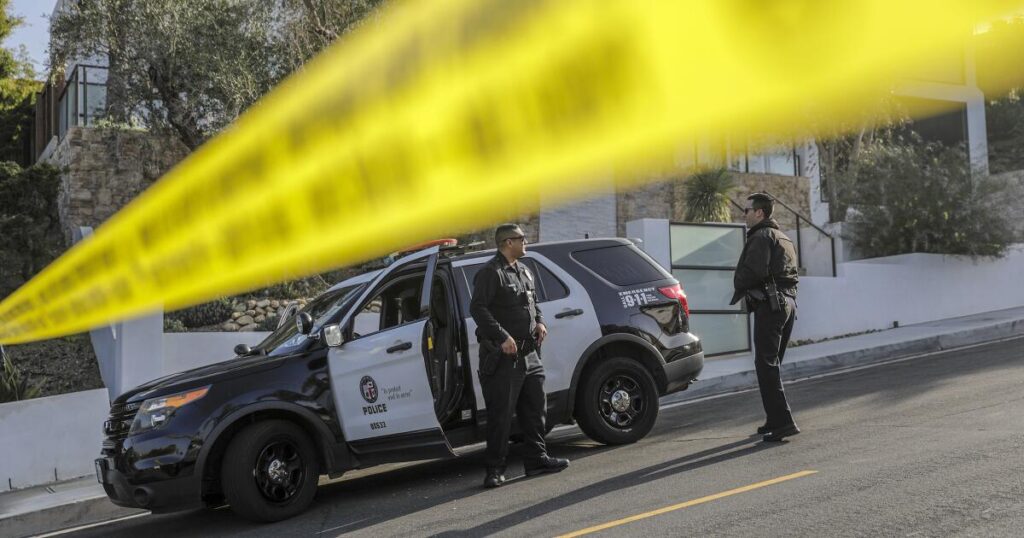
The city of Los Angeles just recorded its lowest homicide total in more than half a century, mirroring precipitous drops in many other large cities nationwide last year — and sparking a range of theories about what’s going on.
According to tentative numbers reported by the LAPD through Dec. 31, the city tallied 230 homicides in 2025 — a nearly 19% decrease from the year before. Police investigators are still reviewing the circumstances of several deaths, but if the current figure holds up, it would be the fewest killings since 1966, when the population was almost 30% smaller.
Measuring per capita, it was the city’s safest year since 1959.
LAPD Chief Jim McDonnell said the reduction in homicides is “not the result of any single action, but the collective work of our first responders and follow-up investigators, our community partners, and the residents who continue to step forward and engage with us.”
The numbers might come as a surprise to those who visit the LAPD’s website. Since switching to a new federal reporting system, the department includes more than just violent killings in its count.
Department officials said the website data now include some traffic deaths that weren’t counted under the old reporting system, such as suspected cases of vehicular manslaughter or crashes in which the driver was found to have been drunk or otherwise criminally negligent. With these “vehicular homicides” included, the total number of killings recorded citywide last year grows to 313 — a discrepancy that has some residents concerned the department isn’t giving a full crime picture.
Experts have long cautioned against putting too much stock in year-to-year crime statistics, which can fluctuate based on complex, intertwined factors — including how authorities classify and count certain offenses.
But it’s clear that killings are plummeting in L.A. and elsewhere. Compared to 2024, homicides were down dramatically in Washington (31%), Chicago (30%), New York City (21%) and San Francisco (20%) — leading some researchers to call it the largest one-year drop on record.
Horace Frank, a former LAPD assistant chief who once oversaw the department’s detectives, said there’s no simple explanation. Some will point to President Trump’s law-and-order policies, he said, while others will credit the work of grassroots organizations working to improve life in high-crime areas.
“A lot has to do with more accountability in the courts. A lot of it has to do with the police themselves,” he said. “Kudos for the work of law enforcement and the support of the community.”
The latest homicide total number might seem unthinkable to some who lived in L.A. in the 1990s, when the city gained a reputation as the gang capital of the United States and annual killings eclipsed 1,000 several times.
The situation has improved steadily in the decades since. Some experts say the return of social services and other programs that held communities together before the 2020 pandemic was a driving factor in the recent turnaround; others point to technological advancements that help police catch more killers.
With the city facing a budget crunch, police officials and union leaders have warned that less resources and manpower risks causing an uptick in crime. But the latest data show killings have fallen even as the LAPD has steadily shrunk and seen officers conduct fewer traffic stops and interactions with the public than in past years.
Apart from homicides, the LAPD reports a decline in most types of violent and property crimes citywide. Homicides and shootings still tend to be clustered in neighborhoods that have long struggled with violent crime, including parts of South L.A.
Recent cuts by the Trump administration that slashed hundreds of millions in federal funding from school safety grants, youth mentoring programs and gang intervention networks have triggered concerns about a looming crime resurgence in the years to come.
Trump has painted a dystopian picture of Los Angeles and other cities led by Democratic officials, but that image has been colored by politics and the COVID-19 pandemic, when the period of increased unemployment and social unrest brought a brief but pronounced spike in killings.
Homicides have dropped by roughly 43% in L.A. since 2021, according to a Times review of Police Department records.
In areas patrolled by the Los Angeles County sheriff, homicides fell from 184 to 159 last year — a nearly 14% decline.
L.A. County Sheriff Robert Luna said that while his department was “encouraged” by the decline, such gains should not be taken for granted.
“We never lose sight of the fact that every number represents a life lost and a family forever changed,” Luna said. “Any reduction matters, but even one homicide is one too many. This progress reflects the relentless work of our patrol station personnel in partnership with homicide detectives and the many analysts, and support personnel who assist in every investigation.”
The 2025 tally for the city of Los Angeles could still grow, as LAPD analysts determine whether certain deaths can be classified as homicides, including five cases from the Palisades wildfire.
Also still pending determination is the Dec. 31 shooting of 43-year-old Keith “Pooter” Porter, who was killed by an off-duty federal immigration agent who confronted Porter as he reportedly fired gunshots into the air to mark the new year. Lawful killings by police officers are not included in the LAPD’s homicide total; officials have said the Porter killing remains under investigation.
LAPD Deputy Chief Alan Hamilton credited the overall drop in crime with a renewed focus on the small percentage of individuals responsible for an outsize proportion of violent crimes.
“I think it’s finally paying dividends, because if you’re sitting in prison because you shot three people and not cycling through the system” the city will be safer, said Hamilton, who runs the department’s detective bureau.
But Hamilton also credited the LAPD’s Community Safety Partnership program and other long-term efforts that have sought to build trust with communities that were historically wary of police, prompting more people to come forward with information and helping to solve more crimes. The department’s approach is more collaborative than it used to be, he said.
Hamilton added that he believes the ongoing federal immigration crackdown has had a deterrent effect simply by adding the presence of more law enforcement officers to the streets over the past year.
Tina Padilla, a longtime gang interventionist, has her own theories.
She said organizations like hers — which use diplomacy to quash street beefs before they spill over into bloodshed — have also become lifelines for certain neighborhoods by providing diapers, formula, and other essential supplies.
The immigration raids have without a doubt disrupted life for wide swaths of the city’s immigrant population, she said.
Padilla, whose organization Community Warriors 4 Peace services Northeast L.A. and areas like MacArthur Park, said that many of her most vulnerable clients have been cut off from their support services because they fear being detained and deported.
“They are just scared of any type of documentation, let alone signing up their child for services, because of the repercussions,” she said.
The post L.A. sees lowest homicide rate in decades — but why killings are down is up for debate appeared first on Los Angeles Times.