In October, JPMorgan Chase, the largest bank in the United States, announced a grandiosely named project intended to address one of the country’s biggest challenges. Dubbed the Security and Resiliency Initiative, the bank pledged $1.5 trillion to “facilitate, finance and invest in industries critical to national economic security and resiliency.”
This gargantuan figure was meant to impress, as was JPMorgan’s creation last month of an advisory council of business and military-adjacent leaders, including Washington Post owner and Amazon founder Jeff Bezos, to provide counsel to the initiative.
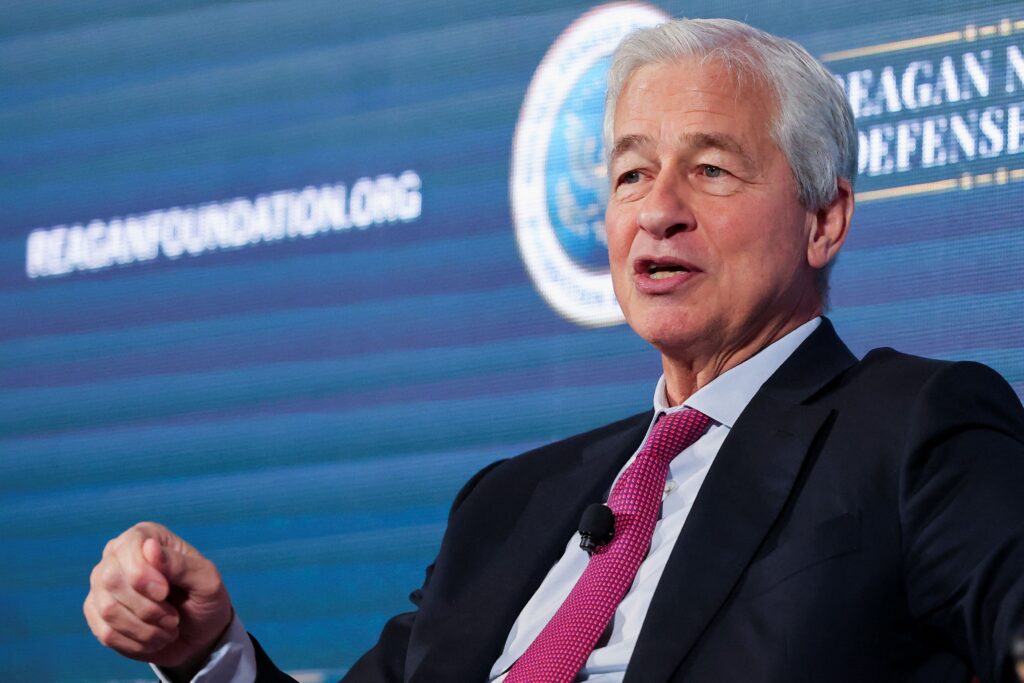
“We can ensure that our firm takes a holistic approach to addressing key issues facing the United States,” Jamie Dimon, the bank’s longtime CEO, said in a statement, suggesting that JPMorgan was harnessing its vast resources and financial acumen for the patriotic greater good. As for the advisory council, the bank professed it would provide “clear perspectives on risks and opportunities to help spur growth and innovation in industries critical to the United States’ national security and economic resiliency.”
If all this gives you the sense that America’s corporate titans are looking out for the country’s best interests, then consider their mission accomplished. Because one thing that JPMorgan’s new initiative certainly does is wrap up everyday business activities with a bow of faddish marketing. It’s an approach that is well suited to an era in which corporate leaders routinely flatter President Donald Trump in word and deed.
But the behavior predates our current era of state capitalism and monarchical-style leadership. Indeed, this isn’t even JPMorgan’s first 13-figure bundling of the latest fashion in investment activity. In 2021, it unveiled a $2.5 trillion Sustainable Development Target, a package of environmentally inflected investments that the Wall Street Journal recently noted “the bank doesn’t talk about that much anymore.”
These types of programs are better thought of as rallying cries than actual investment initiatives. JPMorgan doesn’t purport to be investing $1.5 trillion in defense and economic security efforts, of course. The key word here is “facilitate,” meaning that large sum largely involves investments made by its clients. The bank itself is promising up to $10 billion in national security-related investments, and it hired a top lieutenant of Warren Buffett to lead that effort. That’s a significant commitment but a tiny sliver of the ballyhooed initiative.
Savvy financiers and corporate titans have long been adept at marketing their efforts around what’s popular. In the late aughts, for example, the distinguished but struggling venture capital firm Kleiner Perkins announced the formation of a $100 million “iFund” — dollar values were smaller then — to take advantage of the product ecosystem around Apple’s still-new iPhone. This fund wasn’t actually a fund though. Instead, it was a repurposing of an existing bucket of capital, something Silicon Valley wags called “venture marketing.”
Japanese tech titan Masayoshi Son long has been a master of pronouncing round-numbered plans that send a signal that may or may not be grounded in reality. In 2016, he promised President-elect Trump that his company, SoftBank, would invest $50 billion in the United States, creating 50,000 jobs. (Much of that money went into doomed commercial real estate landlord WeWork.) In December 2024, Son upped the ante, pledging to Trump he’d invest $100 billion, producing 100,000 jobs. (The jury is out on that one.) According to “The Money Trap: Lost Illusions Inside the Tech Bubble,” the excellent memoir by SoftBank’s former chief financial officer Alok Sama, Son thought of these promises in terms of “numerical symmetry.” He gave similar assurances to India’s Narendra Modi and Saudi Arabia’s Mohammed bin Salman.
More recently, Salesforce, the software company whose CEO, Marc Benioff, had angered residents of his hometown by encouraging Trump to deploy troops in San Francisco, pledged to invest $15 billion in the city’s economy over five years. The amount happened to be almost exactly what Salesforce planned to spend on its local operating expenses in that time frame.
Faddish corporate promises come in other forms. In 2019, the Business Roundtable, with JPMorgan’s Dimon as its chairman, changed its long-standing “Statement on the Purpose of a Corporation” from espousing the primacy of shareholders to one that encompassed all of a corporation’s “stakeholders.”
This was during Trump’s first administration but before the president began acting on his hostility for “diversity, equity and inclusion” and environmental “sustainability” programs. Back then, 181 CEOs agreed that it was part of their collective missions to “foster diversity and inclusion, dignity and respect” and to “protect the environment by embracing sustainable practices across our businesses.”
These days, the Business Roundtable has been focusing its public pronouncements on uncontroversial topics like permitting reform, mental health and deregulation.
As much as we think of corporate titans as agenda-setters, they’re as likely to go with the flow as anyone else, for all the usual reasons. They have short attention spans, crave safety and popularity, and are fickle in their allegiances. But they have exceedingly large marketing budgets.
The post Jamie Dimon slips on a new cap for the Trump era appeared first on Washington Post.