In the early-morning hours of January 5, 2021, Thomas Webster, a former U.S. Marine and retired police officer, drove south on Interstate 95 toward Washington, D.C. Webster, who was then 54, had been conflicted about whether to attend the “Save America” rally, but Donald Trump had used the word patriot. Webster had joined the military at 19, taken his first plane ride to boot camp in South Carolina, gotten his first taste of lobster tail on a ship in the Mediterranean. He loved the sense of purpose he’d drawn from the oath he’d sworn when he joined the Marines: I will support and defend the Constitution of the United States against all enemies, foreign and domestic.
Webster, who’d retired from the New York City Police Department, where he’d been a street cop, a firearms instructor, and part of the Gracie Mansion security detail, lived in Goshen, New York, with his wife, Michelle, an Ivy League graduate who worked in biotech sales, and their three teenagers, one of whom had recently joined the Marines. He ran a small business, Semper Fi Landscaping, cutting grass and clearing snow during winter.
In the early days of the pandemic, Webster had masked in public, disinfected his groceries, and slept in the basement if he had the slightest sniffle. At first he thought keeping his kids home from school made sense. But as the months stretched on, he worried about his two younger teenagers, who didn’t seem to be socializing or learning much over Zoom. One morning that spring, when Webster went outside to mow a neighbor’s lawn, he found himself troubled by the surreal silence on his block, like he was standing on a vacant movie set.
When Webster turned on the news, the world seemed upside down. He saw millions of people flouting COVID restrictions to protest the killing of George Floyd. He became suspicious about what the government and the mainstream media were telling him. In the summer of 2020, he puzzled over how CNN and other news outlets could describe the Black Lives Matter protests as “mostly peaceful” while broadcasting discordant images—for instance, the flames from buildings burning orange against the night sky.
During that first year of COVID isolation, Webster consumed more news than he ever had and grew irritated by what he viewed as proliferating government intrusions into people’s lives. New York’s Democratic governor, Andrew Cuomo, issued early stay-at-home orders, imposed one of the first statewide mask mandates, and discouraged in-person church services. As time passed, Webster found his views diverging from some of his neighbors’ in the Hudson Valley. When students were eventually allowed to return to school, his children were among the few who climbed back onto the school bus. This was when he thought he noticed neighbors looking at him differently, as though they disapproved. Back in 2015, when Trump had begun his presidential campaign, Webster hadn’t taken him seriously, because he “said some crazy-ass stuff.” Webster thought of himself as a traditional, small-government, libertarian-leaning Reagan Republican; he’d supported Ted Cruz in the 2016 Republican primary. Now, though, he began to find Trump’s bombast refreshing. In the president’s words, Webster heard echoes of his own thoughts about the strangulating overreach of an authoritarian government. Some of what Trump said about foreign policy also began to resonate with Webster, particularly his statements about wanting America to quit its “forever wars,” because he worried about his daughter in the Marines.
Over the course of 2020, Webster found himself pulled more and more deeply into the MAGA camp. The concept of “Make America Great Again” seemed pretty brilliant to him. Who could argue with it? Webster had been disappointed to see the Obama administration go on what he thought was an endless apology tour around the world. Trump, in contrast, embraced the country and was unabashed in putting America first. “I really appreciated that,” Webster told me recently. “I didn’t view MAGA as ‘extremism.’ I viewed it as a sense of patriotism, a love of God and family and country.”
As the pandemic and the 2020 election campaign wore on, Webster drifted further and further to the right. When he became disenchanted with even Fox News for being too moderate, and especially for its decision to call Arizona for Joe Biden so early on Election Night, he began turning instead to Newsmax and One America News Network. He migrated from far-right sites such as Breitbart News, The Federalist, and Gateway Pundit to smaller, even-further-right forums that pulsed with conspiratorial outrage.
When Trump claimed that the election had been stolen, Webster was inclined to believe him. He read about a Postal Service subcontractor who said that he’d driven 24 boxes of completed mail-in ballots from New York to Pennsylvania in a tractor trailer early one morning about two weeks before Election Day, suggesting that they’d been improperly moved across state lines. He saw images of poll workers in Detroit covering windows, which implied to him that they were concealing electoral skulduggery. He watched a video of poll workers in Georgia pulling what Trump called “suitcases” of ballots from beneath a table after election observers had gone home. Based on everything he was seeing, Webster didn’t find it so far-fetched that a cornerstone of democracy—a free and fair election—had been compromised. He believed Trump when he said that Democrats were using the pandemic to push the use of mail-in ballots in order to perpetrate widespread voter fraud. After the election results were in, when Trump asked how Biden—who, according to the president, had been “hiding” in his basement and couldn’t put two sentences together—had somehow won 81 million votes, Webster had to agree that was awfully suspicious.
Trump had been sowing doubts about the integrity of the election since before the voting even started. “The only way they”—the Democrats—“are going to win is by a rigged election,” he said at a rally in August, and he repeated this sentiment over and over in the weeks leading up to November 3. After midnight on Election Night, while the votes were still being counted, Trump said, “Frankly, we did win this election.” As soon as the votes were finally all tabulated and the race was declared for Biden, Trump began casting doubt and scheming to overturn the result.
On December 14, the leader of the Oath Keepers, the right-wing paramilitary group, published an open letter on their website urging Trump to invoke the Insurrection Act in order to block the transfer of power to Biden using military force. “If you fail to act,” the letter said, “we the people will have to fight a bloody civil war and revolution.” Five days later, Trump urged his supporters to attend a rally in Washington on January 6, the day the Electoral College vote was to be certified. “Will be wild!” he tweeted. MAGA supporters embraced the invitation. Social media and pro-Trump discussion forums teemed with people saying they were planning to “storm the Capitol” on January 6. Many of them declared that they would be armed.
Before 2021, the January 6 electoral certification had generally been a pro forma affair. By the time certification happens, the popular vote has long been counted, the Electoral College totals officially called. But Trump and some of his aides were plotting with a few far-right Republicans in the House of Representatives to stymie the proceedings. During the certification process, members of Congress have the opportunity to object to a state’s results, which triggers debate and then a vote about whether the objection is to be upheld. But in the 133 years that this certification process had been the law, no objection had ever been sustained. Trump and his coterie intended to change that by pressuring legislators, and Vice President Mike Pence, to uphold objections to certain states’ votes. “The Vice President has the power to reject fraudulently chosen electors,” the president tweeted on January 5. Trump supporters got the message: Outside pressure would help. If “a million patriots” show up “bristling with AR’s”—assault rifles—“just how brave do you think” legislators will be “when it comes to enforcing their unconstitutional laws?” someone posted on thedonald.win, a popular pro-Trump website. “Don’t cuck out. This is do or die. Bring your guns.” Other posts echoed this.
As Trump amplified calls for his supporters to assemble in Washington to “stop the steal,” Webster told his wife that he needed to go. Worried about antifa counterprotesters, he packed his NYPD-issued bulletproof vest, with his blood type, A+, written on the inside; he filled his military-issued rucksack with water, Gatorade, and Meals Ready-to-Eat (MREs). He took a Smith & Wesson revolver, small enough to fit in his pocket, and warm clothes, including a snow jacket with distinctive red, black, and white stripes. As he traveled south in his Honda CR-V, he was a man infused with purpose, a patriot answering a president’s plea for help.
The next afternoon, January 6, Noah Rathbun, an officer with the Metropolitan Police Department of Washington, D.C., stood behind a bike-rack barricade on the west side of the U.S. Capitol as a hostile and growing crowd closed in.
Though Rathbun, a U.S. Navy veteran, had been with MPD for five years, he’d never been to the Capitol. After joining the department, he’d been assigned to the Seventh District, which includes high-crime neighborhoods in Southeast D.C. But he was also a member of one of the department’s civil-disturbance units, and that morning his unit had been deployed near the White House. Around 1 p.m., when officers at the Capitol began radioing for help, his unit drove patrol cars toward the complex’s western end. Surveying the scene that confronted him there, Rathbun had never faced so many angry people, a mass of humanity that rippled out as far as he could see. He wore a helmet, a gas mask, a fluorescent-yellow jacket, and a body camera that recorded the crowd.
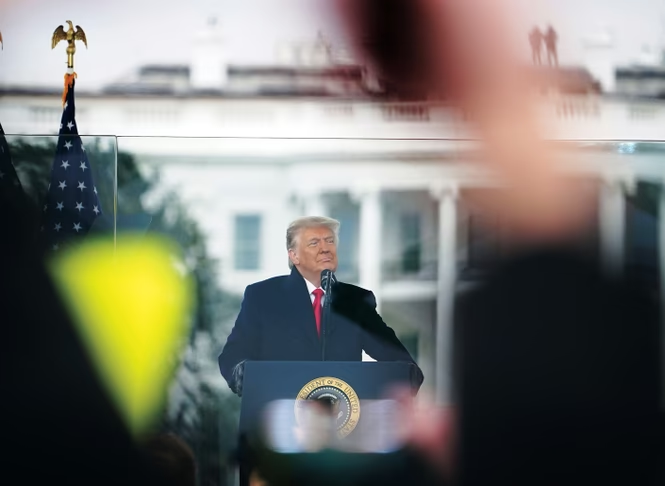
Earlier that day, Trump had begun his morning by once again exhorting Pence, who would oversee the election-certification process, to overturn Biden’s victory. “Do it Mike, this is a time for extreme courage!” he tweeted. Just before noon, the president began speaking to the thousands of supporters he had summoned to the Ellipse. “We won this election, and we won it by a landslide,” he said. After telling them to “peacefully and patriotically” make their voices heard, in order to give Republicans the courage to reject the certification, he shifted to inflaming them: “We fight. We fight like hell. And if you don’t fight like hell, you’re not going to have a country anymore.” He told them to walk down Pennsylvania Avenue to the Capitol, where Congress was beginning the certification proceedings, and said that he would go with them. (He did not go with them.) At 2:11, the rioters breached the Capitol building. Two minutes later, the Secret Service whisked Pence off the Senate floor.
At 2:18, a woman wearing a Trump face mask and holding a Trump flag on a pole tried to push through the barricade that Rathbun was manning. He put his hand on the woman’s shoulder and shoved her back as they tussled over the flagpole. The woman fell to the ground, upsetting the crowd. On body-cam footage, you can see one protester square his shoulders in a confrontational posture, and another raise what looks like a cane into the air as a police officer tries to douse them with chemical spray.
Someone lobbed what looked like a cylindrical Bluetooth speaker into the air. It hit Rathbun in the chest. As he tried to reattach the barricade, which the crowd had dislodged, the woman reappeared. Rathbun put both hands on her chest and pushed her back, and she again fell down. Shortly after that, a bearded man, reading the officer’s name on his uniform, raised his hands in the air and said, “Rathbun, calm down. Nobody’s going to hurt you.”
Another man, wearing what looked to be tactical goggles, pointed his finger at Rathbun and said to the bearded man: “He hit the woman.”
Bearded man: “I know.”
“He’s ready to punch a woman in the face,” the man with goggles said, making an uppercut motion. “I treated Afghan women with way more respect than that.”
Rathbun responded by opening and closing his fingers and thumb like Pac-Man’s mouth, appearing to convey the universal symbol for blah blah blah.
As the crowd blew air horns and chanted “U.S.A.!,” the bearded man asked Rathbun, “Do you love America, Rathbun? Do you love your country, son?”
Rathbun stared forward, his hand resting on the barricade, the final barrier between the crowd and the Capitol’s western entrance. The nation’s legislators were gathered inside, certifying Biden’s election. Rathbun understood that his job was to protect those legislators. The barricades were flimsy and unanchored. He put his foot on the bottom of one, trying to stabilize it. Before long, another man appeared before Rathbun. “Y’all know what’s right and what’s wrong. I know you’re just doing what’s right, doing your job, and we hope that Pence does his job,” the man said. “My vote got disenfranchised by thousands of votes. Thousands of dead people voted. Those dead people are not here. I’m here.”
It was around this moment that Trump tweeted that Pence—then being evacuated to a secure location as some people in the mob chanted “Hang Mike Pence!”—lacked the “courage” to reject Biden’s certification.
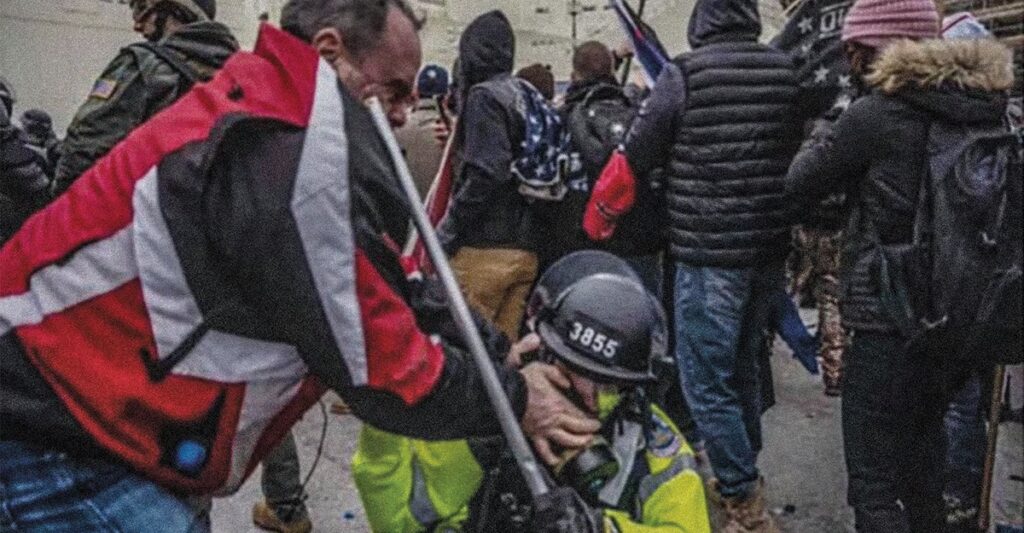
At 2:28, a man in a red, black, and white snow jacket—Tom Webster—pushed his way to the front of the crowd. He carried a large metal pole with a red Marine Corps flag on it. He pointed his index finger at Rathbun and yelled: “You fucking piece of shit! You fucking commie motherfuckers, man. You’re gonna attack Americans? No, fuck that!” As Webster repeatedly jabbed his finger, Rathbun met it with his left hand, as if trying to swat him away. As Webster continued aggressively yelling, Rathbun reached over the barricade and shoved him back. Webster said, “You fucking commie fuck. Come on, take your shit off”—something people say to a cop when they want to fight.
Webster reached down and shoved the barricade toward Rathbun. It slid easily across the concrete, creating a gap between it and the next barricade. Rathbun reached out to shove Webster back and struck him in the head with an open palm. The blow further inflamed Webster, who raised his flagpole into the air and swung it down repeatedly in a chopping motion, hitting the barricade with a loud clang.
Rathbun and the other officers tried to reconnect the barricades but couldn’t, and the crowd surged forward. As Rathbun and other officers retreated, Webster clenched both fists, crouched into a linebacker’s stance, and charged into Rathbun, knocking him to the ground. As the two men wrestled, Webster tugged on Rathbun’s helmet, pulling the chin strap tighter around his neck, to the point where, Rathbun later testified, he struggled to breathe. Webster pulled the officer’s gas mask partway off and pressed his fingers close to his eyes. Rathbun tried to get up but couldn’t, feeling as if someone in the crowd was kicking him. After about 10 seconds, Webster stood and disappeared into the crowd flooding through the breach he’d helped create.
Shortly afterward, someone filmed Webster standing against a wall at the Capitol, his eyes red from tear gas. Stepping away from the wall and looking into the camera, he said: “Send more patriots. We need some help.”
As Webster drove home to New York that night, he wasn’t exactly pumping his fist over what had happened, but he wasn’t full of regret, either. He felt justified in what he’d done. He believed that Officer Rathbun had provoked him, gesturing him to come closer and fight. (Rathbun denied this in court testimony, saying he had “absolutely not” made such a gesture. He did not respond to requests for comment.) Webster thought back to how when he’d arrived on the Capitol grounds, he’d seen an elderly couple leaving, the woman’s face covered in blood. The image had troubled him. American citizens had gone to the Capitol to express their First Amendment rights, only to find themselves assaulted by the police? Webster says he thinks of himself as a “protector,” so seeing that woman put him into a rage, which was the state he was in when he approached Rathbun at the police barrier.
As he absorbed news coverage over the rest of that week, however, he was surprised by its tenor. He’d thought the January 6 crowd would be viewed the way the Black Lives Matter protesters had been—as a mostly peaceful group with a righteous cause. A few bad actors, to be sure, but he wasn’t among them.
But he quickly realized that many Americans viewed January 6 protesters like him not as patriots but as domestic terrorists. Much of the commentary Webster now saw online focused on white supremacy and featured images of protesters holding Confederate flags. Even Trump seemed to briefly forsake them, calling their intrusion on the Capitol a “heinous attack” that had “defiled the seat of American democracy.” As politicians in both parties warned that lawbreakers in the crowd would pay, Webster suppressed a pang of fear.
He seesawed back and forth as he surveyed the evidence. He watched footage of a man hurling a fire extinguisher at a group of police officers. Okay, that clearly crossed the line, Webster thought. Then he watched clips of the Air Force veteran and MAGA devotee Ashli Babbitt getting shot as she climbed through a window into the Speaker’s Lobby leading to the House Chamber, and he felt outraged by what he viewed as her murder.
[From the October 2024 issue: Hanna Rosin on the insurrectionists next door]
Webster learned that the FBI, media organizations, and amateur internet sleuths were using facial-recognition software to identify those who’d stormed the Capitol. His anxiety increased when he heard that federal agents had begun kicking down the doors of identified January 6 protesters. A friend told Webster that his picture was circulating online. One evening as he lay in bed, his wife’s phone rang. His brother-in-law spoke so loudly that Webster could hear what he said: “Tom is going viral on Twitter.” His wife looked at Webster, concerned. “What do you mean?” she asked.
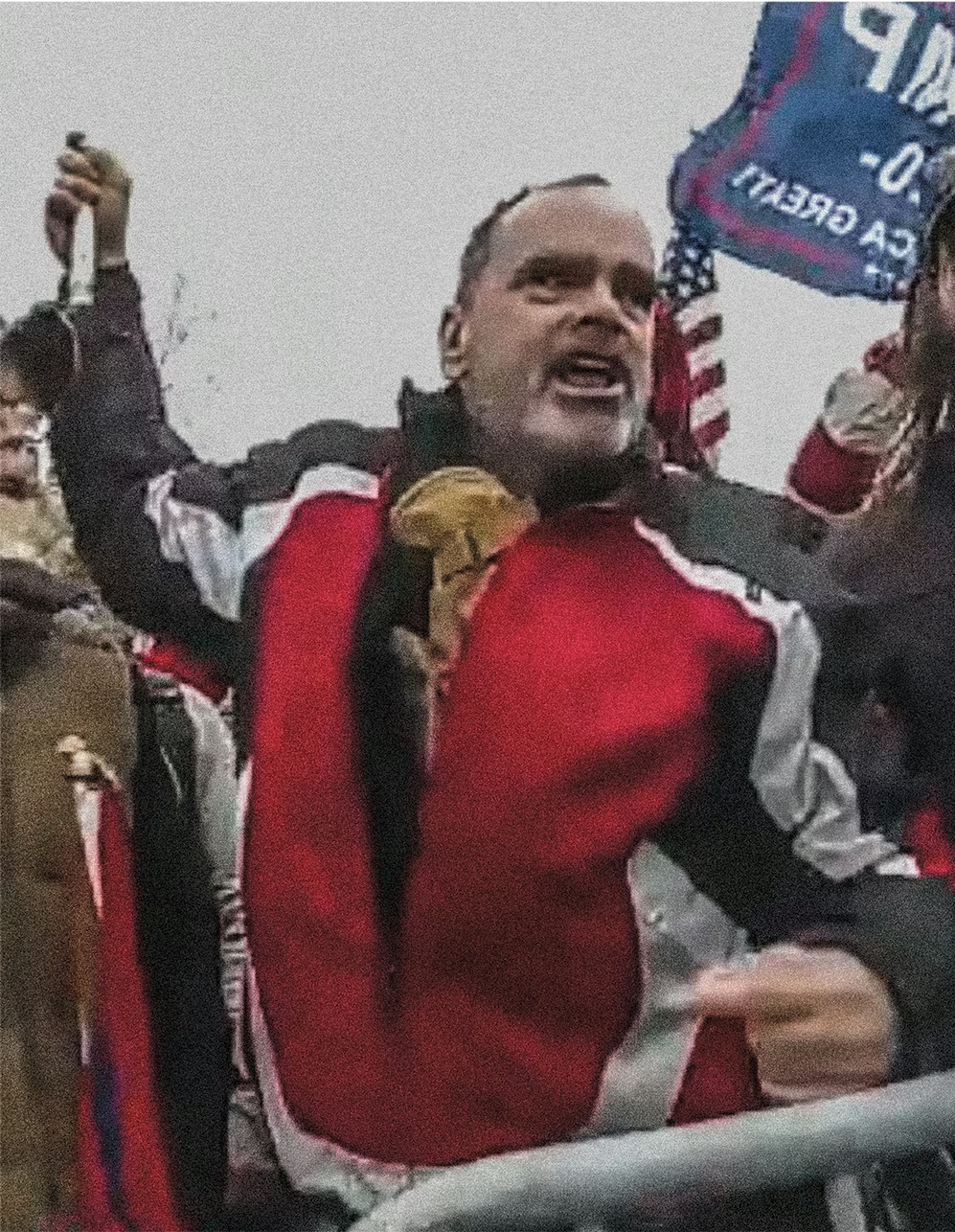
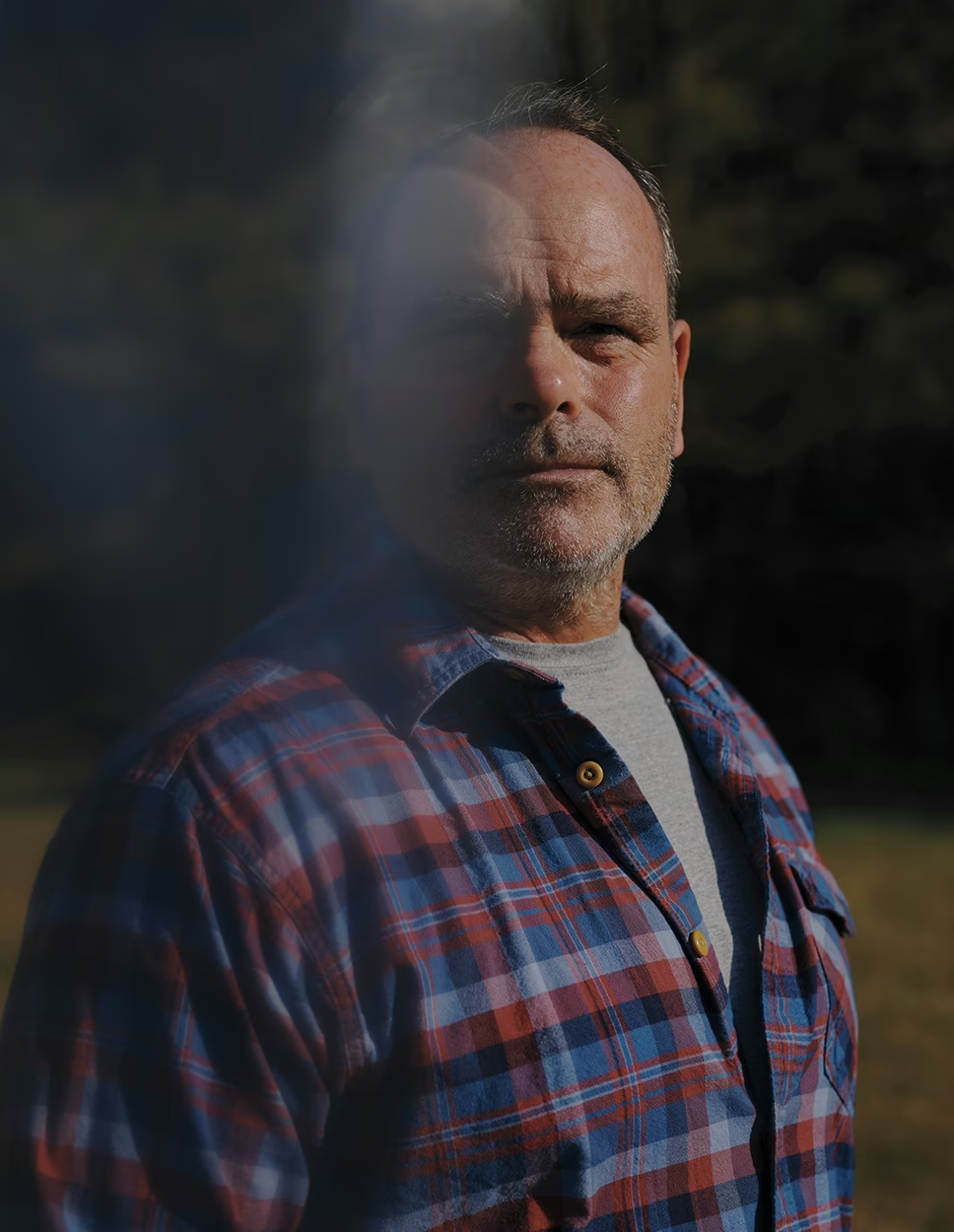
Her brother texted a photograph that he’d found trending online under the hashtag #eyegouger, showing Webster appearing to thrust his fingers in a police officer’s face. Webster had already told his wife about his fight, explaining that the cop had struck him first. Now he again insisted that he’d been provoked, but his brother-in-law sounded doubtful. Whatever you say, dude.
Panicked, Webster went to see the priest at his Catholic church. The clergyman connected Webster with another church member who was a criminal-defense lawyer. He and Webster arranged to meet with the FBI.
In the spring of 2022, Webster sat at the defense table in a federal courtroom in Washington, D.C. Legal wrangling ahead of the trial had stretched out over 14 months, while lawyers and law-enforcement agents pored over hundreds of pages of filings, reports, and statements, and watched scores of video clips. Five attorneys argued the case—three for the government, two for Webster. Jurors heard from 12 witnesses: three U.S. Capitol Police officers, one MPD officer, one Secret Service agent, three FBI agents, a Safeway grocery-store district manager (who testified about how much the violence on January 6 had suppressed business), two longtime friends of Webster’s, and a former NYPD officer with whom he’d attended the police academy. Jurors also heard directly from Webster and Rathbun, both of whom testified for several hours, and repeatedly watched footage of their altercation from multiple angles. The court reporters’ transcription of the proceedings consumed more than 1,000 typed pages.
During closing arguments, a prosecutor urged the jurors to rely on what they’d seen with their own eyes. He repeated this six times, the last time as a question: “What did your eyes tell you?”
After a trial lasting five days, jurors deliberated for less than three hours before finding Webster guilty on all six counts he’d been charged with, including the most serious felony: assaulting a police officer with a dangerous weapon, for violently swinging his flagpole multiple times at Rathbun. At the sentencing, in September, a prosecutor acknowledged that people like Webster might have been pawns in a political game, but added: “Even if he didn’t know better than to believe Trump’s lies, he knew better than to assault a fellow cop, no matter the circumstances.”
Webster’s defense attorney had argued in a presentencing filing that judging his client’s character based solely on January 6 was like “judging the sea by a jugful of its water.”
“The court doesn’t see a lot of Tom Websters,” the attorney, James E. Monroe, told the judge. “In my career, I don’t get a chance to represent many Tom Websters, someone who’s had such a sparkling career and makes such a perfect disaster of his personal and professional life by seconds of stupidity.” He said that Webster came to D.C. at the invitation “of a president that was desperate to retain power. And like many other Americans, he accepted that invitation. And as we’ve laid out in our own papers, the lies and disinformation were sufficient to fool many Americans, especially those who showed up here at the Capitol on January 6.” He also scolded the government for seeking a long prison term for Webster, who’d never before had any legal trouble and who had served his country and New York honorably as a Marine and a police officer; he called the proposed sentence “an act of vengeance as opposed to a prayer for justice.”
Webster rose to speak. He told the judge that he’d become swept up in politics and Trump’s rhetoric. He said he wished he’d never gone to D.C. that day. He turned and addressed the police officer he’d assaulted, who was sitting in the courtroom gallery: “Officer Rathbun, I’m sorry.”
U.S. District Judge Amit P. Mehta, an Obama appointee, agreed that for 25 years, Webster had been “a public servant in the truest sense of the word,” an everyday American who now found himself looking at substantial jail time. But although he’d watched the video of Webster attacking the cop many times, Mehta said, “I still remain shocked every single time I see it.” Webster, he said, had contributed to one of America’s darkest days: “We cannot function as a country if people think they can behave violently when they lose an election.” Mehta believed that Webster had constructed an alternative truth about what happened that day, one that was “utterly fanciful and incredible.”
Before sentencing Webster to 10 years in prison, Mehta suggested that understanding his actions on January 6 required a wider lens. The judge posited that a man like Webster doesn’t do what he did unless he is “brought to a place where his mind and his otherwise sense of equilibrium, his patriotism, his sense of self are lost.”
“People need to ask themselves what conditions could have created that to happen,” Mehta said, “and be honest with yourself when you’re asking the question and answering it.”
After Webster turned himself in at a low-security prison in Texas on October 13, 2022, inmates quickly discovered that he was a former cop. When he sat down for his first meal in the chow hall, another inmate ordered him to go and sit with the “SOs”—the sex offenders.
But what was even harder for Webster to deal with was the knowledge that people didn’t see him the way he’d seen himself on January 6—as a patriot. Even his kids, who’d always looked up to him as the father who fixed their bikes and planned family camping trips, seemed sad and puzzled, as if no longer certain about who he was.
In the days immediately following the insurrection, the country seemed almost unified in agreement that what had happened at the Capitol was violent and dark. “The violence, destruction, and chaos we saw earlier was unacceptable, undemocratic, and un-American,” Republican House Minority Leader Kevin McCarthy said from the House floor just hours after the attack had subsided, adding that January 6 was “the saddest day I’ve ever had serving as a member of this institution.” The next week, the House voted to impeach Trump, and in February the Senate voted 57–43 to convict him, with seven Republicans joining all 50 Democrats in finding him guilty of “incitement of insurrection.” Although this fell 10 votes short of the two-thirds majority necessary for conviction, polls showed that a clear majority of Americans believed Trump bore responsibility for the insurrection. He was effectively banned from all the major social-media platforms, and large corporations declared that they would no longer make financial contributions to politicians who had supported Trump’s election lies. Even the longtime Republican kingmaker Rupert Murdoch, who was then the chair of Fox Corporation, declared, in an email to one of his former executives, “We want to make Trump a non person.” The president seemed to be heading toward political exile, his election claims destined to be inscribed in history as treasonous lies.
But within hours of the attack on the Capitol, an alternative narrative was already forming. On her show the evening of January 6, the Fox News host Laura Ingraham wondered aloud whether antifa sympathizers had infiltrated the crowd. Before long, a chorus of conservative-media personalities, far-right lawmakers, and family members of rioters was suggesting that the reports of savagery had been overblown; that the events of that day had been more peaceful protest than violent insurrection; that the real insurrection had been on November 3, when the election was stolen.
By March, Trump was telling Ingraham live on Fox News that the crowd had posed “zero threat right from the start” and that protesters had been “hugging and kissing” the police. By the fall, Trump and other prominent MAGA figures were regularly referring to the rioters turned defendants as “patriots” and “political hostages.” January 6, Trump would later say, was “a day of love.” News clips featured residents of the “Patriot Pod,” a unit at the D.C. jail that housed January 6 defendants, singing “The Star-Spangled Banner” every night—and before long, Trump was playing a recording of their rendition at the start of his political rallies. On his Fox News show a year after the insurrection, Tucker Carlson said, “January 6 barely rates as a footnote. Really not a lot happened that day, if you think about it.” Representative Clay Higgins, a Republican from Louisiana, has said, “The whole thing was a nefarious agenda to entrap MAGA Americans.” Shortly after the first anniversary of January 6, Trump mentioned the possibility of pardoning the defendants if he were reelected. By March 2024, during the presidential campaign, he was saying that one of his first acts in office would be to “free the January 6 Hostages”; in December of that year, after he won the election, he said he would issue the pardons on his “first day.”
From his cell in Texas, Webster tried to tune out news about the election, the potential pardons, and the J6ers generally, not wanting to get his hopes up. Had the country remained coalesced around the accurate original understanding of January 6—that American citizens had been lied to about the 2020 election by the president and had attempted to sack the Capitol partly at his instigation—Webster might have been forced into a reckoning. Instead, he’d been presented with a more appealing framing that squared better with his view of himself as a patriot and a good person: He and other Americans had gone to Washington simply to petition their government about questionable election results and, while there, had been baited by antifa or undercover federal agents into storming the Capitol. This, in turn, reinforced Webster’s own initial claim about his fight with the MPD cop—that Rathbun had provoked the encounter by striking him in the head, then lied about it to counter Webster’s righteous assertion of self-defense, resulting in his wrongful conviction.
When Trump officially announced another run for president, in November 2022, it solidified everything Webster believed about Trump—that he was a fighter, that he loved America, that he would not be cowed. Despite all that the government had done to Trump, including impeaching him twice, the ex-president remained unyielding.
On Election Night in November 2024, Webster sat in the prison television room, watching the results. By the time he returned to his cell for the inmate head count at 9 p.m., Florida had been called for Trump. Webster spent the next few hours lying on his bunk in the dark, listening to the radio as newscasters called North Carolina for Trump, then Georgia, then Pennsylvania, then the election. Webster drifted off to sleep, full of hope.
For the next few weeks, he wondered whether Trump would keep his word about pardoning the J6ers on his first day back in office. He worried that Trump might pardon only some of the 1,600 defendants, and not the supposedly violent ones like him. Or maybe Trump would wait until the end of his term, to avoid any political heat. For Webster, that would mean continuing to languish in prison for years.
On Inauguration Day, Webster was anxious. He watched the ceremonies for a few hours, then went back to his cell to rest. Later that evening, a prison guard called out: “Webster! Get down to the lieutenant’s office right now.” Just before midnight, he stepped into the cold Texas night, a free man.
[From the February 2026 issue: Jeffrey Goldberg on Donald Trump’s inexcusable pardons]
The Metropolitan Police Department in Washington, D.C., requires nearly all of its 3,200 officers to work inaugurations, typically one of the longest and most boring days of their career; many calculate how close they are to retirement by how many more inaugurations they still have to work.
In January of last year, hundreds of MPD officers who had been at the Capitol on January 6, 2021, were working to safeguard Donald Trump’s second inauguration. To Officer Daniel Hodges, the experience was surreal: The last time he’d seen so many people wearing MAGA hats, they’d been trying to kill him.
On that day five years ago, Hodges had reported for duty at sunrise as part of a civil-disturbance unit, CDU 42. The group (25 officers, four sergeants, and one lieutenant) was specially trained in riot tactics: how to deploy large canisters of chemical spray; how to shoot rubber bullets from 40-millimeter launchers; how to perform extractions—fast, targeted operations to remove people from danger. But on that day, January 6, platoon members looked like typical patrol officers, standing in navy-blue uniforms along the blocks of Constitution Avenue leading to the Ellipse, where Trump was holding his rally. Supervisors had not authorized them to wear riot gear, which was stashed in nearby vans, or carry munitions. They’d been told that their assignment was simply to be visible.
Hodges watched the crowd flow by, noting that a significant number wore tactical gear such as helmets, goggles, and ballistic vests—not the sort of accoutrements people typically wear to peaceably listen to speeches. Around 11 a.m., a large crowd began streaming back toward the Capitol. Around 1 p.m., the U.S. Capitol Police summoned MPD for help; protesters were attacking officers, crashing through barricades, and climbing scaffolding that had been erected in advance of the inauguration. An MPD commander ordered CDU 42 to the Capitol for backup.
A little after 1:30 p.m., Hodges and other officers stood outside their vans putting on hard-shell protective pads that covered their shoulders, shins, and other bones. They listened as a veteran MPD commander at the Capitol began to sound more desperate over the police radio. Officers, some not yet in full gear, rushed into two scout cars and four vans, and sped toward the Capitol. Only two officers had managed to pull on their protective coveralls, stretchy black suits that look like onesies and shield them from flames and chemical spray.
On the northwest side of the Capitol, Hodges and other officers arranged themselves in a two-column formation as a sergeant called out orders: “Shields down! Cameras on!” As they marched toward the Capitol, Hodges noted that his platoon mates, who had worked many protests together, were grim and silent, as if nervous about what they were about to encounter. Many had never worked at the Capitol and had no idea where to go. An officer on the scene led them toward the West Terrace. As they drew closer, a loud roar filled the air. Taking in the crowd, Hodges saw that police officers were preposterously outnumbered. Each put a hand on the shoulder of the officer in front of them, and they marched into the dense, roiling horde, so thick that the two columns were forced to collapse into a single line. Soon the scene devolved into individual battles between officers and rioters.
One rioter tried to rip the baton from Hodges’s hand as he took blows from all sides. Another man, who wore a ballistic vest that bulged with thick protective plates, as if prepared for heavy gunfire, asked, “Are you my brother?” Another said, “You will die on your knees.” A rioter who’d climbed up scaffolding tossed down something heavy, hitting Hodges in the head. Another man tried to take Hodges’s baton and they fell to the ground, the man kicking Hodges in the chest as they wrestled. Hodges managed to hang on to his baton but then found himself on all fours, surrounded by the mob, terrified that he would soon be torn apart.
With the help of colleagues who materialized around him, Hodges managed to stand back up, and he and other platoon members fought their way through the crowd, arriving at the police line in various states of dishevelment. They joined other officers on the West Terrace and tried to keep the crowd at bay. Standing there, Hodges struggled to take in a scene of jarring dissonance: someone waving a flag with Trump’s head atop Rambo’s body; the steady, warlike pounding of a single drum; one angry protester demanding, “I want to speak to a supervisor!” The absolute entitlement of these people, Hodges thought. As minutes passed, Hodges felt as if he could feel the shift and flow of the crowd’s energy, a push of aggression followed by an unsteady lull. A man appeared before Hodges and shouted, “Do you think your little peashooter guns are going to stop this crowd?” Hodges scanned people’s hands for guns and knives, trying to calculate when and whether to use force, how to use just enough to stop the crowd but not inflame it, how any action he took might look later on video.
Horrified, he watched the crowd burst through the police line. An MPD commander shouted over the radio: “We’ve lost the line! All MPD, pull back!” Two men pushed Hodges against a wall; one man reached beneath his protective visor and dug into his right eye with his thumb. Hodges cried out in pain, and managed to shake the man off before his eye was permanently damaged.
Standing near the steps of the Capitol, trying to hold back the marauders, Hodges felt that the job was futile: He would fight off one man, and another 20 would appear. Hodges retreated with other officers inside the building. A high-ranking MPD commander, Ramey Kyle, called out, “It’s gonna be old-school CDU”—civil-disturbance unit—“if they come in those doors, do you hear me?” Officers took that to mean that this was no time for the reform-minded policing of recent years; this fight would be hard and violent. “We are not losing the U.S. Capitol today!” Kyle shouted.
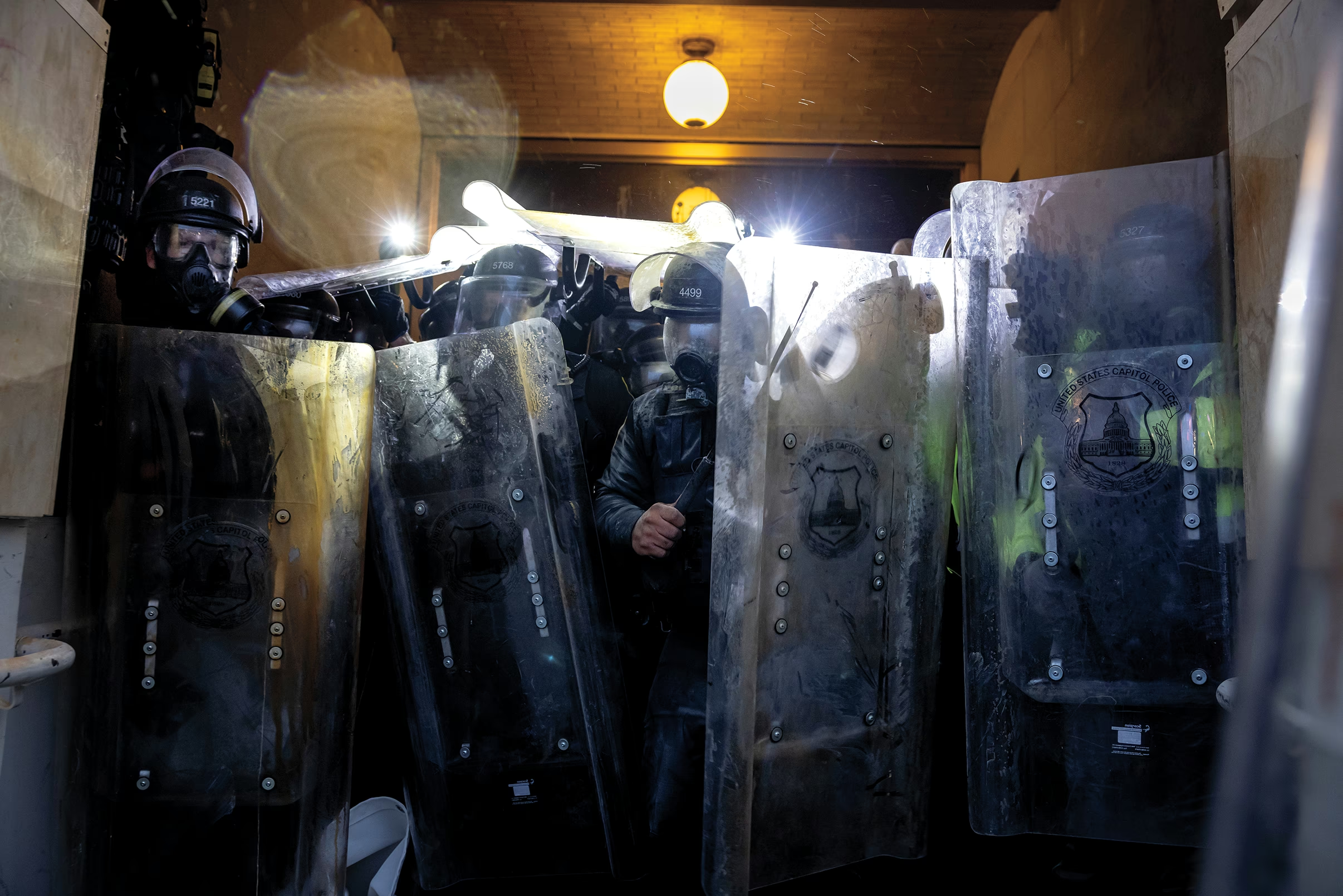
Another officer called out for Hodges’s platoon: “42, come on!” Bracing himself to rejoin the battle, Hodges headed toward the Lower West Terrace tunnel, arriving at a dark concrete hallway about 10 feet wide. There, Hodges saw a few dozen officers in a haze of smoke—rows of four or five stacked shoulder to shoulder—struggling to hold off the hundreds of protesters who’d already breached two sets of doors. Behind those hundreds, thousands more swarmed. The officers believed theirs to be the last line of defense protecting the Capitol. They didn’t know that rioters had already entered the building on the northwest side.
Police and the mass of protesters battled for inches. The attackers swayed back and forth, their bodies working as battering rams. The crowd, Hodges realized, had itself become a weapon. When officers got injured or succumbed to exhaustion or pepper spray, they would fall back, other officers stepping forward to take their place in the fray. As officers around him fell, Hodges pressed to the front of the line. The other side was doing the same, calling out, “We need fresh patriots up here.” Unlike the police, though, the protesters seemed to have an infinite number of replacements.
Hodges had worked many protests, particularly during the long summer of 2020, after the killing of George Floyd. In his experience, when demonstrations turned violent, the violence itself was the point, serving as catharsis and release. But this crowd had a singular goal—to get inside the Capitol. Only a handful of exhausted cops, Hodges among them, stood in the breach.
Hodges braced himself against a metal door frame to his right. But as soon as he got situated, the momentum shifted. The crowd shouted “Heave, ho!” and pushed toward the officers, pinning Hodges against the door frame. He felt the hard plastic of a police shield that rioters had stolen pressing into his other side.
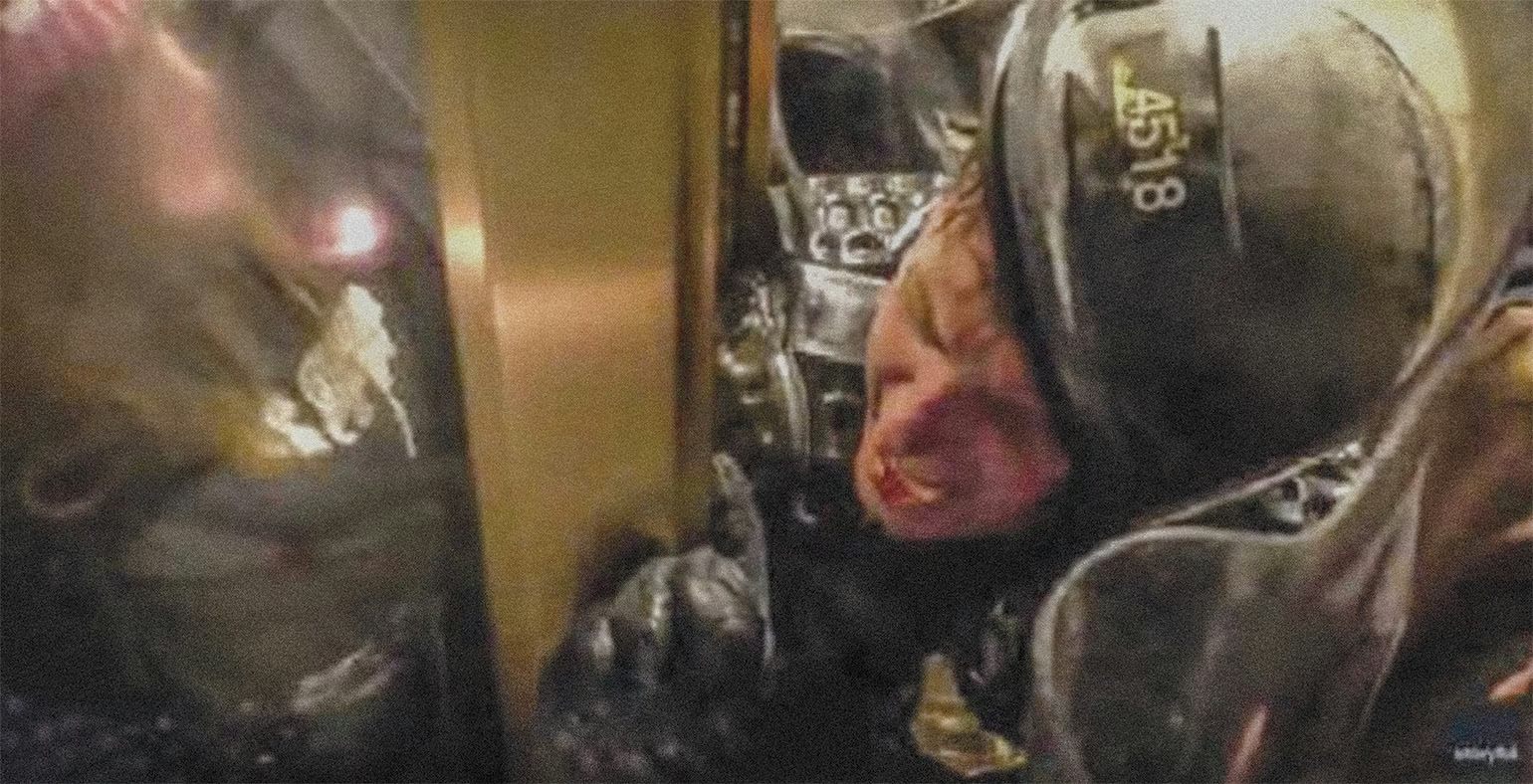
A video—which would soon be viewed by millions of people around the world—captured what happened next. Hodges was trapped, his whole body getting crushed. His arms hung uselessly at his sides. He effectively could not move his legs. A man wrapped his hand around Hodges’s gas mask, violently shoving it back and forth and then ripping it off, shouting what sounded like “How do you like me now, fucker?” As Hodges stood there, scared and vulnerable, the man grabbed his baton and bashed him on the head with it, rupturing his lip and smashing his skull. The video focused on Hodges’s face, his mouth bloody as he struggled to breathe. Fearing that he would soon collapse and be dragged into the crowd, Hodges did the only thing he could—he screamed for help.
Most cops have hero dreams, protector fantasies that sustain them through days that are mostly mundane. The video of Hodges crying out plaintively is the antithesis of how a cop wants to be seen. In the ensuing days and years, Hodges has had to come to terms with that helplessness. He’d bravely advanced to the front of the police line, but in the end, he’d needed rescuing. Like so many people whose lives have been defined by seconds of video from that day, Hodges doesn’t like the story his tells. But he has accepted it, because it’s what happened. Over time, he has learned to laugh when friends joke about how he got his ass kicked on January 6. But the seriousness of his predicament, how close he came to blindness or maybe death, remains ever near; he can still feel the man’s fingers crawling up his cheek toward his eye.
A little after 4 p.m., Trump finally submitted to the multiple entreaties from members of Congress, the vice president, and many others and recorded a video telling the protesters to go home. “We had an election that was stolen from us. It was a landslide election and everyone knows it, especially the other side,” he said. “But you have to go home now. We have to have peace.” He continued: “There’s never been a time like this where such a thing happened, where they could take it away from all of us—from me, from you, from our country. This was a fraudulent election, but we can’t play into the hands of these people. We have to have peace. So go home.” National Guardsmen and other reinforcements finally began to arrive. At 6:01 p.m., Trump tweeted: “These are the things and events that happen when a sacred landslide election victory is so unceremoniously & viciously stripped away from great patriots who have been badly & unfairly treated for so long. Go home with love & in peace. Remember this day forever!”
Though the Capitol had been breached and defiled, and the certification proceedings interrupted, police officers like Hodges—and Noah Rathbun; and Capitol Police Officer Eugene Goodman, who saved lawmakers by redirecting a group of marauders away from the Senate chamber; and Capitol Police Lieutenant Michael Byrd, who in shooting Ashli Babbitt potentially stopped what would have been a surge of rioters toward the House chamber, where members of Congress were hiding—had held off enough of the mob for long enough that no legislators were killed or badly injured. The proceedings could resume, allowing the transfer of power to Joe Biden two weeks later.
Hodges and his fellow CDU 42 officers stayed in the Capitol Crypt until late that night, sitting cross-legged and leaning against columns, nursing their wounds. They were battered and exhausted, but would have fought again if they had to, he told me.
In the years that followed, Hodges testified in court at his attackers’ criminal trials and sentencing hearings. He believed it was important that they face consequences. He told one judge that he wasn’t a vengeful person; he just wanted what was fair. Two of his attackers from the tunnel, Patrick McCaughey III and Steven Cappuccio, were convicted of multiple felony counts and sentenced to roughly seven years each in prison. The man who dug into his eye, Clifford Mackrell, pleaded guilty to assaulting officers and was sentenced to 27 months.
In November 2024, when Americans reelected Trump, Hodges felt a deep sense of grief. During 11 years of policing, he’d seen people do terrible things to one another—shootings, stabbings, maimings. But the election results strained his faith in humanity more than any of that. After all Trump has done? Hodges thought. After all we know about him? His friend Harry Dunn, a former Capitol Police officer who’d been called “nigger” for the first time while in uniform on January 6, later said that seeing the 2024 election unfold was like watching the end of Titanic : You knew what was coming, but it still hurt to watch. Both Dunn and Hodges long ago grew tired of talk about the “shifting narrative” of January 6. “Ain’t no narrative,” Dunn likes to say. “Play the tape.”
As Hodges worked the inauguration in January 2025, he surveyed the legions of happy people in MAGA hats. The scene befuddled him. “It was just very baffling to me, how we’d gotten to this point, after everything we’d been through, that people saw fit to vote for him again,” he said. The assembled Trump supporters, none of whom seemed to recognize Hodges, may not have been thinking about the chaos of January 6, 2021, but he was. He thinks about it every day. His physical injuries have healed, but his psychic ones have not; he has PTSD symptoms and has been diagnosed with depression. When Hodges returned home from the inauguration that night and read about the pardons, he wasn’t surprised. He tried to wrap his mind around the idea of another four years of Trump, and around the incongruity of a so-called law-and-order president, hours into his second term, pardoning people who had attacked cops with weapons that included knives, Tasers, bear spray, pepper spray, lumber, bicycle racks, a cattle prod, a sledgehammer, a ladder, a flagpole, a baseball bat, a hockey stick, and a fire extinguisher.
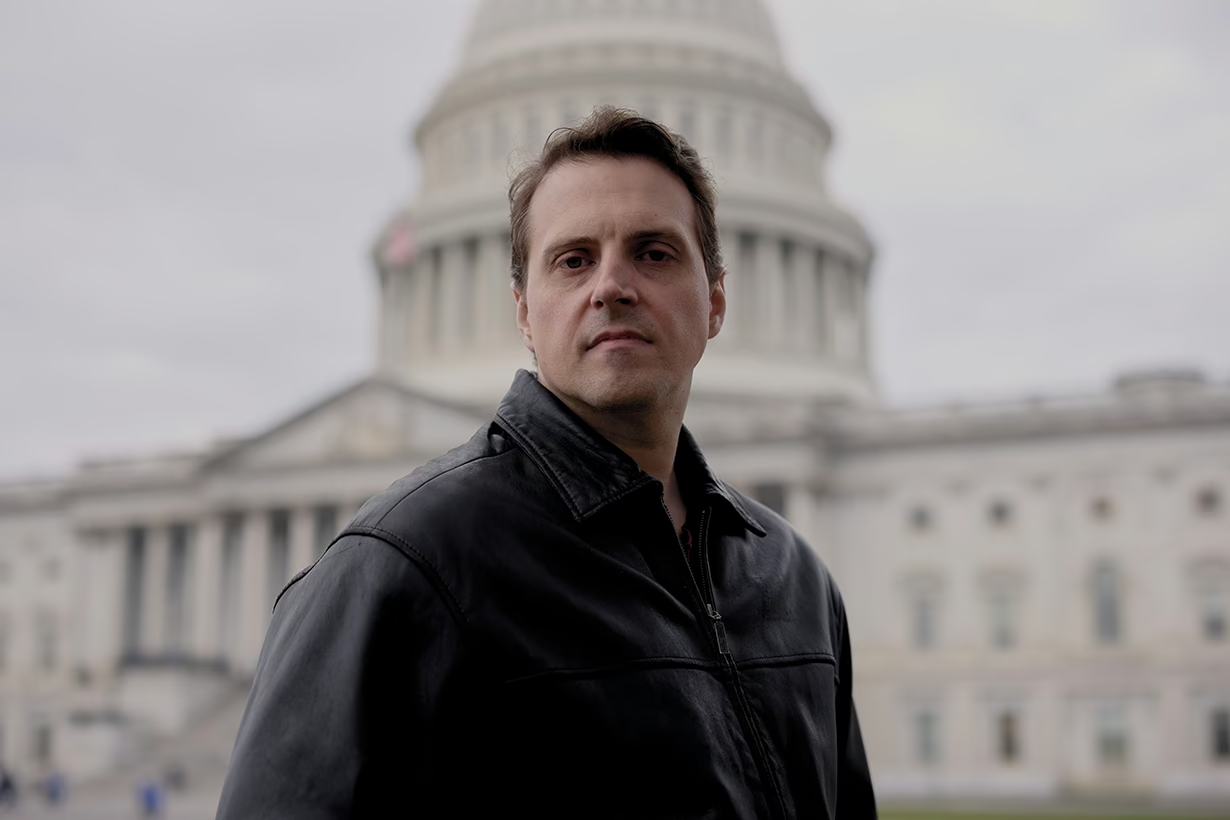
How could this happen in a democracy, propelled by the leaders of a political party that professed to “back the blue”? It was even harder to understand how so many police officers still supported Trump. The Fraternal Order of Police, the profession’s largest union, had endorsed him for a third time in 2024. Certainly there was blame to go around, Hodges believed. He put some of that on Democrats, who’d all but abandoned police after Floyd’s killing.
Still, Hodges hoped that there would be some nuance in who received pardons. There was not. Trump did not weigh each case like Solomon: He issued full pardons to almost all of the 1,600 people charged in connection with the insurrection. Of those, about 600 had been charged with resisting arrest or assaulting officers, 175 of them with dangerous or deadly weapons. No matter how big their sin, no matter what all of those judges and juries had decided, almost everyone was just—poof—forgiven. The only (partial) exceptions were the 14 members of the Oath Keepers and Proud Boys whose sentences Trump commuted, meaning they were released from prison but their convictions were not erased.
After the government spent tens of millions of dollars on what the Department of Justice said was one of the largest and most complex investigations in the country’s history, Trump erased it all at a stroke. Roughly 1,000 people had accepted culpability and pleaded guilty. “No,” Trump’s pardons declared, “you’re not guilty.” Another 250 people had taken their cases to trial. Only four were acquitted of all charges, according to NPR; the rest were found guilty by judge or jury on at least some counts. Nearly 500 defendants awaited trials or sentencing in 2025. “Anyone who spent any time working on Jan. 6 cases saw how violent a day that was,” Mike Romano, a former U.S. attorney who prosecuted some of those cases, told The New York Times recently. “It’s incredibly demoralizing to see something you worked on for four years wiped away by a lie—I mean the idea that prosecution of the rioters was a grave national injustice. We had strong evidence against every person we prosecuted.”
Hodges has watched as the January 6 defendants have been not merely forgiven but extolled, telling their persecution stories at Republican fundraisers as donors snack on meatball platters and charcuterie boards. Sometimes he can’t believe the lengths to which Trump will go to rewrite the history of that day: It was not an insurrection, but a “day of love.” The J6ers were not insurrectionists, traitors, and miscreants but patriots, heroes, and innocents. Hodges worries about the fact that Trump has ordered the Smithsonian to review all of its exhibits in order to “restore truth and sanity.” (One former Capitol Police officer told me that he’d donated the boots he’d worn on January 6 to the Smithsonian, hoping they’d be included in a future exhibit—now he fears they’ll be tossed.)
Though other cops sometimes accuse them of grandstanding, of seeking money or fame, Hodges and Dunn and a few others have continued to speak about what happened to them on January 6, because they believe it’s important to prevent history from being rewritten. “If people would just admit what happened that day, we wouldn’t have to keep telling our stories,” Hodges said. But the efforts of Trump and others to falsify the story, he added, have kept him “tragically relevant.” (Outside of court, many cops have not spoken publicly about their experiences on January 6, including Rathbun.) Hodges says this should not be a partisan issue. He would have defended Trump if he had been attacked at his second inauguration—just as, he says, he would defend the Capitol against an attack by a Democratic mob. “The second a Democratic president tries to hold on to power illegally, I will go after them hard,” he told me. “Until such a time, there’s only one person who’s done that.”
Recently, I told Hodges that I’d been interviewing Tom Webster about January 6. Hodges vaguely remembered the story about the former NYPD cop who’d assaulted one of his colleagues. When I told him that Webster still believed that the 2020 election may have been stolen, Hodges was not surprised. He doesn’t think people like Webster will stop lying to themselves anytime soon. “They can’t,” Hodges said; the cognitive dissonance and moral pain would be too great.
Accepting reality would mean reevaluating everything they thought they knew—that their actions were ethical and justified, that they are great patriots. Accepting the truth of January 6 would require coming to grips with the fact that they supported a con man and participated in a violent plot to subvert democracy. The immediate reward for undertaking this kind of hard self-examination would mainly be shame and regret.
“To grapple with these truths would, in a very real way, unmake them,” Hodges said.
After Thomas Webster was released from prison on January 20, 2025, having served a little more than two years of his 10-year sentence, he went home to a house he’d never seen and a group of people he’d never met. His wife, Michelle, had moved to Mississippi, where members of a church and a J6 support group had adopted her. They brought dinner and a cake to celebrate Webster’s return.
He worried that he’d struggle to readjust, but he quickly felt at home. He and Michelle, married for 25 years, had some bumps as they dealt with the damage from that day—social, financial, logistical—but he told me they’ve gotten past those. Webster mourns all that he missed—teaching his youngest son how to drive, moving his middle child into her college dorm, watching his oldest daughter graduate from boot camp. Interactions with his wife’s family remain strained; to this day, no one has told 99-year-old Nana that Webster was in prison.
Webster and his wife bought a one-story ranch house, 20 acres in the middle of nowhere. He likes living in Mississippi, where he feels farther from the reach of government and politics. Not long ago, when his daughter called him for help with a flat tire and he was able to drive out to her with a patch kit, he felt grateful to Trump for the pardon that allowed him to do that.

Over time, Webster has opened up, telling the people he’s gotten to know at the Toccopola Grocery, an old country store with checkered red-and-white tablecloths and vintage Coca-Cola signs, what he’s been through. He sent them a video about his case, one of the few that he thought rendered his story accurately—that he’d gone to petition his government peacefully and had been assaulted by an aggressive cop. Webster can’t determine if they believe him or not but, unlike some folks back in New York, they seem open-minded. “Ain’t our place to judge,” they say to him.
Webster remains frustrated that the full story of January 6, in his view, has yet to be told. Trump freed him and his fellow patriots from physical prison, Webster told me, “but we’re not truly free until people know the truth.”
When I asked Webster what the truth is, he said he believes that the 2020 election was probably stolen. (About a third of Americans share this belief, even though no credible evidence has ever emerged to support the claim, and dozens of courts have rejected it.) He believes that the federal government made an organized effort to entrap Trump’s biggest supporters on January 6. And he believes that, in pursuing the J6 defendants so mercilessly, the government attempted to silence them, by terrifying them and other conservatives across the country.
Webster has filed a petition to the court asking that it vacate his conviction, arguing that crucial facts were not known during his trial that could have led to him being found not guilty. Even though he’s now been pardoned, Webster told me he felt it was important to document his entire story for the record, preserving it for future generations to consider during “more stable times.”
I pointed out to Webster that he had apologized to Officer Rathbun in court. Wasn’t that a concession that he’d acted wrongly on January 6? In response, Webster said that, although he feels “bad about how the whole day went down,” his apology should not be taken as an admission of guilt: “I was pressured by my lawyer to apologize. He said it would help me reduce my sentence.”
Webster is disappointed by where things stand now: With Trump in office and MAGA conservatives in power, they finally have the ability to prove what happened that day—so why aren’t they? When Dan Bongino was a podcaster, he repeatedly asserted that undercover agents embedded in the crowd had helped orchestrate January 6; now that Trump has made him deputy director of the FBI, why isn’t Bongino releasing the evidence? Webster feels similarly disappointed in FBI Director Kash Patel and Attorney General Pam Bondi. “Why are you guys always bragging about arresting illegal Mexicans doing roof work?” he asked. He wonders why they’re not instead exposing the plots of the deep state, as Trump has demanded. Webster believes that Bongino and Patel have become polluted by the same swamp that Trump has again and again vowed to clean up.
Webster says he barely recognizes the version of himself who drove to D.C. five years ago. Who was that man filled with so much bravado that he thought he could save the country? His days of charging into the fray are over, he said. Sometimes he feels guilty about the life he has now. So many of the J6 defendants have been divorced by their wives, disowned by their kids, fired from their jobs. By Webster’s count, at least five have died by suicide. Yet he still views Trump as the best hope for cleaning out the deep state. “He’s the one person I still kind of believe in,” Webster said.
Recently, he was asked to speak at an event with other J6 defendants. He’d felt fine as he’d approached the podium, full of thoughts to share. But as he stood onstage, he was overcome with emotion. Scenes from that day flashed through his mind: the cop with the gas mask. The feel of the flagpole in his hand. Their tug-of-war. His own rage.
As Webster looked out at the members of the crowd, he thought they’d probably Google him when they got home. Which video clip would they find? he wondered—would it tell the right story or the wrong one? Would they see him as a felon or a patriot? Which truth would they believe?
On his way home, Webster told his wife that he wouldn’t speak at any more events. Reliving what they’d been through was too painful. And he didn’t see much point until the whole story was revealed. So he waits for the truth to solidify into something firm enough to stand on, a day he fears may never come.
This article appears in the February 2026 print edition with the headline “Is This What Patriotism Looks Like?”
The post Is This What Patriotism Looks Like? appeared first on The Atlantic.