When the relentless Donald Trump chronicler Michael Wolff finally got on Instagram in 2025, he was prepared for political trolls. What he wasn’t expecting was questions about his luxe cardigans and compliments on his tufted armchairs.
The 72-year-old writer (who does not consider himself a journalist) films his bombastic takes on current events from a 19th-century Hamptons home straight out of a Nancy Meyers movie. Mr. Wolff, who has been a main character in the news himself for conflicts with the president and first lady, frequent appearances in Jeffrey Epstein’s inbox and claims made in his books, navigates the political swamp amid freshly picked zinnias and rows of glinting copper pots. It’s CNN’s “Crossfire” mixed with Ina Garten’s “Be My Guest.”
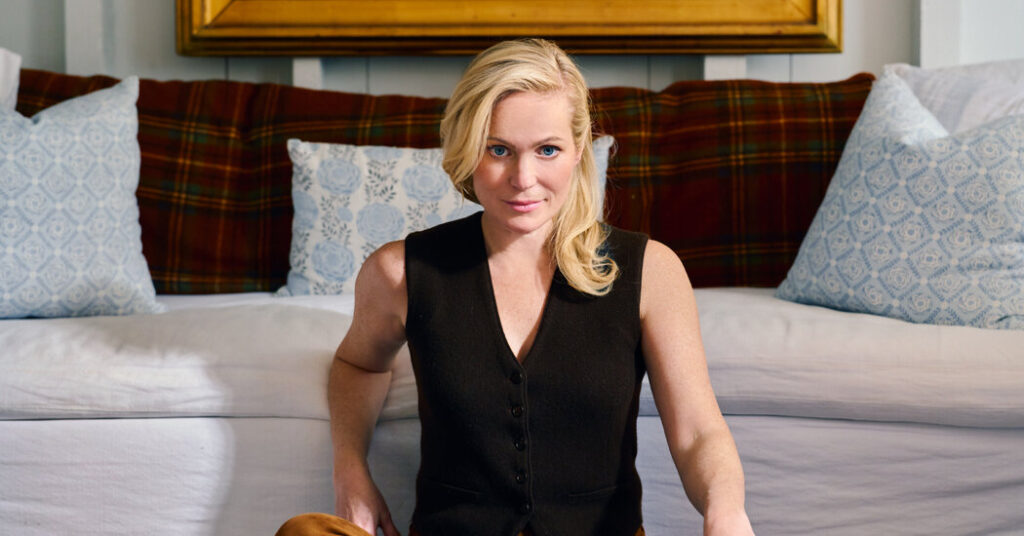
The mastermind behind Mr. Wolff’s domestic idyll — and his new chapter as a social-media influencer — is his wife of nearly eight years. Victoria Wolff, 45, has helped her husband start a Substack newsletter, Howl, and an Instagram account. She has also created her own lifestyle-focused Substack newsletter, Our Amagansett House, and its accompanying Instagram account.
All the channels are hits. Howl, started in October 2025, has over 65,000 subscribers, and Mr. Wolff’s Instagram has over 765,000 followers (with about 7,300 paid subscribers, he said, that puts his newsletter income at over $600,000).
Our Amagansett House attracts a smaller, but loyal readership of over 9,000 subscribers, with nearly 1,000 of them paid, that allows Ms. Wolff to make what she calls “real money” from her writing after 10 years spent at home raising their two young children. She has over 51,000 followers on Instagram.
The Wolffs’ bucolic farmhouse, bought in 2021 for over $3 million, has become a nonstop content factory. It’s a very 2025 collision of the lurid news cycle with Instagram-friendly aesthetics.
In Mr. Wolff’s videos, filmed by his wife, he delivers straight-to-camera commentary on the news with a focus on President Trump and Mr. Epstein. Following the light, she moves him around the house “like a garden gnome,” as their friend the writer Thomas Beller put it.
Ms. Wolff’s content for Our Amagansett House is a personal version of a shelter magazine: wrapping gifts, potting paperwhite bulbs, baking gingerbread cookies. Mr. Wolff’s book-lined office is walled off from the living room by two (historically accurate) doors fused together, to prevent the children from hearing his more unbridled moments, and vice versa.
This homegrown media business wasn’t premeditated. When Mr. Wolff released “All or Nothing,” his fourth book about Donald Trump, in spring 2025, he expected to do the usual promotional gauntlet of cable news shows. But the president blasted the book, and the networks got skittish. So Ms. Wolff offered a solution: “Michael, I know you hate it, but we’ve got to go on social media.”
Their just-so house became a character in Mr. Wolff’s political content. Ms. Wolff found that many of the new followers said, “I’m here for the commentary, but I’m staying for the décor,” which she found “hilarious” and “weird.” She remembered thinking, “He’s talking about these horrific, depressing things in this bucolic setting, but actually it worked completely and it made it stand out.”
She crept out from behind the scenes to start her own Substack and Instagram in fall 2025 to keep up with the demand. In her Substack, she wrote, “It remains to be seen if we will combust in this new social media phase.” Referring to her husband, she added, “Meanwhile, the subjects of his work — Trump, Murdoch, Bannon, Epstein — hover like Dickensian specters over our otherwise idyllic 1829 farmhouse.”
“That ‘Strange Intern’”
For Ms. Wolff, Our Amagansett House is a tentative step into the limelight for a woman who felt burned by the media when she first got together with Mr. Wolff almost 20 years ago.
When Victoria Floethe met Michael Wolff, a writer almost twice her age who was married with three children, at a dinner party in 2006, they hit it off immediately. He was working on a story about the embattled editor and publisher Judith Regan, who was fired from HarperCollins, and Ms. Wolff had a source for him.
In 2007, after they had started dating, but before he was divorced, she accepted a job as a researcher at Vanity Fair, where he was a contributor, but she said they did not interact at the office. She eventually decided to leave the magazine in 2008, but the media stirred up rumors about their supposedly torrid office romance (Ms. Wolff said she was “dancing on the grave” of the gossip website Gawker).
Ms. Wolff’s early attempts at telling her own story — an essay in the British magazine The Spectator, and an online series of essays about female desire — were eclipsed by questions about the so-called scandal. After that, she felt discouraged. “I was stuck as a 27-year-old in the internet world,” she said. “So it was creatively very inhibiting.”
“I felt like I couldn’t share anything because people would pigeonhole me as that ‘strange intern,’” she continued. (She was never an intern at Vanity Fair, as some outlets reported at the time.) She devoted herself to parenting their children, baking, painting and decorating. She also worked on a historical novel, which now sits in a drawer. The couple lived in Manhattan until 2024, when they moved full-time to Amagansett.
“Until this past spring, I was living a very private, creative life,” Ms. Wolff said.
She’s always been drawn to the domestic arts, she said. “This life which we’re leading is a manifestation of my childhood dream,” she said. Growing up in Sarasota, Fla., and Atlanta, she studied Martha Stewart and Alexandra Stoddard’s entertaining books.
Her grandparents, Richard and Louise Floethe, were a writer-illustrator team that wrote charming children’s books, many of which are arranged on a table fireside at the Wolffs’ house today. She credited them, along with her father, Ronald Floethe, a documentary filmmaker, for inspiring her imagination and penchant for staging picture-perfect scenes. She remembered her father instructing her to re-wrap and reopen Christmas gifts over and over for home videos.
The fashion publicist Erika Bearman, a friend from the city, said that on Valentine’s Day, Ms. Wolff and her daughter would go beyond handmade cards. They hand made the actual paper. “That is Victoria in a nutshell.”
When she set up her husband’s social media accounts, Ms. Wolff realized that the quiet work she’d been doing in the background might be interesting to other people. She had long shared snippets of her home life to her private Instagram account, and she finally felt emboldened to make it public. Of the gossips, she thought, “I’m a middle-aged woman, so what are you going to say?”
“She started to build her own brand through creating Michael’s social media,” said Kate Orne, the creative director in chief of the magazine Upstate Diary, who got to know the couple after inviting them to an event at Jackson Pollock’s former home in the Hamptons.
“A Business and Media Revolution”
For Mr. Wolff, this is yet another chapter in a long, public and intermittently lucrative media career, including forays into the business side. His 1998 book “Burn Rate” is a memoir about his misadventures as a tech founder with his company Wolff New Media, which published books about the nascent World Wide Web and had an early search engine. Ten years later, he started Newser, a news aggregation site. After a period as a columnist at New York magazine, he was part of a group that made an unsuccessful bid to purchase the magazine.
Mr. Wolff sees those experiments as “disasters” and credited Ms. Wolff with having the vision for his latest self-publishing era. He pointed to the success of his regular video podcast with Joanna Coles, “Inside Trump’s Head,” for The Daily Beast (at over 500,000 listeners, he said it has “bigger audiences than cable television”) which grew out of the Instagram presence designed by his wife.
“This is a business and media revolution going on here,” he said.
Mr. Wolff compares his wife’s curation with the packaging of a magazine. He said that when he wrote for New York and Vanity Fair, the stories would be expanded, framed and visualized within a larger context. That’s what Ms. Wolff, in her filming and set design and publishing of their channels, is doing on Substack and Instagram.
“Christmas in Connecticut”
A short walk from Amagansett’s charming storefronts, the Wolffs’ home is part of a modern, upscale Mayberry. Ms. Wolff said that one of her favorite movies was the 1945 classic “Christmas in Connecticut,” in which a writer fabricates a picture-perfect rural life in her newspaper column and then is forced to devise it.
The Wolffs’ home is smaller than it appears onscreen. With its swimming pool, expansive garden and high-ceiling kitchen, it’s enviable, but more “World of Interiors” quirky than “Architectural Digest” impressive. Decorated for Christmas with pine cones and ribbons, it’s a cozy place to “weather a media storm,” the topic of one of Ms. Wolff’s recent newsletters (she suggested wearing a belted, dramatic coat on the day when the tempest reaches the op-ed pages).
The farmhouse, like a boomer version of a Los Angeles YouTube creator mansion, is simultaneously a place to live, a refuge from the outside world and a content machine. Ms. Wolff’s storybook taste has become the entire family’s de facto personal brand.
In Our Amagansett House, she wrote, “The house, rather than being invaded, was in fact offering its own counteroffensive: a gentle insistence on proportion, on reason, on civility. In the clash between the horror and the hydrangea, the hydrangea got the last word.”
Mr. Wolff, formerly a die-hard New Yorker, does not have a driver’s license and does not plan to get one. He walks everywhere in the village and said it was like still being in the city. Plus, he said, “I don’t feel any limitations because Victoria drives me everywhere.”
The post How to Live Like a Wolff appeared first on New York Times.