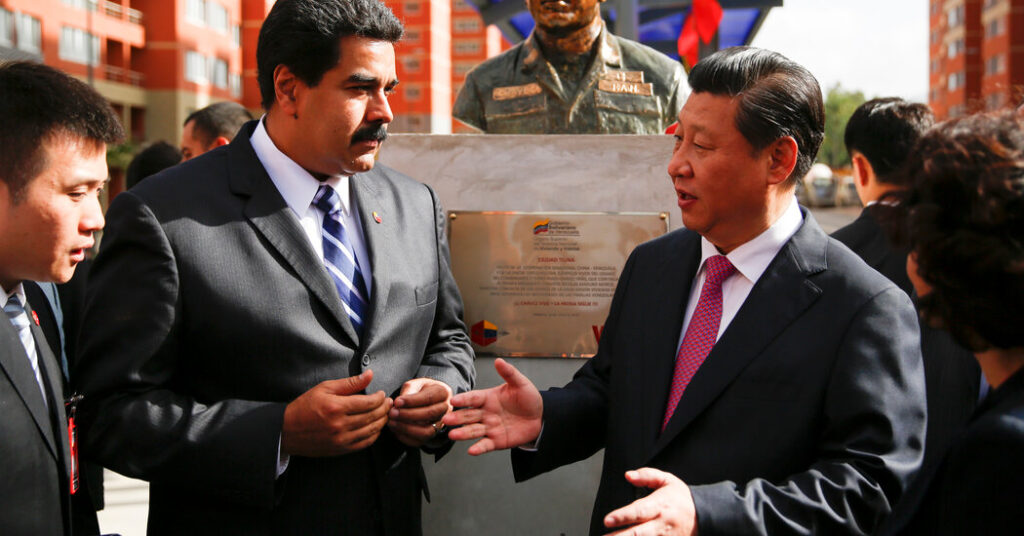
Just hours before American commandos seized President Nicolás Maduro of Venezuela in a daring raid, a senior Chinese official had met the Venezuelan leader at the presidential palace, a show of support for one of Beijing’s closest partners in the Western Hemisphere.
The speed with which U.S. forces acted afterward to capture Mr. Maduro sent a blunt message to Beijing about the limits of its influence in a region that Washington treats as its own. China now risks losing ground in Venezuela after Saturday’s assault in Caracas, despite decades of investment and billions of dollars in loans.
But the assault also reinforces a broader logic that ultimately favors President Xi Jinping’s vision of China and its status in Asia: when powerful countries impose their will close to home, others tend to step back.
The White House has framed the Maduro operation as part of an updated Monroe Doctrine, or as President Trump describes it, the “Donroe Doctrine.” A globe carved into spheres of influence — with the United States dominating the Western Hemisphere and China asserting primacy across the Asia-Pacific — and where might makes right, regardless of shared rules, could benefit Beijing in a number of ways.
It could keep the United States and the brunt of its military forces away from Asia. And it could undercut Washington’s criticism of Beijing when Chinese forces elbow their way across contested waters of the South China Sea and menace Taiwan, the island democracy China claims as its own.
The assault on Caracas “does further erode the norms against great power use of force that have steadily weakened in the last two decades, which works just fine for Beijing,” said Rush Doshi, a China expert at Georgetown University and the Council on Foreign Relations. “More important, if it distracts the United States by tying us up in Venezuela, all the better for Beijing too.”
Beijing has long railed against what it calls America’s strategy of containing China, which includes stationing troops in Japan and South Korea, and deploying U.S. naval ships in the Taiwan Strait and the South China Sea. And it has criticized Washington’s moves to deepen security ties with India and help Australia develop nuclear-powered submarines.
Mr. Xi has depicted China as a reliable and powerful pillar in the region, in contrast to the United States, as he sought to court neighbors to his side in a trade war with President Trump.
In a speech at a high-level Communist Party conference on regional diplomacy, Mr. Xi called for the region to be governed by “Asian values,” Asian supply chains and an Asian security model where countries shared “weal and woe.”
On Monday, Mr. Xi once again appeared to underscore the contrast between the Trump administration’s assault and China’s “neighborhood diplomacy” in a meeting with President Lee Jae Myung of South Korea in Beijing. Mr. Xi, casting China as a benevolent major power, said Beijing and Seoul were able to achieve “harmony without uniformity” by “resolving differences through dialogue and consultation.”
In fact, China has not hesitated to use its massive economic power for coercion and its ample modern military to intimidate its neighbors.
Just last week, China fired more than two dozen long-range rockets into waters around Taiwan and surrounded the island with bombers, fighter jets and warships in a two-day show of force aimed at intimidating the island’s leadership. China has also punished Japan economically for showing support for Taiwan.
None of this means Beijing is calibrating its approach to Taiwan based on events in Venezuela. Chinese leaders have long treated the island as a domestic issue to be resolved on their own terms, independent of U.S. actions elsewhere.
China has sometimes been explicit about how it sees its power in its own neighborhood. At a meeting with Southeast Asian officials in 2010 over the South China Sea, China’s then-foreign minister, Yang Jiechi, said: “China is a big country and other countries are small countries, and that’s just a fact.”
That blunt view of power helps explain both China’s confidence in Asia and its vulnerability farther afield, as Venezuela has made clear.
China will not easily give up on Latin America, a region where Beijing has been expanding its economic and political influence for years, buying soybeans and minerals and investing in ports, telecommunications networks and space infrastructure. It has aligned itself with Brazil, Colombia and, of course, Venezuela, in being willing to stand up to Washington’s bullying.
Led by socialist strongmen who dared to defy the United States, Venezuela shared an ideological kinship with China’s communist leaders. The South American nation has been the region’s largest recipient of Chinese loans and the largest buyer of Chinese military equipment. In 2023, Beijing elevated bilateral relations with Caracas to one of its highest tiers, known as an “all-weather strategic partnership.”
China’s stake in the country, which includes around $10 billion in outstanding loans, could now be at the mercy of the Trump administration, which indicated on Sunday that it would assert leverage on Venezuela’s leadership by imposing a military “quarantine” on the country’s oil exports.
For Beijing, the timing of Saturday’s strike only compounded the blow. China’s special envoy for Latin American affairs, Qiu Xiaoqi, had met with Mr. Maduro in Caracas at Miraflores, the presidential palace, earlier in the day on Friday, their meeting shown on local broadcasts.
“The United States took such action at a time when China’s delegation was visiting Venezuela. For China, it is very embarrassing,” said Wu Xinbo, dean of the Institute of International Studies at Fudan University in Shanghai. He said that the attack would affect relations between Washington and Beijing.
That it took place during the Chinese delegation’s visit also pointed to a potential failure of China’ intelligence services and its diplomats, said Ja Ian Chong, an associate professor of political science at the National University of Singapore.
Beijing has condemned the U.S. strike and said that it was “deeply shocked” by the “blatant use of force.” In what appeared to be his first remarks on the matter, Mr. Xi on Monday criticized what he called “unilateral bullying actions” that he said were “severely undermining the international order.”
It is unclear how much contact Beijing has had with Caracas since Mr. Maduro was deposed. Even as the two administrations remained close, China had grown frustrated by corruption and the mismanagement of the country’s resources by the Maduro government, which came to power in 2013, analysts say. As billions of dollars in unpaid loans racked up, China effectively stopped lending to Caracas more than eight years ago.
“Venezuela is a headache now for China, but it’s a headache worth having,” said Ryan C. Berg, director of the Americas Program and head of the Future of Venezuela Initiative at the Center for Strategic and International Studies. “Beijing saw Maduro as a complete clown, but in many ways, he was their clown as long as he remained in power.”
Berry Wang contributed reporting.
David Pierson covers Chinese foreign policy and China’s economic and cultural engagement with the world. He has been a journalist for more than two decades.
The post How the ‘Donroe Doctrine’ Reinforces Xi’s Vision of Power in Asia appeared first on New York Times.