Nathan Tate had told almost no one about that day five years ago. He worried people might not believe him. Or they’d think he sounded weak. Or Tate would laugh, because that’s what he does when he’s nervous, even though nothing about Jan. 6 was funny to him.
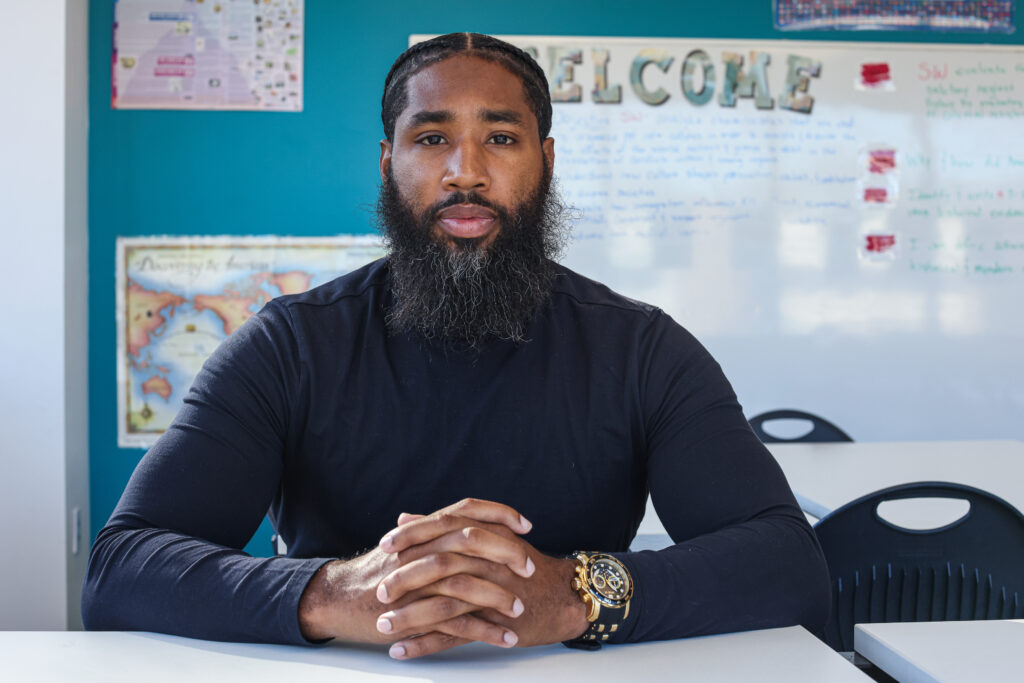
Looking out at his classroom of 23 middle-schoolers — kids shifting in their seats and doodling in their workbooks — he wasn’t sure what they already knew. They were third-graders in 2021. This lesson could be the first time they heard about it from someone they trusted.
“Let’s talk,” the social studies teacher said.
In the unraveling narrative of Jan. 6, 2021, so many people claim to know the truth: The rioters who say they were protesting a stolen election. Republican leaders who have recast members of the violent mob as patriots. The quarter of Americans who say it is “probably” or “definitely” true that the FBI instigated the attack. The president who called it a “day of love.”
Here in his classroom, nearly 250 years after the birth of American democracy, Tate wondered if he had the power to persuade a room of teenagers to reject all that.
He chose his words carefully. Since January 2021, more than 40 states had taken steps to restrict how teachers discuss certain subjects. Educators in Florida, Tennessee, Texas and elsewhere had been fired for talking about race and social movements. The Smithsonian had been ordered to scrub displays that could be construed as divisive, race-centered or “anti-American.” Harriet Tubman’s photo had disappeared from a government website.
History is scripted by those in power, Tate knew, and under the Trump administration, the story he’d lived as a D.C. police officer on Jan. 6 had been rewritten. He’d been hailed as a hero for protecting democracy, until the whole narrative turned inside out. Who were the good guys anymore? And who got to decide?
He wanted the students to understand how terms such as “patriotism” and “protest” could be warped. Both the Boston Tea Party and the Capitol riot, he explained, happened when citizens believed their government no longer represented them.
“There’s a powerful connection between the two moments in American history,” said Tate, 36, “one that helped create democracy.”
“We know democracy is what?” Tate asked. “Who has the power?”
The students called out: “The people.”
Tate’s job was to teach these young people how the U.S. government was designed to work. The class had already covered the origins of the American Revolution. Still to come were the separation of powers, the right to vote and the peaceful transition of power.
Jan. 6 wasn’t technically in the curriculum. But it had been a violent attempt to overturn an election — the worst assault on the Capitol since the War of 1812. Four people died during the attack, and one officer suffered two strokes and died a day after he confronted rioters. Four policemen later died by suicide.
As Tate prepared the PowerPoint on the Boston Tea Party and the use of violence in protests, he thought: How could he ignore an urgent lesson he was primed to teach? One where he was also a primary source?
Tate held the clicker in his hand and pressed play, showing the students footage from a documentary about the insurrection. On the screen were officers in ballistic helmets equipped with face shields and batons, pushing back the rioters. At 19 minutes and 45 seconds, he paused.
The students, often chatty and easily distracted, sat stone silent.
“Right there,” Tate said, zooming in on the middle of the frame, on his own face.
Tate applied to be a police officer because he recognized a younger version of himself in so many kids.
As a boy growing up in Prince George’s County, he saw a body outside the 7-Eleven on his way home from church. As a teenager, he never called police for help, scared that he’d be the one ending up in handcuffs like the older guys. And when he was an adult, his 3-year-old stepson was injured by a stray bullet while riding a tricycle.
If he was the one with the badge, he thought, maybe things would be different. Maybe each positive interaction with a kid — saying yes when they wanted to race him, asking them about school — would cancel out the bad things they thought about police officers. At 28, he became a D.C. police officer serving the Sixth District in many of the District’s most impoverished neighborhoods.
Tate soon discovered a part of himself that came out only when he was in uniform. He felt humbled by the badge and the responsibility of the gun. He moved through the world more alert, more receptive to strangers. People turned to him in a crisis because they believed he could help, and he started to believe that, too.
He responded to a report of a young man hanging off a roof, threatening to let go. “Brother, don’t do this,” he recalled saying. “You got so much to live for.” The young man was crying, ordering him: “Don’t come any closer.” But Tate continued to inch forward, until he and another officer could grab the man and pull him to safety.
And he said he earned the trust of a man who had just been involved in a shoot-out. The injured man was yelling at officers to get away.
“Hey, man, I’m here for you,” Tate recalled telling him. “Yes, I’m worried about what happened, but you’ve got a gunshot wound, sir.”
“It hurts,” Tate recalled him saying. “It hurts so bad.”
After a few minutes, Tate said, the man lay in his arms and cried.
Then came Jan. 6, 2021.
In the footage from that day, Tate stands at the front of the police line, blocking the man in front of him from advancing toward the Capitol. A blue Trump flag waves in the distance. He unpaused the video for his class.
The man in front of him grabs his shoulder. Tate punches him. Then comes the pop of a gas grenade and the smoky haze of chemical irritants.
He told the students about being temporarily blinded by bear spray and knocked to the ground. He thought the rioters would kill him before he could make it home to his six children.
As he spoke, Tate felt his body reliving the day. The smoke in his lungs. The crack of glass in his ears. Trying to pry open his burning eyes. Hitting his head on the scaffolding, dropping to a crawl. He pictured the rioters, their faces twisted in anger.
“I remember being surrounded, unable to see, gasping for air,” Tate said. “I kept fighting to hold the line beside my fellow officers, not out of anger, but out of duty and love for our country.”
The students stayed silent.
What he did not tell them, what he has not told even his closest friends: how the attack on the Capitol, and its aftermath, broke him.
The morning after Jan. 6, he woke up exhausted and sore. He lay in bed, eyes closed, and felt the pressure of what it meant to be a police officer.
He told himself that at least he wasn’t beaten up, like his friend who’d been pulled into the crowd. He didn’t have to go to the hospital like so many others. He wasn’t bloodied, like the sergeant behind him whose head was hit by a projectile.
He thought of the people who counted on him: his children, his siblings, his fellow officers. Tate reminded himself that he chose this job to help others, and he couldn’t do that from his bedroom. He got up, splashed water on his face, put on his uniform and kissed his kids goodbye.
Eventually, the department held a mandatory group session where officers were reminded that therapists were available to them. After that, he says, no further discussion. He often felt reduced to a number: Badge 5469, computer-aided dispatch 11280.
He never spoke to a therapist. But he felt like screaming to the country: I put my life on the line for you guys.
Tate struggled to explain the day to his own kids. He didn’t know how to tell them that one of the men who attacked him had walked free. He didn’t want to give them anything to fear.
“Why would they let him free?” Kani, 10, asked Tate one afternoon in November.
“He should get like — ” Dawab, 12, said, trailing off.
“20 years,” Kani said.
“No,” Dawab said, “like five years.”
“No,” Kani said, looking at his dad, “life in jail for assaulting a police officer.”
Penina, 8, was trying to follow along. She tugged on her dad’s jacket.
“Maybe,” Penina said, “he learned his lesson.”
Tate wasn’t so sure. He remembered sitting on the hard bench of a federal courtroom in June 2024, waiting to hear what the judge would decide about the fate of that rioter, Andrew Taake.
Tate had spent hours trying to find the right words for a victim impact statement at Taake’s sentencing. How to describe the worst pain he’d ever felt. He settled on words like “living death” and “lifelong scar.”
Taake, then 32, had traveled to Washington while on pretrial release for a child solicitation case in Texas. He used bear spray and a metal whip to attack multiple officers and ultimately pleaded guilty. Taake would later claim that Tate lied about his injury. He could not be reached for comment, and his attorney did not make him available for an interview.
The judge sentenced Taake to six years in prison. Seven months later, President Donald Trump set him free with the stroke of a pen.
Though he pleaded guilty in the child solicitation case, Taake received credit for the time he served for Jan. 6 and never went back to prison.
Back in class, Tate clicked to his last slide, which flashed a prompt: “Can violence ever be justified in the name of patriotism or protest?”
Two and a half centuries after the Boston Tea Party, 58 months and 7 days since the Capitol insurrection, it was a question America was still struggling to answer.
Tate paused, taking in the looks on his students’ faces.
Maybe the video had been too much, he thought.
“I ain’t gonna make y’all do this right now.”
It had been a long morning, and he wasn’t sure his students could handle the heavy essay question.
He also didn’t know if he was ready to hear their answers.
Officer Tate. For so many years, that was how he introduced himself. Even out of uniform, he learned to carry himself differently, walking straighter and talking more slowly, pausing before speaking. He said “no” to things, like another round at the bar, always seeing himself as a representative of law and order.
In June 2023, Tate was put on paid administrative leave after an off-duty fight. He said it was self-defense, and he was acquitted, court records show. But the internal investigation added to a sense of betrayal that had been growing since Jan. 6.
As Trump sought election again, Tate’s distrust and uncertainty intensified. He worried about what the former president might encourage his supporters to do next.
Just before Election Day, he handed in his department-issued phone, pepper spray, the D.C. police vest, his uniform and his badge. All the things that, for seven years, had told him who he was.
A few months after leaving the D.C. police, he applied for a job at the Charles County Sheriff’s Office. While talking to the background investigator, he tried to keep eye contact, communicate clearly, think through his answers. But he felt his heart beat faster. His hands were shaking. He couldn’t calm himself.
As he walked out of the red-brick station, he realized he could never be an officer again.
Sitting in Tate’s classroom wearing teal braces was the class president. A few seats away was the artist with pink hair whose parents supported Trump, and the girl wearing glasses whose mom used to work inside the U.S. Capitol.
The kids here looked up to Tate. They lingered by his door in between classes, telling him about a new haircut or a girl they liked. They asked him to sit at their table while they completed worksheets. And they gave him the greatest compliment a teacher could get at an arts school: They thought he looked like Daveed Diggs, the suave Black actor who played Thomas Jefferson in “Hamilton.”
He’d landed the teaching job this school year at the Phoenix International School of the Arts in La Plata, Maryland, after an old friend on the force put in a word.
Tate was never a good student. Out of 11 siblings, he was the one who took an extra three years to graduate high school, spending his days drinking, playing football, doing anything but homework. But when Tate learned that more than half of the students at the school were boys and a majority were Black, he thought he could make a difference again.
He also knew that inside this public charter school classroom, he’d have more freedom than most teachers. Still, he was careful not to tell the students what he thought, which was that the country was forged in violence, and violence remained part of its fabric.
Tate was descended, as best he could tell, from the Cherokee tribe on his father’s side and from enslaved people on his mother’s side, which means that some of them were considered three-fifths of a person and others were forcibly displaced on the Trail of Tears.
The way he saw it, if Black people had been responsible for the Boston Tea Party, history would note it as armed robbery and destruction of property — not a revolutionary spark. And if the crowd storming the Capitol had been predominantly Black, he believes, authorities would have responded with significantly more force.
He thought violence was justified only in self-defense. He followed Romans 12:18: “If it be possible, follow peace with all men.”
He’d seen the consequences of people choosing violence — as a kid playing pickup basketball, as a young adult when those around him got locked up, as a police officer enforcing the law.
Tate wouldn’t tell his students what to think. It was important for them to make up their own minds, to sift facts from conspiracy theories and TikTok nonsense, to seek credible sources, to back up their arguments.
Even though he was no longer guarding the U.S. Capitol, he still felt like he was defending democracy in the most fundamental way.
With the PowerPoint done, he braced himself for what the students would ask now.
Natalie Betton raised her hand.
“When you got hurt,” Natalie, 14, asked, “did they pay for your medical bills or anything like that?”
“Um,” Tate muttered as he looked down. He hadn’t expected this kind of question.
“Nah,” he said. In fact, he said, he had to go back to work within hours. “I didn’t have any time to process it.”
A boy in the front of the room who had been learning about stress and anxiety in another class raised his hand.
“How long did it take for you to mentally and physically process through that?” asked Micah Brown, 13.
“It’s still a process today,” Tate said. “I don’t like a lot of crowds. I don’t like being in a crowded area. It’s not a good place for me.”
More students raised their hands. No one mentioned Trump or the political battle over what that day meant for the country. They wanted to know about Mr. Tate. They wanted to know he was okay. It caught him off guard. These kids, with a million distractions, made him feel valued in a way he hadn’t felt in a while.
Allisson Pineda Alvarado, who always sat at the back table, turned toward Tate and raised her hand.
“How many people did you hit there?”
“Um, I don’t know.”
The other kids looked shocked. One called out, “Why do you want to know that?”
“I just saw him throwing hands,” Allisson, 13, said, “and I just wanted to know.”
The class was getting a little rowdier, and Tate thought this could be a good moment to tell them what he wished the country had already realized.
He pointed at Allisson and said, “I was defending your democracy.”
She looked puzzled, and then she said: “Mine?”
Democracy, he wanted them to know, wasn’t just built or broken in revolutionary moments or clouds of smoke. It required one person, and then another, to pay attention.
Allisson blinked.
“Wait,” she said. “Mine?”
The post He was attacked on Jan. 6. Can he make sense of it for the kids he teaches? appeared first on Washington Post.