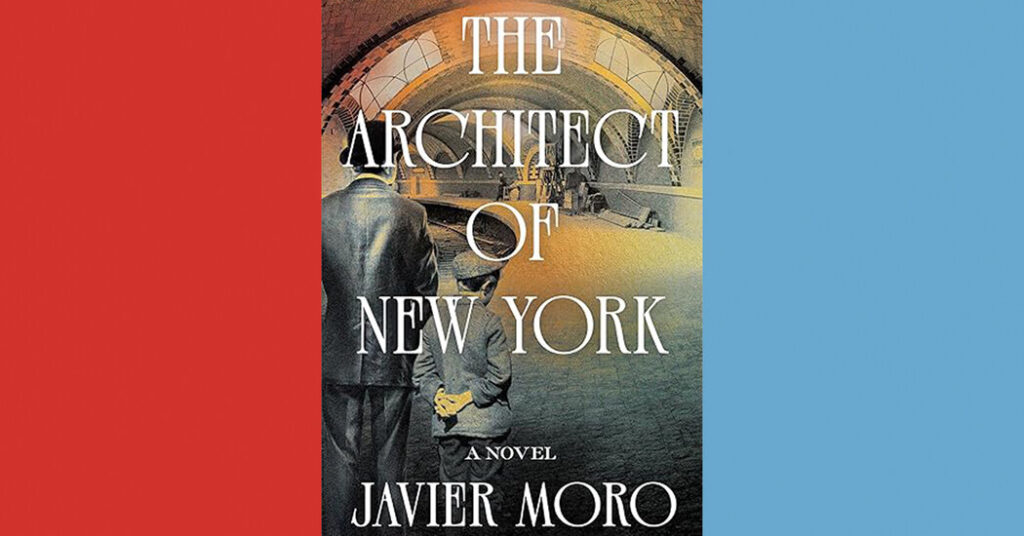
THE ARCHITECT OF NEW YORK, by Javier Moro; translated by Peter J. Hearn
Even New Yorkers who don’t think they know Rafael Guastavino know Rafael Guastavino. Though the 19th-century Spanish architect is hardly a household name, his innovative vaults and domes lend a soaring grandeur to beloved public spaces all over Gotham.
Ever slurped chowder beneath the majestic, herringbone-patterned ceiling of the Oyster Bar in Grand Central Terminal? Those gravity-defying, arched expanses of tile overhead were made by Guastavino’s firm. Ever gazed up at the otherworldly dome that crowns the Cathedral Church of St. John the Divine? Also Guastavino. Ever visited the registry room at Ellis Island or hurried into the Chambers Street subway station through the open-air arcade of the Manhattan Municipal Building? These dramatic spaces are graciously surmounted by curving Guastavino vaults.
“The Architect of New York,” a new novel by the Spanish writer Javier Moro, purports to be a memoir by Guastavino’s son Rafaelito, who worked closely with his father and built on his legacy after the older man’s death in 1908.
It’s an appealing premise, an opportunity to explore the immigrant journey of a father and son who made such a vivid mark on their adopted city and country. It is also a chance to tease out the separate identities of the two men, who have often been conflated.
“The fact that we shared a name — both of us Rafael Guastavino — reinforced our renown and our brand,” the son writes in the book’s (fictional) preface, “but it also blended us: Where did he end and I begin?”
We first encounter the Guastavinos in 1881, shortly after their arrival in New York from Spain. Rafaelito’s mother, Paulina, after sniffing another woman’s perfume on Rafael’s lapel, announces that she is taking her two daughters and son back to Barcelona for good. In the ensuing argument, during which Rafael insists that his namesake remain with him in New York, 9-year-old Rafaelito gleans clues that his sisters have a different father. It is the first of a lifetime of revelations about his own father’s sometimes scandalous personal life.
Rafael brings to America knowledge of traditional Catalan tile-vaulting construction, which he continually improves upon and patents. A financially sloppy visionary, he works with the fervor of an evangelist to convince Americans that his fireproof system can safely span vast spaces — until the influential architect Stanford White hires him to create the vaulting for the Boston Public Library. Commissions then pour in.
Moro conducted impressive research for the novel, unearthing family letters that revealed, among other secrets, that Rafael led a double life in Barcelona before his emigration, maintaining two families at once. But despite this rich source material, the book feels as though it never underwent the marvelous alchemy, catalyzed by imagination, that transforms research into literature. Instead, the narrative often reads like a dutiful biography — long on historical facts but short on nuanced exploration of its subjects’ inner lives. We learn far more about the interiors of grand buildings than of the human beings who designed them.
The novel is most successful in presenting the elder Guastavino through the eyes of the younger, whose attitude toward his philandering father evolves from veneration to resentment to competitiveness before returning, after Rafael’s death, to veneration. Far less satisfying is Rafaelito’s sketchy account of his own messy private life.
Among the Guastavinos’ masterworks is the opulent original City Hall subway station in Manhattan. Though it was closed in 1945, savvy New Yorkers know you can still get a glimpse by staying aboard the downtown 6 train after its last stop at the Brooklyn Bridge-City Hall station. If you peer through a window as the train makes its turnaround loop, the Romanesque Revival station emerges out of the darkness for an enticing instant: a vaulted ceiling, intricate skylights and a staircase, all ornamented with an extravaganza of glazed tiles in green, beige and red. Moro’s novel is similarly tantalizing: Though we do get intriguing peeks into the Guastavinos’ psyches, too often we seem to be passing them by from a distance.
THE ARCHITECT OF NEW YORK | By Javier Moro | Translated by Peter J. Hearn | Counterpoint | 341 pp. | $29
The post He Built Some of New York’s Finest Spaces. His Life Was Far Messier. appeared first on New York Times.