Nicolás Maduro wasn’t due to arrive at his arraignment yesterday in downtown Manhattan until noon, but a large crowd had already formed outside the federal courthouse by 9 a.m. Actually, two crowds. One had come to tell Donald Trump to keep his hands off Venezuela. The other, which seemed largely Venezuelan, had come to celebrate.
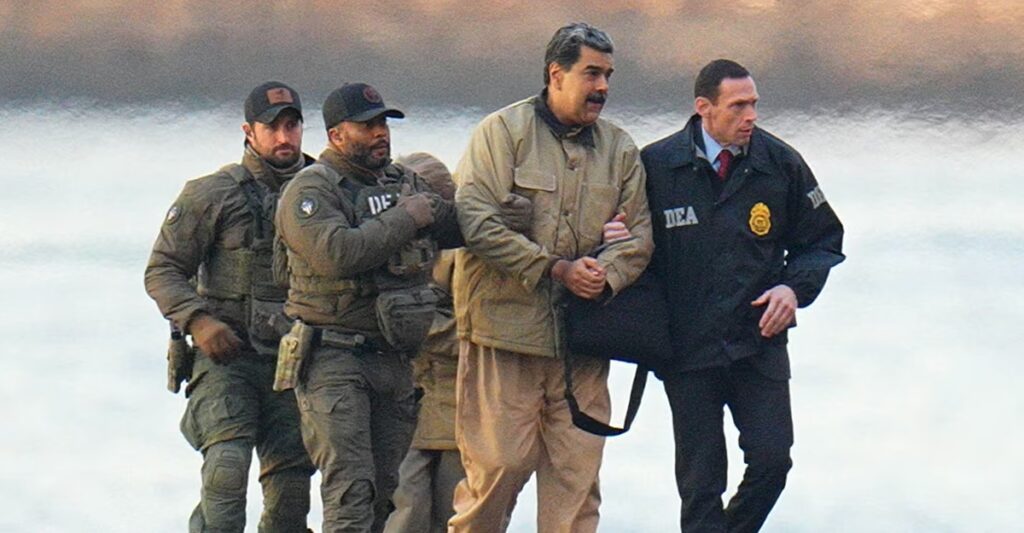
Maduro was, until Saturday, a widely hated ruler. His last election campaign consisted of threatening his people with a “bloodbath” if he lost. (Even so, he lost, but he claimed victory anyway.) The two crowds outside the courthouse mirrored the split reaction following Maduro’s capture by the United States. For many international observers, his ouster was cause for alarm—a sign that a U.S. president can drop bombs abroad and kidnap a foreign leader without a declaration of war or congressional approval. But for so many Venezuelans, the sight of Maduro in shackles was about a tyrant facing justice.
Before the hearing began, the hallway outside the courtroom was packed with people hoping to get a seat. Some were law students who had come because they sensed that a legal precedent was being set, though not necessarily a good one. The way Maduro was captured “puts the system of international law in danger,” Leo Enderle, a German student at NYU, told me. Another group of people had come for the sheer spectacle. The man standing in front of me said he had attended the arraignments of Sean Combs and Donald Trump in the same building; according to him, this crowd was just as big. When I arrived, he was outraged that a Venezuelan man had cut in line to join a friend. The Venezuelan explained that he had been a political prisoner for years and had dreamed of this moment. Just because you were a political prisoner, the man in front of me was lamenting, doesn’t mean you get to cut the line.
[Read: The Venezuelan opposition’s desperate gamble]
But by far the largest group of attendees I spoke with were Venezuelans who wanted to see Maduro punished. The last time I had stood in line with so many Venezuelans angry at Maduro was in 2013, when I still lived in the country, in one of the infamous breadlines that resulted from rationing. Then, like now, people were very talkative. At the courthouse, an elegantly dressed woman from Caracas told me she had left her newborn granddaughter at home with a nanny. “This historical moment, I couldn’t miss it!”
David Cardenas, a Venezuelan opposition activist, told me that Maduro had singled him out on TV one day, threatening to send police to his house and jail him as part of “Operation Knock-Knock.” Soon after, Cardenas, who lives in the United States, posted a video saying Maduro would be the target of Operation Trump-Trump. “I guess Trump-Trump came before Knock-Knock,” Cardenas told me with a smile.
Elsewhere in line, a young woman I’ll call Maria had come to the courthouse with her mother, who was visiting from Venezuela for the holidays. (She asked me to withhold her name for privacy concerns.) Maria told me that nobody she knew in America could understand why she was excited to see Maduro arrested: “My friends are like, ‘This is imperialism!’ and ‘So sorry Trump did this to your country!’” When one of her housemates told her they were thinking of going to protest Maduro’s capture, Maria responded that not every prisoner deserves sympathy.
After we were seated in the courtroom, Maduro walked in, escorted by guards. Instead of his usual button-down, he wore a navy-blue T-shirt, with an orange one peeking out from underneath. Maduro scanned the audience as though he were looking for a friendly face, but he didn’t seem to find one. “Buenos días,” he said to no one in particular, and sat down.
[Read: The biggest question about Venezuela]
“Are you Nicolás Maduro Moros?” the judge asked.
Maduro responded in Spanish, as he would throughout the hearing. “I am Nicolás Maduro Moros, the constitutional president of Venezuela,” he said, and went on to explain that he’d been kidnapped by the United States. He called himself a “prisoner of war.” Visibly impatient, the judge suggested that Maduro should respond with a simple yes or no. “Are you Nicolás Maduro Moros?” the judge asked again. “I am Nicolás Maduro Moros,” he responded.
The judge then read the charges aloud: narco-terrorism conspiracy, cocaine-importation conspiracy, and two others related to weapons. Maduro pleaded not guilty, adding, “I’m a decent man and still the president of Venezuela.” Once again, the judge told Maduro to keep his answers succinct, before addressing Maduro’s wife, Cilia Flores, who was sitting nearby wearing the same outfit.
The judge told Maduro that, as a foreigner facing trial in the United States, he had the right to consulate resources. But Maduro himself had effectively closed Venezuela’s consulates when he recalled the country’s diplomats from the United States in 2019, leaving more than half a million people without representation. It’s unclear, then, exactly what resources Maduro will have access to.
As the hearing finished and Maduro stood to leave, spectators jeered at him in Spanish, a liberty that—had they taken it in Venezuela just last week—would probably have landed them in prison, or worse. “Have fun in jail,” one said. “On behalf of all Venezuelans, you will pay,” shouted another. One woman was even more blunt: “Damn you.”
The post ‘Have Fun in Jail’ appeared first on The Atlantic.