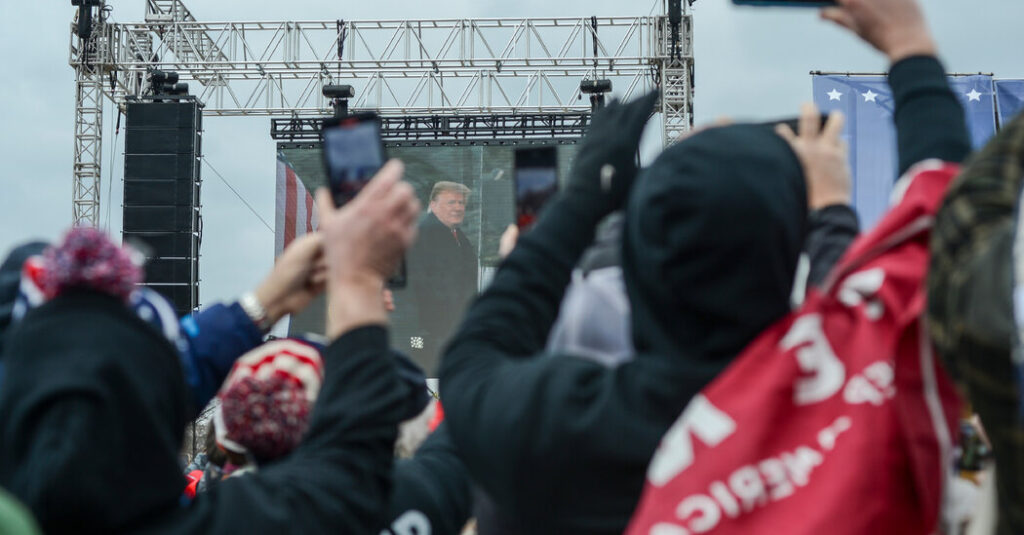
Over the past year, President Trump has engaged in a steady campaign to rewrite the history of Jan. 6, 2021, attack on the Capitol, when his supporters, believing lies of a rigged election, smashed windows and doors and assaulted law enforcement officers.
His revisionist history is taking on new significance ahead of this year’s midterm elections — and could carry more weight if Republicans lose control of Congress, which the president has said he believes may happen.
On Tuesday, the five-year anniversary of the Jan. 6 attack, Mr. Trump was again seeding doubt about the integrity of American elections. “Our elections are crooked as hell,” Mr. Trump told congressional Republicans.
Offering a glimpse into his concerns about an election loss in the midterms, Mr. Trump said Republicans needed to retain control of the House because he expected to face a third impeachment trial if Democrats won. He said he would not call for this year’s election to be canceled because critics would accuse him of being a dictator.
“They’ll find a reason to impeach me,” Mr. Trump said. “I’ll get impeached.”
Also on Tuesday, the Trump administration created a new page on the White House website attempting to rewrite the history of the riot, blaming congressional Democrats and former Vice President Mike Pence for standing up to falsehoods about the 2020 election and allowing it to be certified. Mr. Pence, the webpage claimed, was guilty of “cowardice” for refusing to subvert the will of the voters to keep Mr. Trump in power on Jan. 6, 2021.
It was the latest turn in a year in which Mr. Trump has attempted to rewrite election rules, take control of state and local election systems and offered support to those who promote election conspiracy theories. He granted clemency to all of the nearly 1,600 people charged in connection with Jan. 6, including assailants of law enforcement officers and the leaders of right-wing extremist groups.
He installed those who challenged the legitimacy of the 2020 election throughout his government, and he ordered investigations into and retribution against those who investigated the Jan. 6 attack. He even targeted those who merely stated that the election wasn’t rigged, such as Chris Krebs, the former cybersecurity official in Mr. Trump’s first term who said that the 2020 election had been conducted securely.
Michael Waldman, president and C.E.O. of the Brennan Center for Justice at the New York University School of Law, said the president’s “obsession” with the 2020 election served a significant purpose: “It lays a predicate for trying to undermine the 2026 election.”
A New York Times review of Mr. Trump’s public statements found more than 150 instances in the past year in which he falsely claimed he had won the 2020 election, portrayed Jan. 6 rioters as victims and denigrated investigators of the Capitol riot.
His campaign to rewrite the history of Jan. 6 was often overshadowed by major policy moves: Sweeping tariffs on goods across the globe, troops dispatched into American cities, missile strikes on foreign lands.
But time and again, he would come back to 2020 — often unprompted.
“They didn’t assault,” Mr. Trump said of the Jan. 6 rioters on Feb. 9. “They were assaulted.” In reality, more than 150 police officers were injured during the Capitol violence.
Even this weekend, as the United States was carrying out a military operation to arrest the president of Venezuela, he was still fuming over his 2020 loss to Joseph R. Biden Jr.
Mr. Trump repeatedly posted on social media over the weekend, sharing wild conspiracy theories about American elections, including that the C.I.A. rigged his election loss; that widespread fraud may have stolen state-run elections from him in Georgia and Pennsylvania; and that election machines made by Dominion Voting Systems were somehow in on the plot — all claims that have been repeatedly disproved.
“One of the objectives of Donald Trump’s return to power has been to launch a campaign of historical revisionism to change, to attempt to change, the undisputed facts of what happened on Jan. 6, and that has included stacking his administration with election deniers,” said Norm Eisen, a former ambassador who worked with House Democrats on Mr. Trump’s first impeachment.
Instead of focusing on Mr. Trump’s statements about the 2020 election, a White House spokeswoman said, the news media should pay more attention to his successes in office.
“The media’s continued obsession with Jan. 6 is one of the many reasons trust in the press is at historic lows — they aren’t covering issues that the American people actually care about,” said Abigail Jackson, the spokeswoman. “President Trump was resoundingly re-elected to enact an agenda based on securing the border, driving down crime and restarting our economy — the president is delivering.”
But Mr. Trump himself has talked about Jan. 6 and the 2020 election repeatedly, often bringing up unfounded grievances while speaking about unrelated topics, the Times review shows.
In March, on Air Force One, while speaking about Iran, Mr. Trump claimed the 2020 election was “rigged.”
In April, speaking about Russia’s invasion of Ukraine, he again referenced the 2020 election.
“You have millions of people dead that shouldn’t be dead. Think of it. Think of what a rigged election means,” he said. “We would’ve had absolutely — We wouldn’t have had the war in Ukraine.”
In August, at a Kennedy Center event, he claimed he won the 2020 election by a landslide.
“We had a great election in 2020. We won the election by a lot, but it was a rigged election and we had to wait four years,” he said.
Mr. Trump has done more than talk. He has rewarded those who helped perpetuate claims of a stolen election.
For example, Mr. Trump named Ed Martin, who helped raise money for Jan. 6 defendants, to a top Justice Department post to go after Mr. Trump’s perceived enemies, including prosecutors, F.B.I. agents and members of Congress who investigated the events of Jan. 6.
Harmeet Dhillon, who challenged the results of the 2020 presidential election, now runs the Justice Department’s Civil Rights Division.
Heather Honey, an election denial activist, is now the deputy assistant secretary for Election Integrity at the Department of Homeland Security.
And Kurt Olsen, a lawyer who has worked closely with Mike Lindell, the chief executive of MyPillow and a Trump ally, to promote stolen-election theories, has been tasked with examining the 2020 vote and other election matters.
Other powerful figures in the G.O.P. have followed Mr. Trump’s lead.
Republican leadership in Congress have declined to hang an official plaque honoring the law enforcement officers who defended the Capitol, even though it is required to be hung by law. And they have also established a new select subcommittee to investigate the Jan. 6 attack on the Capitol, continuing the party’s efforts to rewrite the history of the riot.
Those efforts have, at times, been met with pushback.
Jack Smith, the former special counsel, defended his decision to twice indict Mr. Trump, accusing him of “exploiting” the violence on Jan. 6, 2021, to overthrow the 2020 presidential election, according to a transcribed interview released on New Year’s Eve.
“Our investigation developed proof beyond a reasonable doubt that President Trump engaged in a criminal scheme to overturn the results of the 2020 election and to prevent the lawful transfer of power,” Mr. Smith said, according to the transcript.
Luke Broadwater covers the White House for The Times.
The post Five Years On, Trump Keeps Pushing Jan. 6 Conspiracies appeared first on New York Times.