Over the course of a few hours on Monday, the sea ice changed completely.
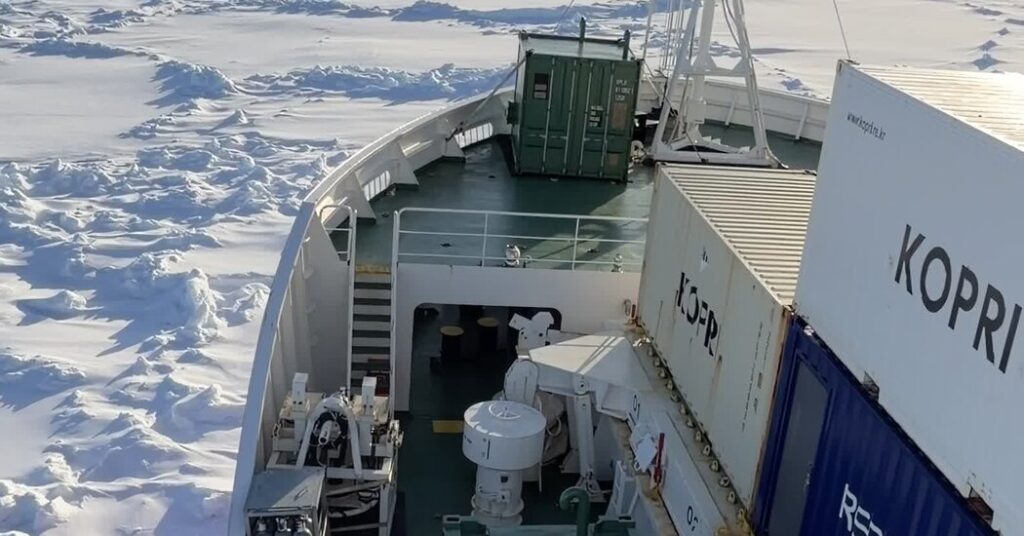
No longer was it disconnected plates that you could plausibly walk across. Instead, it was a huge icy plain in all directions, as if the ship were sailing atop snow-covered land.
Before, the floes had been dynamic, bumping and jostling against one another as the wind pushed them around. Now, the world around us was stock-still, as if physics itself had been suspended. Even the giant icebergs looked trapped, unable to break the hold of the much punier-looking sea ice around them.
On Monday afternoon, as the Araon was barreling through the sea-ice zone with ease, I found Won Sang Lee, the chief scientist on our expedition, gazing out the windows of the bridge. We had been so lucky on this trip, I told him. No storms, minimal swells. And no impassable sea ice.
Dr. Lee was unmoved. “It’s like we’re about to face the real challenge,” he said.
He was right. By evening, our ship was fighting the same foe that has tested generations of polar explorers: impenetrable sheets of frozen sea.
The ship’s captain, Kim Gwang-heon, and its ice pilot, Lim Chaeho, paced about the bridge, looking out across the ice for weak points that might give us a path out of this frozen expanse. They took the ship forward and backward. They eased into gaps and nudged the bow side to side to clear away ice. When the ship could advance no farther, they executed the nautical equivalent of a three-point turn.
The bridge was as quiet as a library. Nobody seemed stressed, even as the ship quaked and juddered as it scraped against the ice. Icebreakers are built with reinforced hulls and extra-powerful engines to handle environments like this. But the actual work of breaking ice remains quite blunt and brutal, boiling down to throwing the ship’s weight around in carefully considered ways.
Captain Kim has a steely, Clint Eastwood squint and a taciturn manner to match. His commands to the sailors at the controls were never anything but calm.
“Starboard 20.”
“Starboard 20, sir.”
“Midships.”
“Midships, sir.”
“Hard to starboard.”
“Hard to starboard, sir.”
A few hours before, the ice floes around us appeared on the radar screen as distinct dots. Now the display looked like a Jackson Pollock splatter painting.
Outside the bridge’s windows, the only moving things were the animals. Snow petrels swooped and dived. Here and there, groups of penguins were on the ice doing normal penguin things: waddling, kissing, flopping onto their bellies to slide.
By Tuesday morning, conditions had gotten even worse. It was snowing and windy. The blowing flakes had obliterated not only the horizon, but everything beyond a few hundred feet. We were zigzagging through a realm of pure, blinding white.
For now, none of the scientists are talking about changing our destination, the fastest-melting glacier in Antarctica, the Thwaites. The start of field work has obviously been pushed back. Our fate is in the captain’s hands, just as it’s been since we set sail.
Raymond Zhong reports on climate and environmental issues for The Times.
The post Fighting Through the Ice appeared first on New York Times.