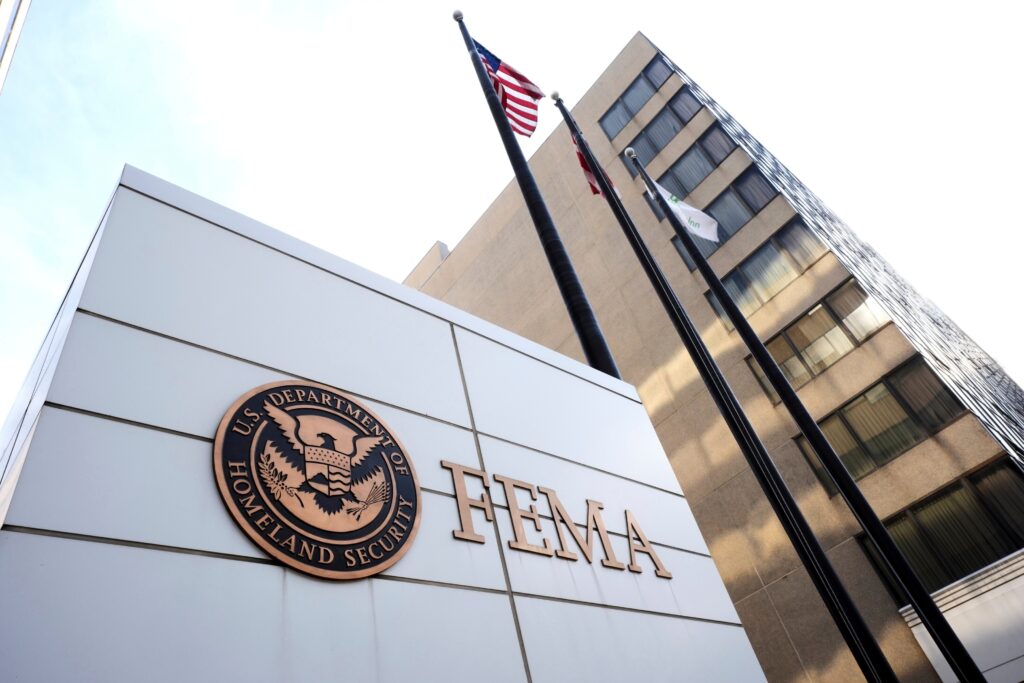
The Department of Homeland Security has drafted plans to drastically cut the Federal Emergency Management Agency workforce in 2026, according to documents obtained by The Washington Post that detail potential reductions to thousands of disaster response and recovery roles.
The terminations are likely to come in waves, according to three people familiar with the plans who, like some others interviewed for this report, spoke on the condition of anonymity for fear of retribution. They said the cuts began on New Year’s Eve with the elimination of about 65 positions that were part of FEMA’s largest workforce, known as the Cadre of On-Call Response and Recovery (CORE) — staffers who are among the first on the ground after a disaster and often stick around for years to help communities recover.
Independent journalist Marisa Kabas and CNN earlier reported a portion of the New Year’s Eve cuts.
Emails sent to senior agency leadership in late December include detailed tables identifying roles that can be cut from the agency’s divisions. These tables include a 41 percent reduction in CORE disaster roles, amounting to more than 4,300 positions. They also list reductions in surge staffing, standby workers who are often the first on the ground when a disaster strikes, by 85 percent, or nearly 6,500 roles.
In a statement, FEMA spokesperson Daniel Llargués said the agency has “not issued and is not implementing a percentage-based workforce reduction.”
“The materials referenced from the leaked documentation stem from a routine, pre-decisional workforce planning exercise conducted in line with OMB and OPM guidance,” Llargués added. “The email outlining that exercise did not direct staffing cuts or establish reduction targets.”
Homeland Security Secretary Kristi L. Noem has long wanted to cut back on CORE staffing, according to two former senior officials.
Losing a large number of disaster-specific workers over a short period “would mean greater delays in processing and survivors not being dealt with as quickly as they had been before,” said Cameron Hamilton, who led FEMA as acting administrator in the early months of President Donald Trump’s second term.
Internal agency emails and documents, as well as people familiar with the plans, suggest Noem is spearheading the drastic reductions, which may impede FEMA’s ability to fulfill its legal obligation to help the nation respond to disasters, according to three FEMA officials.
Noem, who has exercised a tight grip over FEMA since taking over its parent department, has repeatedly expressed a desire to shrink or eliminate the agency. The Post reportedthat she previously made recommendations to cut agency staffing by about half.
Although the documents call the staffing reduction an “exercise” and say “no staffing actions or personnel decisions are being directed or implemented as part of this request,” two officials familiar with the situation said the tables reflect Noem’s targets for the agency.
An email describes the tables, which list total reduction counts and percentages for most of the agency’s divisions, as a “planning document.”
Llargués said in FEMA’s statement that the “accompanying spreadsheet was an internal working tool used to collect planning inputs.”
The emails show that there have been “deliberate” discussions regarding workforce reductions, said a person familiar with them, who added that the documents request “senior leadership to review and ensure that whatever staff is retained is absolutely necessary.”
DHS has said publicly that it terminated 50 people in early January and that the cuts were “a routine staff adjustment of 50 staff out of 8000.”
Two officials with knowledge of the process said that number is closer to 65. The officials had been told to expect that hundreds more people would lose their jobs by the end of January. CORE staffers whose jobs were supposed to be renewed this week still have not heard anything about their status, officials said.
Llargués said the New Year’s Eve cuts were unrelated to the “planning exercise described in the leaked email.”
The potential for additional cuts come less than a year after a wave of FEMA terminations, including of hundreds of probationary employees. FEMA officials are also awaiting a final draft of a report by a Trump-appointed review council on the agency’s future, which was supposed to be released last month. The Post previously reported that a version of that report recommended making FEMA leaner but also more independent — findings that countered recommendations from Noem, the council’s co-chair.
Three FEMA officials raised concerns about the rapid and drastic dismantling of the agency workforce.
Under the Post-Katrina Emergency Management Reform Act, the homeland security secretary is prohibited from taking actions that “substantially or significantly reduce the authorities, responsibilities, or functions” of FEMA.
“It’s not just unprecedented — it directly contradicts the law,” said a veteran FEMA official who has also worked within DHS.
Having the head of DHS determine the fate of disaster response roles “strips FEMA leadership of its statutory authority and puts control of the nation’s disaster workforce in the hands of a department that Congress explicitly told to step back after Katrina,” that person added.
Emergency management historian Scott Robinson said cutting FEMA’s staffing at these levels “would [undo] an act of Congress without an act of Congress.”
“The president is using a lot of administrative tools to try and do things we would have traditionally expected legislation to do,” Robinson said.
There are about 17,500 CORE employees spread across the country — the majority of FEMA’s workforce of 22,316, an agency official said. Under the Stafford Act, FEMA hires these staffers for multiyear terms using the disaster relief fund.
CORE teams partner directly with state and local officials to support ongoing response and recovery after a hurricane strikes or a fire tears through a town. They may move resources from warehouses to hard-hit communities; they process grants and conduct trainings. Some staffers were working on long-term projects related to Hurricanes Sandy, Maria and Fiona. CORE teams also include lawyers, IT experts and others who may help oversee nuclear plant operations or help in hazard reduction for earthquakes.
For example, in a region that includes Texas, Louisiana and more than 60 tribal nations, about 80 percent of the FEMA staffers deployed in support roles are CORE employees, a former senior official said.
Ongoing discussions to downsize FEMA also underscore how much autonomy the nation’s emergency management agency has lost since the start of Trump’s second term. FEMA has been without a congressionally appointed leader for nearly a year, cycling through temporary officials who have lacked disaster management experience, which is required by law to lead the agency. After David Richardson resigned in November, DHS tapped its chief of staff at the time, Karen Evans, to act as the agency’s interim administrator.
An agency official familiar with the discussions said Evans has been part of conversations about the future of this disaster-specific workforce for the past few weeks, including about whether to extend positions for a month or two until the agency has had enough time to review the need for the roles. But the official said it seemed that Noem was making the final decision.
As documents detailing workforce cuts made rounds within the agency over the past week, FEMA officials were stunned and pointed out that getting rid of nearly half of the nation’s disaster workforce would greatly harm communities in various stages of disaster recovery. States would need much more time to prepare and bolster their own disaster capabilities before the federal government significantly pulled back resources such as CORE employees.
“The entire framework of a reduction should be built on stronger state partnerships, not knee-jerk reactions from the federal government,” Hamilton said.
CORE appointments are typically renewed every two to four years. When the end of an employee’s contracted term approaches, their supervisors submit paperwork to renew those roles and send it up the chain. Most of the positions are usually reinstated, according to four current and former FEMA officials, in part because recovery work is long and complex.
In mid-December, DHS took away FEMA’s authority to independently renew these positions, and it instituted a hiring process that requires Noem to review all CORE positions and help decide whether they should continue to exist, according to emails and a person familiar with a meeting where these new requirements were discussed.
An email from Dec. 17 described how Noem — often referred to as “S1” in internal DHS and FEMA conversations and documents — created parameters for keeping the CORE employees.
“To improve DHS review outcomes, each CORE term renewal justification must be written to fit what the S1 verification form is designed to capture,” it said.
Noem overseeing hiring for disaster-specific employees “is completely outside the norm,” said the veteran FEMA official who also served within DHS. “CORE renewals have always been handled inside FEMA, as Congress intended under the Post-Katrina Emergency Management Reform Act.”
The new system created year-end confusion as supervisors scrambled to send in detailed letters justifying a variety of positions.
For example, in one region with 40 CORE employees whose jobs were to be renewed in January, supervisors sent lengthy justification notes for about 35 of those workers. That same day, they were told to trim the letters and send them again.
They heard nothing in response, until they learned on Dec. 31 that they would lose nine employees “regardless of the recommendations of emergency management experts,” one official familiar with the situation said. The fate of the rest is unknown, a supervisor said. He said he was also told “there was no plan” to extend any other CORE employees whose jobs were supposed to be renewed this month.
It is unclear whether FEMA or DHS took the justification memos into account.
In the last weeks of December, the office was inundated with hundreds of these justification memos, including statistics and data meant to explain why specific roles were crucial to FEMA’s mission to help communities recover from disasters.
Then, on New Year’s Eve, human resources staffers were told to inform people they had lost their jobs, according to a person familiar with the situation and memos obtained by The Post. Some CORE staffers learned they were fired on New Year’s Day while on vacation, and they were asked to send in their equipment by Jan. 2.
Several agency officials who supervise CORE team members were shocked when they learned that numerous employees had suddenly lost their jobs, emails show.
“This must be a mistake,” one supervisor wrote to FEMA’s HR services and other officials, explaining that they had approved their employee’s renewal and sent the paperwork through the proper channels.
Another supervisor overseeing recovery work for Hurricane Helene expressed concern and confusion over losing a staffer, stating in a New Year’s Eve note to human resources that “based on the attached emails and form,” the worker’s “appointment should be renewed.”
“I would like to resolve this ASAP, as this is a disappointing and confusing email to get right before a holiday,” the supervisor said.
In response, a top human resources official said the situation was essentially out of their hands.
The post Emails outline potential cuts affecting thousands of FEMA disaster responders appeared first on Washington Post.