TAIPEI, Taiwan — President Donald Trump’s dramatic move to seize Venezuelan leader Nicolás Maduro could ultimately benefit China in its competition with the United States, analysts say, even though Beijing has forcefully condemned the military intervention.
The surprise American attack early Saturday provides China an opportunity to promote itself, by contrast, as a responsible global power while also making it easier for Chinese officials to forcefully assert their own interests in their backyard, including in Taiwan, according to security and political analysts.
“If you are headed toward a world where great powers can use force and use power ruthlessly in their own neighborhoods … that precedent is not entirely a bad one from China’s perspective,” said Hal Brands, a professor at the Johns Hopkins University School of Advanced International Studies and former official in the U.S. Defense Department. “It fits with the way that Beijing would ultimately like to behave in places like the South China Sea or the Taiwan Strait.”
China has been waging an intensifying campaign aimed at pressuring Taiwan, an island off China’s coast that Beijing claims as its own. Chinese leader Xi Jinping has made “reunification” with Taiwan a major goal and has been deploying increasing numbers of warplanes and ships around Taiwan. Just last week, China launched massive military drills to simulate a blockade of the island.
China has also grown more assertive in the South China Sea in recent years, igniting tensions with countries such as the Philippines by pressing claims to disputed territory in the waterway.
By carrying out the military strike on Venezuela, the U.S. government has also undercut its ability to muster an international response to a potential attack on Taiwan, said Steve Tsang, director of the SOAS China Institute in London. Chinese officials worry that an assault on Taiwan would provoke a “united response” by the world’s democracies but now, “everything that is being said about the importance of defending Taiwan is being undermined by the lawlessness of Trump in the attack on Caracas,” Tsang added.
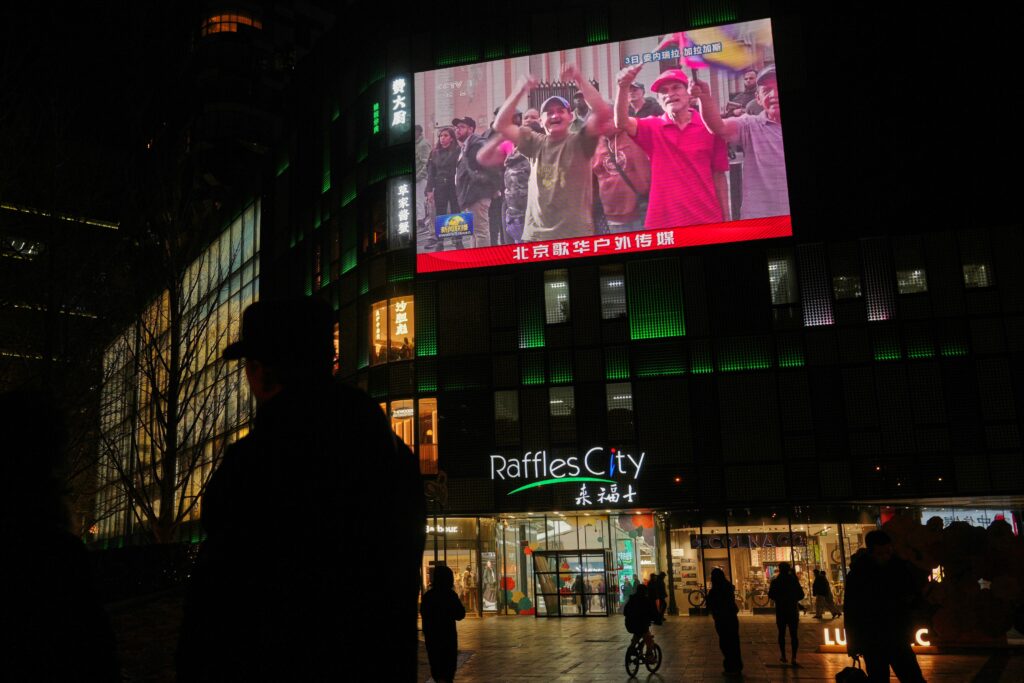
China’s Foreign Ministry spokesperson Lin Jian said Monday that China was “deeply shocked” by the “blatant use of force against a sovereign state” and called on the U.S. to release Maduro and his wife. Chinese state media joined the criticism, with the official news agency Xinhua, for example, saying that Washington’s “true colors are revealed,” returning “the world to a barbaric colonial era of plunder.” Xi himself warned Monday that “unilateral bullying is severely impacting international order.”
China’s strong reaction in part reflected its close diplomatic and economic relationship with Venezuela. Beijing has offered a lifeline to Maduro’s embattled regime by providing loans to the country and buying the majority of Venezuela’s oil exports amid U.S. sanctions.
Just hours before he was captured, Maduro had met with a high-level delegation of Chinese officials in Caracas, led by Beijing’s special envoy for Latin American and Caribbean affairs, Qiu Xiaoqi.
Zhao Minghao, deputy director of the Center for American Studies at Shanghai’s Fudan University, said Chinese officials are watching developments in Venezuela closely for clues about Trump’s geopolitical thinking.
One takeaway is his “desire to revitalize and enhance [American] control over the Western Hemisphere,” Zhao said, adding that it’s also clear that Trump “is driven by practical interests,” such as controlling Venezuelan oil resources, rather than “an ideological or naive narrative of democracy replacing authoritarianism.”
Some on the Chinese internet have been eager to suggest that China should exploit this apparent return to a world of competing spheres of influence and plan a similar attack on Taiwanese President Lai Ching-te. One commentator on the Chinese social media site Weibo, for instance, wrote on Saturday that “the Venezuelan situation offers a possible solution for unifying Taiwan: first, conduct special operations to arrest Lai Ching-te, then immediately declare the takeover of Taiwan.” The post quickly racked up more than 2,500 likes.
But Zhao said he doubted that the U.S. attack on Venezuela would affect how China approaches Taiwan, since Chinese officials consider the status of Taiwan to be an internal issue. He said Beijing has its own “consistent” set of policy considerations regarding Taiwan.
Nor does everyone in China agree that Trump’s norm-busting behavior is beneficial for China. Analysts in Beijing suggest that any damage to a rules-based international system will hurt China.
“This American mindset is indeed rooted in traditional spheres of influence … [and] it poses a significant challenge to the international community, including China,” said Niu Haibin, a Latin America expert at the Shanghai Institutes for International Studies. “China absolutely does not agree with or accept the practice of dividing spheres of influence. Nor will it construct an American-style sphere of its own.”
Drew Thompson, a former Pentagon official focused on China, said the sophistication of the American operation, which effectively combined different military services, would not be lost on Chinese officials.
“The U.S. government can bring all aspects of its power to operate jointly,” said Thompson, who is now at the S. Rajaratnam School of International Studies in Singapore. This stands in contrast to China, where the military’s “systems integration has always been a weak point,” he added, especially after high-level military purges in Beijing.
In Taiwan, there has also been a mixed response to the U.S. attack on Venezuela.
“On the one hand, of course, there are some voices that are [saying] that the U.S. is not a good actor because it violated the international order that, in some way, it helped establish after World War II,” said Yang Kuang-shun, co-founder of US Taiwan Watch, a think tank. This could further fuel skepticism about the U.S. in Taiwan, he said, at time when there is rising concern among Taiwanese about whether they can count on American protection.
On the other hand, Yang added, the attack demonstrated American willingness to decisively use force beyond its borders, giving hope to some Taiwanese that the U.S. would come to their aid. Taiwan relies on Washington for unofficial support under its policy of strategic ambiguity, which does not clarify whether it would intervene in a conflict with China.
Taiwan’s Ministry of Foreign Affairs, in a comment to The Washington Post, said it is monitoring the situation in Venezuela and “will continue cooperating with the U.S. and other democratic partners” on global security.
The Chinese government’s support for Venezuela in recent years is part of a broader campaign by Beijing to forge closer ties in Latin America. A white paper released last month outlines China’s political, security, and economic engagement with the region aimed at raising cooperation to a “new level.”
Chinese Foreign Ministry spokesperson Lin Jian indicated Monday that the effort would not be interrupted by Maduro’s ouster. “No matter how the international landscape may evolve, China will always be a good friend and partner to Latin America and the Caribbean countries,” he said.
But Victor Shih, director of UC San Diego’s 21st Century China Center, said the U.S. intervention in Venezuela could deal a serious blow to Chinese influence in the region. “If Venezuela transforms into a fundamentally pro-U.S. regime, that will be a setback for China’s Latin American ambitions,” he said.
If the U.S. is drawn into a prolonged entanglement in Venezuela, however, this could open a door for China to move against Taiwan while American officials are distracted, said Tsang of the SOAS China Institute.
“They will probably want to wait and see whether the Americans end up in a quagmire in Venezuela first,” he said. “If that happens, [attacking Taiwan] would be much more of a temptation.”
The post China studying U.S. strike for lessons and opportunities, analysts say appeared first on Washington Post.