Cody Zervas was looking for his wife. He used to be engaged, but then his fiancée broke it off, and now he was ready to explore new opportunities. He desired a one-in-a-million match, which meant he needed to enlarge his dating pool.
Just before Valentine’s Day in 2022, he logged onto Twitter and offered a bounty of $20,000 to the person who introduced him to his future bride. The prize would increase each year until she appeared.
Mr. Zervas remains single, but his “wife bounty” found him another kind of partner. It led to an introduction to Jake Kozloski, the founder and chief executive of Keeper, a matchmaking start-up built around artificial intelligence. Now, Mr. Zervas is the company’s chief product officer, playing data Cupid for other straight people with exacting standards and money to spend. In November, he traveled to San Francisco to represent Keeper at Love Symposium, a freewheeling gathering of “earnest founders, experts, and intellectuals” with an interest in “proliferating healthy connection at scale.”
I reached out to Mr. Zervas when I saw him on the symposium schedule, promoting the idea of “love at first match.” He became my entry point to a certain way of thinking about human relationships: as problems that could be measured, optimized and solved.
Over the course of the weekend — and for $200 per person — attendees heard presentations on relationship outcome prediction technology, investigated “metarational” marriage practices and joined a flash matchmaking session at SF Commons, a shoes-off “fourth place” on the same street as a Salt & Straw and a Buck Mason.
Among them were an M.I.T.-trained philosopher-builder generating human digital “twins” for dating simulations; a woman plotting to print her own currency under the pseudonym Ayn Forger; a British “mind coach” who offers intuition sessions; a social media manager developing a religion for people with autism; and Ann Pierce, a start-up founder who organized the event.
Silicon Valley has been mediating human relationships for decades, reshaping our private lives with its speculative bubbles and ideological currents. Love Symposium, now in its second year, has emerged as the romantic discourse has reached a tenor of disaster. There is a marriage “crisis,” a loneliness “epidemic,” a demographic “collapse.” People are flirting with A.I. boyfriends and virtually undressing strangers on X.
Could more technology help?
Finding Love in a ‘Thinky Town’
Ms. Pierce greeted me at the Commons on a Friday afternoon in a red turtleneck dress, leading me past a hallway adorned with Hogwarts-house pendants to a couch secluded by rolling whiteboards. She told me that she once co-founded a start-up in the dating space that allowed users to upload photographs of themselves and receive crowdsourced ratings on how competent or fun they appeared.
After her co-founder bought her out of the company — around the time she divorced her husband of 10 years — she semiretired and took up an interest in the subject of interpersonal conflict.
Through Bay Area philosophy groups, she encountered Matthew Fisher, an A.I. researcher and engineer concerned with the loneliness of constant digital connection. The human intimacy “search problem,” as he called it, meant that compatible partners were swiping in obscurity, unable to find one another. He wanted the next technological wave to be “a bridge to other humans, not a Skinner box,” he said.
A URL was secured, and the symposium was born. They spread the word to relationship Substackers, Silicon Valley philosophers, dating app developers like Mr. Zervas and a loose community of hyper-intellectually curious posters on X.
“This is a very thinky town,” Ms. Pierce said. But new philosophical crosscurrents were emphasizing emotion, spirituality and the general idea that “we’re more than just a brain on a stick,” she said.
Ms. Pierce, 38, is a cerebral and warm host, and she prepared the space in an adorable style, punctuated by A.I.-generated images of robots and nymphs. The place felt like the setting for a quirky tale of nerds putting their heads together to find love.
But in the background was the buzz of seed funding and political power. Participants spoke of developing psychometrics to make objective measures of the mysteries of human relations, a promise of tenderness that could also devolve quickly into the brutal ranking of human beings.
People or Products?
At a coffee shop down the street from the symposium, I met Mr. Zervas and two of his Keeper colleagues, men in their early 30s who seemed to have dressed from a shared closet of preppy neutrals. Before he became Keeper’s chief business officer, Wes Myers shot missiles for the U.S. Army and earned an M.B.A. at the University of Pennsylvania. Hunter Ash, Keeper’s social media manager, posted frequently on X about what he described as an interest in psychology.
I told Mr. Zervas that when I looked him up online, I found a link to a request form titled “Anonymous feedback for Cody,” as if he were a customer service experience or a Burger King location. I asked him what the form was for.
“Anything. Any encounter you have with me,” he said. “Collecting and improving based on feedback is an important part of any process in life. If you’re trying to make a good product —”
“But you’re not a product,” I said.
“I’m reasoning by analogy,” Mr. Zervas said. “The worst thing would be to go through your life, having your life be shaped by forces that you don’t understand.”
Keeper’s goal is to understand its users so well that it can connect them with their soul mates on the first try.
And it has instituted a bounty of its own in order to “align incentives” between the company and its users. Singles who sign up for its $50,000 Marriage Bounty plan pay an introduction fee for each match, then the balance of the sum if a match leads to a long-term relationship.
The application, which can take hours to complete, asks users for their height, ancestral background, SAT score and their feelings about entrepreneurs. They can chose from an exhaustive list of political affiliations (conservative or progressive, Zionist or anti-Zionist, neoliberal or neo-Nazi) and select their partner’s “ideal” ethnicity. The system can assess their cheekbone prominence, jaw strength or body-fat percentage from a scanned photo, and analyze their application to estimate an IQ score.
Users who fail to make a match, or who bomb on a date, receive constructive feedback. “It wouldn’t say, ‘Lose 15 pounds,’” Mr. Myers said. “It would say that we know what type of person you are looking for, and the people you are looking for would be a match for you if you lost 15 pounds. So do with that information what you will.”
The system, the men say, is intended to go beyond a user’s “general mate value factor” to honor each user’s idiosyncratic desires. Mr. Ash, who writes in Keeper’s institutional voice on X, provided an example from his research.
“If the woman is about half a standard deviation more agreeable than the man, that’s the optimal point for relationship durability,” he said, to which I must have emitted an observable psychometric signal.
“Look at your face,” Mr. Zervas said. “You’re horrified.”
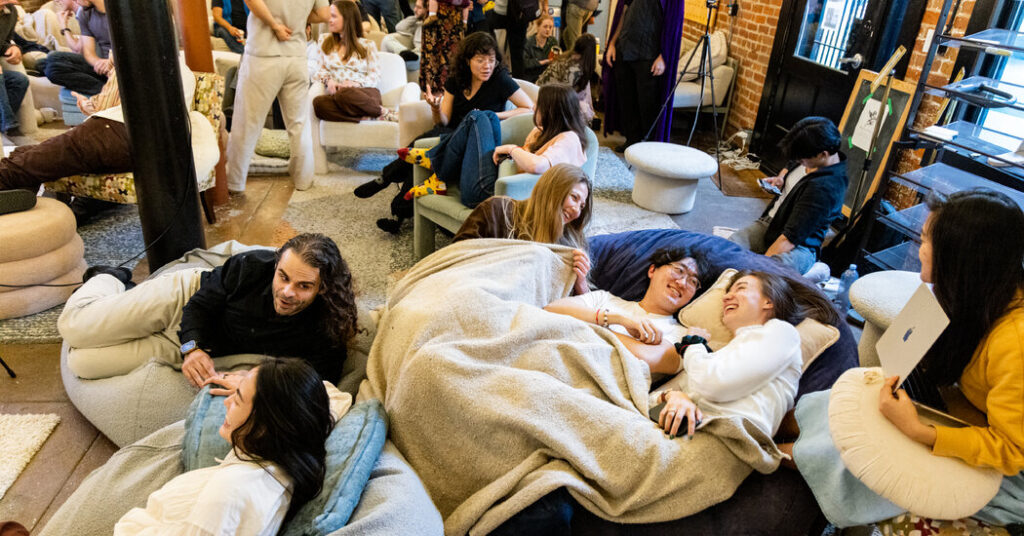
Later that evening, Mr. Zervas stood before an audience of around 80 people who settled into an expanse of cozy armchairs and fuzzy poufs. Keeper, he said, was working on the toughest cases in modern dating: Jewish woman seeks non-Jewish man who will convert for her; man with rare eye condition seeks woman with same; guy who invented his own political party seeks girl with similar views.
With an assist from A.I., he said: “You can effectively separate private value from common value, which will allow the human mating market to go from zero sum to positive sum for the first time in human history, which could unlock untold human well-being and happiness.”
A woman in the crowd raised a hand. She noted that one of Mr. Zervas’s slides had featured an image of a modelesque woman. She had been assigned an attractiveness rating of 8.6.
“If that was an 8, what’s a 10?” she said. “I’ve never seen a 10 if that’s an 8.”
“That was an example profile,” Mr. Zervas said. “Don’t base your entire Weltanschauung” — German for “worldview” — “on my slides.”
Can A.I. Help?
The talks continued for three days.
Other strategies for human flourishing were proposed and debated. Mr. Fisher, the researcher and engineer, spoke of highly personalized A.I. agents that could potentially work to match compatible people when they walked into a bar by “amplifying her laugh” from across the room or “slightly brightening the light above him when she looked his way.”
Geoffrey Miller, an evolutionary psychologist at the University of New Mexico who advises Keeper, suggested that monogamous human relationships could be threatened by A.I., but perhaps also strengthened by the development of artificial threesome partners. A human augmentation technologist, Dünya Baradari, proposed that social media data could be uploaded to an A.I. avatar that could court virtually on your behalf, reducing the chance of incompatible first dates. Mr. Miller wondered whether these avatars could be digitally aged, so that you could know what your date would look like when they get old.
Christine Peterson, a forecaster who coined the term “open source” software, delivered a talk on how “men and women should date differently,” a view she said was based on insights from human evolution. She described a protocol in which men pursued the women they most desired while women accepted numerous dates, never “chasing the boys” but delaying sex indefinitely until they had locked down an acceptable partner. Then she took questions.
“Honestly, your strategy scares me a little,” an entrepreneur in the audience named Quinn Sure said.
Dating as an Asian man in America, Mr. Sure said, had soured him on such status games, a sentiment that earned him approving snaps from the crowd.
“I prefer that someone just likes me for who I am,” he said. To which Ms. Peterson replied: “Oh, well!”
Mr. Sure, 35, told me that he’s developing an app that uses A.I. to facilitate friend groups among people with similar interests and vibes, eliding hierarchies and softening romantic pressures. He described it as finding your “soul buddy.”
When he lists himself on dating apps, he feels that all that his matches see is a 5-foot-6 Asian American man. “If they get to know to me as a tennis buddy, they might realize that I’m actually really patient, I’m nice, I am willing to teach people and I’d be down for grabbing a drink afterward,” he said.
Before artificial intelligence, before the internet, the computer-dating systems that emerged in the 1960s were forged along conservative social lines, seeking to match partners — assumed to be heterosexual — by race, class and education level.
“It was an attempt to make the technology seem more respectable, so that computer dating was not going to upset social hierarchies,” said Mar Hicks, a historian of technology at the University of Virginia. “The social implications are that the rich get richer, the powerful stay powerful, and they internally validate their frankly quite stupid ideas.”
As I learned more about Keeper, I came across the personal X account of Mr. Ash, its social media manager. I found that Mr. Ash had listed “I love eugenics” on his online dating profile, and that his ideas had recently attracted Elon Musk’s attention. As he posts online in Keeper’s voice about how the app’s “pro-family” technology can introduce you to a person “you love so much that you want to make more of them,” his personal account shares other views on family formation.
In May, he wrote that the United States could resolve its racial disparities by “preventing the bottom 25 percent of the overall population from breeding.” At the time, Mr. Kozloski, the Keeper chief executive, replied in a post: “Way too cruel. Everyone should be able to experience the joy of having a family. Better to encourage IQ selection in IVF and similar future technologies.”
When I asked Mr. Zervas about the comments, he said Mr. Ash’s views were not Keeper’s official position and that they didn’t necessarily reflect his own either. “But when you’re in the world of start-ups,” he continued, “and you’re trying to do something no one has ever done before, it comes with the territory. The people who are interested in developing something exciting and new may also have some out-there, edgy, or what I call ‘high openness’ perspectives.”
(Later, Mr. Ash sought to clarify his position: “I do not support any kind of mandatory sterilization,” he told me over email. “The purpose was to illustrate the general point that colorblind policies can result in group convergence over time.”)
‘A Little “Black Mirror”’
The Love Symposium was a place for selling apps and ideas, but also submitting them to skeptical inquiry. Some participants questioned how much this business of measuring people, ranking them by “mate value” and doing so “at scale” had to do with loving them.
“I don’t want people to rely on A.I. rather than their own inner guidance system,” said Georgina Dorothea, a mind coach and psychic who mingles in the post-rationalist community. “That’s where we lose autonomy over our own thoughts, our own will, on an extreme basis.”
“It’s a little ‘Black Mirror,’ this idea of an algorithm deciding who your soul mate is, and running simulations in the background to see if it will work out,” said Lana Li, referring to the Netflix series.
During her session, Ms. Li, who writes a Substack about data and dating called Love Me Like A Robot, presented her own lessons from a year of dating. When she surveyed a group of men she had casually dated, asking why things didn’t work out, she was surprised to learn how many mentioned her vaping habit and her messiness. “So I stopped vaping, and I stopped bringing men back to my apartment,” she said. Soon after, she met her current boyfriend, a messy man who vapes.
Ms. Pierce, the event organizer, finds herself somewhere in the middle. “It is really difficult to measure people,” she said. “And in the process of measuring people, you change people.”
On Sunday afternoon, Love Symposium organizers persuaded a couple who had met on Hinge and planned to go on their first date at a nearby coffee shop to instead stage the encounter in front of an audience. Mr. Fisher called it “a great reminder of the messy and emotional realities of the human experience of dating that we’re trying to improve.”
A research scientist and a stand-up comedian walked into a symposium. They were accidentally matching, in black jeans and gray long-sleeve shirts. They sat on a couch at the front of the room, their legs almost touching. We watched them negotiate their connection, trying to figure out if they liked each other and how much they ought to show it. Then we interrogated them.
“What are your relationships with your mothers?”
“Do you want kids?”
“Somebody open a prediction market!”
“We would like it if you slow-danced for us,” Ms. Pierce said.
They assumed the standard position. The audience felt giddy with the possibility that we could engineer a romance with a few simple commands. When the symposium ended, they decided they were better off as friends.
Amanda Hess is a writer at large for The Times.
The post Can You Optimize Love? appeared first on New York Times.