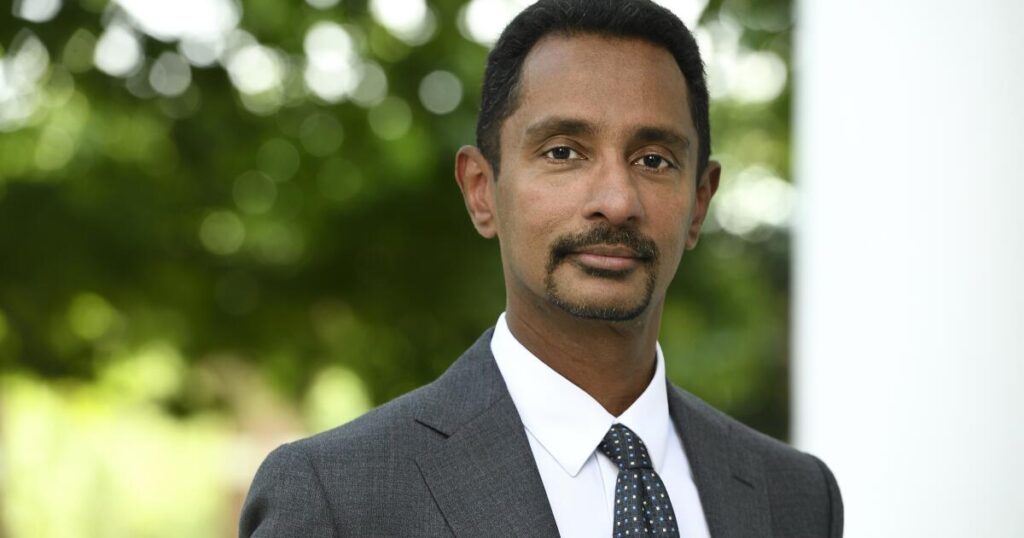
Ray Jayawardhana, an astrophysicist and provost of Johns Hopkins University, will become the next president of Caltech — one the nation’s wealthiest and most elite universities — as it enters a second year of challenging terrain amid Trump administration cuts to scientific research.
The campus’ board of trustees announced the appointment Tuesday morning after a months-long search to replace President Thomas F. Rosenbaum, who said in April that he would step down.
Jayawardhana will take the helm of the 134-year-old campus — which has produced numerous scientific breakthroughs and dozens of Nobel laureates — on July 1. The 124-acre Pasadena university has more than 300 faculty and roughly 2,400 students.
Caltech also operates NASA’s Jet Propulsion Laboratory in La Cañada Flintridge, which struggled with hundreds of layoffs last year.
In a statement, trustees Chair David W. Thompson said that “the board’s unanimous decision reflects our confidence in Ray’s ability to chart Caltech’s future — advancing our mission, inspiring our community, and elevating the Institute’s global impact.”
Thompson called Jayawardhana “a leader of exceptional distinction who brings a complement of qualities — as a pioneering astrophysics researcher, respected university administrator, and compelling science communicator — that together will ensure Caltech builds on its legacy of transformational research and exploration to benefit humanity.”
Born in Sri Lanka, Jayawardhana has been in his role at Johns Hopkins since 2023. He was previously at Cornell University, where he became the College of Arts and Sciences dean in 2018 after four years as a science, physics and astronomy professor at York University in Toronto.
Jayawardhana, who has also held positions at the University of Toronto, University of Michigan and UC Berkeley, has a PhD in astronomy from Harvard University and completed his undergraduate studies at Yale.
Research universities face challenges
Jayawardhana acknowledged the federal funding challenges facing Caltech and other major research institutions, as well as rapid developments in artificial intelligence and other technological advancements that are changing the higher education landscape.
In June, the campus joined 14 universities and education organizations in suing the Trump administration over a policy to reduce overhead funding grants from the National Science Foundation and other agencies that could cost Caltech up to $70 million a year in losses.
“We are in a moment of inflection; one marked by dramatic change and immense possibility,” he said in a statement. “It’s a moment that calls for Caltech’s distinct contributions and leadership.”
He said his goal is to “stay true to Caltech’s North Star of fundamental research and exploration integrated deeply with education.”
Jayawardhana said Caltech’s achievements are rooted in its “deceptively simple formula: empowering brilliant minds to explore important questions with imagination and courage and making bold commitments to efforts others might consider too risky or far-fetched.”
In selecting Jayawardhana — an expert in the origins of planets and planetary systems — Caltech leaders said they sought someone with deep academic and administrative experience.
“We heard that the community was looking for a strong communicator; an individual who has a record of leading with integrity, courage, and creativity; a leader who possesses the ability to be an effective steward of JPL,” said Jonas Zmuidzinas, a professor of physics and search committee chair.
President Rosenbaum’s legacy
Rosenbaum, who has lead the university for a dozen years, will remain as a faculty member.
Under his leadership, Caltech’s endowment doubled to more than $4.1 billion. Rosenbaum oversaw a five-year capital campaign in 2016 that raised $3.4 billion from 14,500 donors; more than half those funds went toward the endowment.
In a major scientific breakthrough in 2015, Caltech and MIT scientists at the vaunted LIGO lab — short for Laser Interferometer Gravitational-Wave Observatory — for the first time detected gravitational waves from the collision of two black holes, fulfilling a prediction Albert Einstein made a century prior. The scientists received the Nobel Prize in Physics in 2017.
Rosenbaum guided the campus through financial and enrollment challenges during the COVID-19 pandemic and saw Caltech institute new diversity recruitment efforts. In fall 2024, the university made history: For the first time, more than half the new undergraduate class were women.
Rosenbaum also saw the university through additional challenges.
In July 2025, Caltech said it would end its relationship with the e-learning company Simplilearn. A class-action lawsuit alleged the firm and the university misrepresented a cybersecurity boot camp and misled students by suggesting the course had close ties to the Pasadena campus and instructors, even though the connection was minimal.
In 2021, Rosenbaum announced that Caltech would remove the name of its founder — Robert A. Millikan — from “campus buildings, assets, and honors” along with five other historic Caltech figures because of their affiliation with the racist eugenics movement.
Student and faculty critics also accused the university of being too slow to respond to complaints about a rising star astrophysicist, Christian Ott, accused or harassing and discriminating against female graduate students as early as 2012. The professor was placed on unpaid leave in 2015 and, after a campus investigation, resigned in 2017.
The post Caltech names new president, an astrophysicist who vows to empower ‘brilliant minds’ appeared first on Los Angeles Times.