When he woke up in his bamboo shelter on New Year’s Day, hundreds of Facebook notifications were awaiting Mohammed Faruque on his phone. It was his birthday. It was his wife’s birthday, too. And that of his five brothers and sisters, his parents, and his best friend, Mohammad Ullah. And most fellow residents of Camp 7.
He had already posted his best wishes the night before, apologizing tongue-in-cheek that he wouldn’t be able to congratulate them all.
According to their United Nations refugee cards, hundreds of thousands of Rohingya in this and more than 30 other camps in Bangladesh were all born on the same day, Jan. 1.
Not really, though. When members of the ethnic minority were violently driven from their homes in neighboring Myanmar in 2017, the overwhelmed U.N. aid workers put that date on the paperwork used to register them.
The shared, arbitrary birthday leads to annual rounds of humor on social media. “We need a cake that can cover an area of around one kilometer,” one refugee posted this year.
But the jokes are bittersweet. The refugee card is the only ID document that Mr. Mohammed Faruque says he owns. He was actually born on Sept. 13. Along with the loss of a homeland that has left him stateless, the incorrect birthday makes him feel like a part of his real identity has been taken.
“When I see the date, I feel like I am no one,” he said.
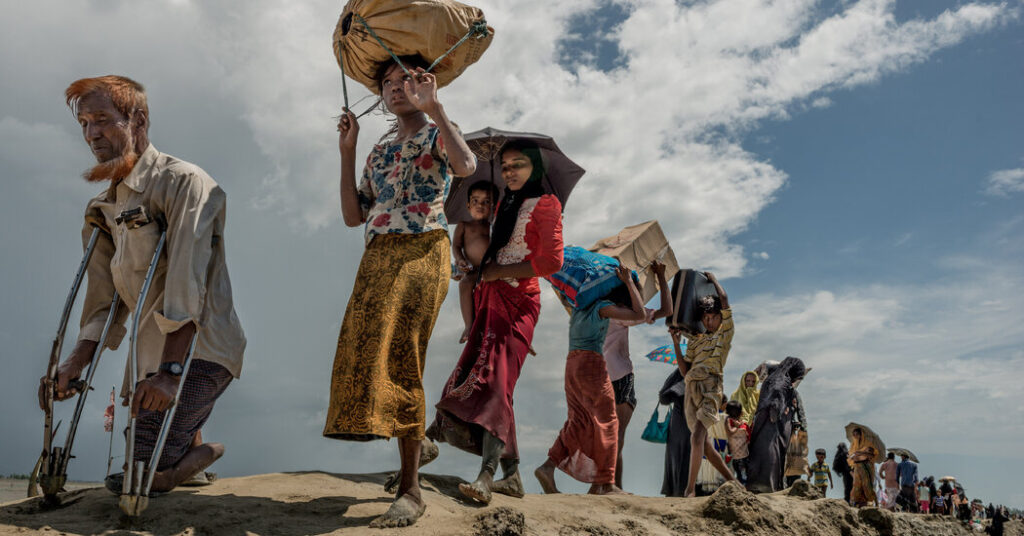
It is an erasure that began decades before, when successive military governments began chipping away at their citizenship rights. The Rohingya were finally driven from Myanmar during an ethnic-cleansing campaign of arson, murder and rape.
When they fled to Bangladesh, many were given the arbitrary birth date to fit them into the U.N.’s refugee system. The same thing has also happened to refugees in other parts of the world.
The Office of the U.N. High Commissioner for Refugees said 67 percent of Rohingya living in the camps are registered as born on Jan. 1.
In the chaotic early days of the refugee crisis, staff were not always careful with data, said Md Tajwar Rashid Ayan, who worked at a U.N. registration center. He said many arrivals also couldn’t provide a birth date.
“We didn’t have much time, and the refugees needed a document,” he said. “We had to put something.”
The U.N. refugee agency said that it could not rule out that mistakes were made, but that refugees also have a responsibility to update information. “We continue inviting them to specify their dates,” said Astrid Castelein, head of protection for the agency in Bangladesh.
Refugees say this is hard to do. One woman in the camps, Rafsan Jaan, said she tried to change data on her card last year, but was told it was impossible after five months.
Mohammed Anis, a resident of Camp 12, has just turned 26 according to his U.N. ID, but was actually born on Jan. 15.
When he reached Bangladesh, the U.N. staff didn’t want to know which day or month he was born, he said. “They just asked me: How old are you? I said 17.”
They gave him an ID card with Jan. 1 as his date of birth, and as a fresh arrival, he didn’t feel he could complain.
Ever since, the mistaken birthday has trailed him. When he recently applied for a job, he felt obliged to use it on his résumé. “The date is wrong and I feel upset about it,” he said. “One day we might be forgetting our actual date of birth.”
As members of the world’s largest stateless community, many Rohingya cling to whatever documents they still have as proof they have not totally lost their identity. Some wrap them in plastic or keep tattered papers under their pillow when they sleep.
“Identity documents are a treasure for us,” said Mayyu Ali, a Rohingya author who resettled in Canada in 2021.
He said a niece who also moved to Canada had no way to change her date of birth there, forcing her to keep it.
“These policies of erasure still affect us in our new life,” Mr. Mayyu Ali said.
Rohim Ullah, a photographer, who shares the “UNHCR birthday,” as he calls it, with his eight brothers, is concerned that it might cause him trouble if he ever returns to Myanmar. The date of birth on his U.N. card would not match the one on his household registration, the only document that still ties him to his homeland.
“It looks like I have wrong documents,” he said.
However, the prospect of returning remains unlikely. The military junta, accused by the United States and other nations of genocide against the Rohingya, is set to legitimize its power in stage-managed polls this month.
Mr. Rohim Ullah, the photographer, has resigned himself to the date now on his ID, but he doesn’t plan to observe that or his real birthday, which is in May.
“As long as I don’t have soil under my feet that is my own, I don’t want to celebrate,” he said.
The post At Refugee Camps, Most Birthdays Fall on New Year’s appeared first on New York Times.