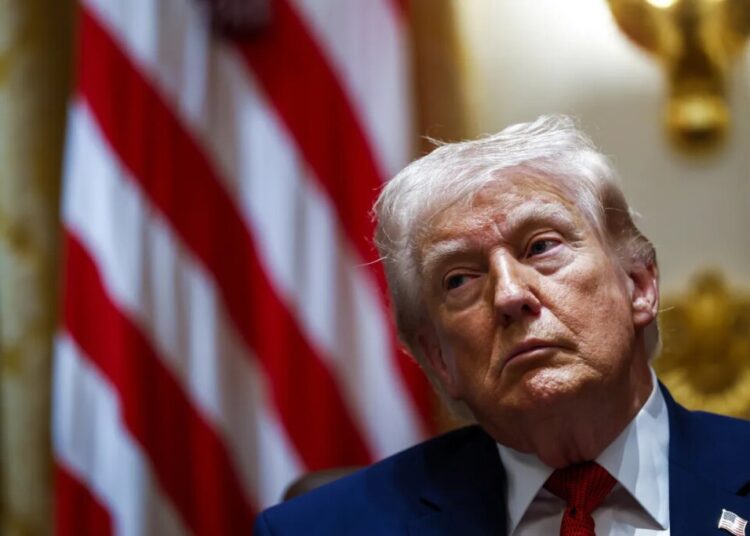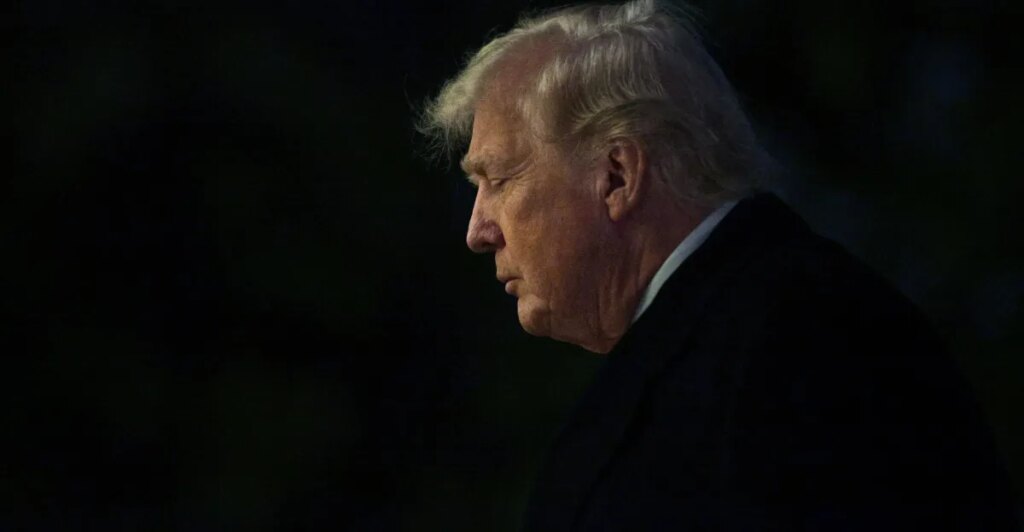
After illegally invading Venezuela — and capturing its dictatorial leader — President Donald Trump is threatening to launch similar attacks against a wide array of countries.
On Sunday, the president reiterated his belief that the United States must annex Greenland, since its waters are “covered with Russian and Chinese ships.” He further declared that the US may take military action against Colombia, as its president “has cocaine mills and cocaine factories.” Mexico may also warrant a bombing, Trump suggested, in light of its failure to police its cartels. And he also warned Iran’s authoritarian regime that, if it starts killing the protestors who’ve recently amassed in its streets, “they’re going to get hit very hard by the United States.”
Of course, the president says a lot of things. If Trump’s words were a perfect guide to US policy, America would currently be governing the Gaza Strip.
Therefore, until this weekend, it seemed safe to assume that the president’s most outlandish military threats were mere bluster. Now that he has greenlit the overthrow of a foreign leader, who had ordered no attack against the United States, it is hard to be so sure.
Yet, there is one big reason to think that, in military terms, Trump’s bark still exceeds his bite.
Why Trump’s military interventions could get bolder
Before turning to the causes for doubts about America storming the beaches of Greenland, it’s worth noting why the world is suddenly taking such scenarios seriously.
Since the beginning of his first term, Trump’s acts of war have grown steadily more audacious. In 2020, he ordered the assasination of Iran’s top military official; in April, he ordered large-scale air strikes against that nation’s nuclear facilities; now, he has deposed Venezuelan president Nicolas Maduro, a sitting head of state, killing at least 80 people in the process.
In each of these cases, Trump ignored warnings that his actions could sow chaos and instability — if not all-out war. And in every instance, the intervention’s immediate costs to the United States appeared lower than skeptics had predicted.
It is clear that this pattern of events has emboldened Trump. In an interview with Fox News Sunday night, he hailed his own operation in Venezuela as “incredible” and said that “we have to do it again. We can do it again, too. Nobody can stop us.”
Given Trump’s words and deeds, the world should prepare for the US to deploy military force more frequently — and perhaps, ambitiously — in the coming years.
Certainly, the president has shown that neither international nor constitutional law constrains his martial ambitions. And he insists that America has a right to “dominate” the Western Hemisphere and seize the resource wealth of weaker nations.
The line that Trump still hasn’t crossed
Yet, the president still appears bound by the primary constraint on American war-making since the invasion of Iraq: the US public’s low tolerance for American casualties.
Trump has yet to order a novel military operation with a substantial American death toll. No US troops died in the course of assassinating Iran’s Major General Qasem Soleimani or bombing its nuclear sites, nor did any Americans perish in the raid on Maduro’s palace.
And the desire to avoid US casualties appeared to structure American policy in all of these cases. Iran responded to both the killing of Soleimani and bombing of its nuclear facilities by firing ballistic missiles at American airbases in the Middle East. When these failed to kill any US soldiers, Trump declined to return fire, evidently to avoid further escalation.
In Venezuela, meanwhile, the US has evidently decided to leave Maduro’s party in power, rather than hazard the sustained military occupation necessary to displace that authoritarian regime.
Such restraint is politically wise. Even in the absence of American bloodshed, public support for Trump’s operation in Venezuela remains tepid, with just 33 percent of voters approving of the strike in a Reuters/Ipsos poll. The typical American does not perceive any compelling national interest in Venezuela being governed by one leftist dictator they’ve never heard of rather than some other one. Had any US troops died in Caracas, political opposition to Trump’s adventurism would surely be orders of magnitude more intense.
The American public’s aversion to US military deaths can be seen in the trajectory of Joe Biden’s presidency. Although inflation corroded Biden’s popularity, his approval initially collapsed amid America’s bloody withdrawal from Afghanistan, which claimed the lives of 13 American servicemembers. Trump is well aware of the damage that this did to Biden; the Republican attended an anniversary memorial for those fallen soldiers in the heat of the 2024 campaign.
The backlash to American deaths from an invasion of Greenland or Colombia would likely be even more intense. After all, voters had actually supported withdrawing US troops from Afghanistan before it happened. By contrast, few Americans want to buy Greenland, let alone conquer it.
Trump could still get a lot of Americans killed
Of course, there is still no guarantee that Trump will steer clear of a major war. It is impossible for even the most judicious leaders to perfectly anticipate the consequences of their military operations; conflicts can escalate. And Trump is not known for rigorously thinking through all of his policy decisions.
Moreover, even if Trump is unwilling to shed much American blood in service of his imperial fantasies, he could still reap a lot of death and chaos. Given our nation’s drone fleet and aerial might, Trump need not sacrifice many US soldiers to destabilize entire countries.
Yet, there are limits on what even a great power can achieve militarily without forfeiting its soldiers in large numbers. America probably can’t conquer Greenland — or cause genuine regime change throughout South America — without accepting a great many flag-draped coffins. And Trump still has not indicated that this is something he’s prepared to do.
The post After Venezuela, how far could Trump really go? appeared first on Vox.