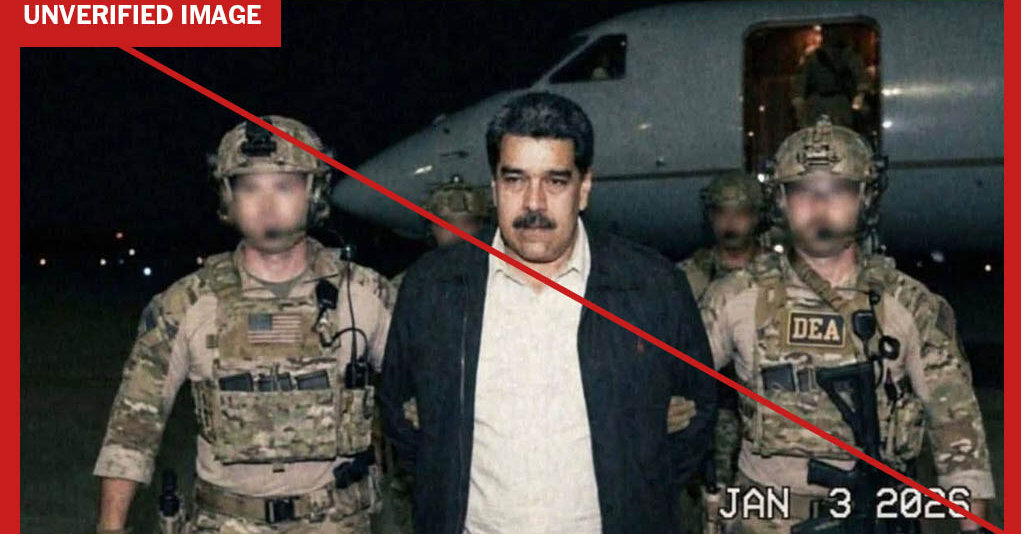
Just hours after news spread online that Nicolás Maduro, Venezuela’s ousted president, was arrested by U.S. forces, social media was overrun with photographs depicting him in handcuffs, escorted by drug enforcement agents or surrounded by soldiers on a military aircraft.
The images were fake — the likely product of artificial intelligence tools — in what experts said is one of the first times that A.I. imagery has depicted prominent figures while a historical moment was rapidly unfolding.
“This was the first time I’d personally seen so many A.I.-generated images of what was supposed to be a real moment in time,” said Roberta Braga, the executive director of the Digital Democracy Institute of the Americas, a think tank.
Most major A.I. image generators have rules against deceptive or misleading content, and several explicitly ban fake images of public figures like Mr. Maduro. And while it is difficult to identify exactly which tool was responsible for creating the most popular fakes that circulated after the attack, many mainstream tools were willing to create similar images in tests conducted by The New York Times on Monday. They often did so free of charge and in a matter of seconds.
The threat that such fakes could confuse and mislead people as news breaks has loomed large over the tools since they gained widespread popularity. The technology has now become advanced enough, and popular enough, to make that threat a reality.
Jeanfreddy Gutiérrez, who runs a fact-checking operation in Caracas but is based in Colombia, noticed the fake images of Mr. Maduro spreading on Saturday, the day his arrest was announced. He said some circulated through Latin American news outlets before being quietly swapped out for an image shared by President Trump. Mr. Gutiérrez published a fact-check this weekend that identified several deepfake images of Mr. Maduro, including one that “showed clear signs” that it was made by Gemini, Google’s A.I. app.
“They spread so fast — I saw them in almost every Facebook and WhatsApp contact I have,” he said.
NewsGuard, a company that tracks the reliability of online information, tracked five fabricated and out-of-context images and two misrepresented videos linked to Mr. Maduro’s capture. It said the content collectively garnered more than 14.1 million views on X in under two days (the content also appeared, with more limited engagement, on Meta platforms like Instagram and Facebook).
After Mr. Maduro’s arrest, The Times tested a dozen A.I. generators to determine which tools would create fake images of Mr. Maduro.
Most of the tools, including Gemini and models from OpenAI and X, quickly created the requested images. The fakes undermined assurances from many of technology companies that they have designed safeguards to prevent the tools from being abused.
Google has rules prohibiting users from generating misinformation and specifically bars misleading content that is “related to governmental or democratic processes.” But a Google spokesman said that the company does not categorically bar images of prominent people and that a fake image depicting Mr. Maduro getting arrested that was generated in tests by The Times did not violate its rules.
OpenAI’s tool, ChatGPT said it could not create images of Mr. Maduro. But when The Times queried through another website that taps into the same model of ChatGPT, it relented and produced the images. In an emailed statement, an OpenAI spokesperson said the company uses safeguards to protect public figures but focuses on preventing harms like sexual deepfakes or violence.
Grok, the model by X.ai, immediately produced lifelike images of Mr. Maduro’s arrest.
The spokesman for Google said the company has focused on its hidden watermark, called SynthID, that Gemini embeds in every image it creates, enabling people to determine whether it was made by its A.I. tool.
“You can simply upload an image to the Gemini app and instantly confirm whether it was generated using Google A.I.,” he said.
Grok has come under heavy scrutiny, including last week when watchdogs reported that it was responding to requests to remove clothing from images of children. Grok’s account posted that its team identified “lapses in safeguards” and that it was “urgently fixing them.”
X.ai did not respond to a request for comment.
Other tools, like Facebook’s Meta A.I. chatbot and Flux.ai, responded by creating images showing a man with a mustache getting arrested, but did not accurately depict Mr. Maduro’s features. When prompted to create a more realistic depiction of the ousted president, Meta’s chatbot replied: “I can’t generate that.”
Meta declined to comment.
Along with popular tools created by tech giants are a growing assortment of lesser-known image generators created by other A.I. companies.
Many of those tools have few guardrails, allowing meme-makers and activists to create A.I. fakes targeting politicians, celebrities and other notable people.
In tests by The Times, tools including Z-Image, Reve and Seedream responded by creating realistic images of Mr. Maduro getting arrested outside of a military aircraft.
Generative artificial intelligence tools are more accessible than ever before, said Mariví Marín, the director of ProboxVE, a nonprofit that analyzes digital ecosystems in Latin America. She wrote in a text that the Maduro deepfakes that emerged over the weekend, most of them before an official photo was released, were a response to “a collective need to fill in ‘the perfect image’ of a moment that each Venezuelan imagines somewhat differently,” as a sort of “reaction to the urgency of filling that visual gap (with real or unreal content) as quickly as possible.”
Venezuela is among the most restrictive countries in the world for press freedoms, with limited media sources, making trustworthy information hard to come by. In the news vacuum, the mistrust bred by deepfakes is exacerbated.
Mr. Gutiérrez said that many people were skeptical that the image of Mr. Maduro posted by Mr. Trump was authentic.
“It’s funny, but very common: Doubt the truth and believe the lie,” he said.
Latin American fact-checkers like Mr. Gutiérrez said they have been primed by earlier synthetic videos and images of Mr. Trump and former President Joseph R. Biden to be on the lookout for deepfakes of public figures. And since the pandemic, fact-checking groups across the region have collaborated to tackle cross-border rumors and conspiracy theories that surface during international conflicts and elections.
“It just took a lot of work, because we always lose the battle to convince people of the truth,” Mr. Gutiérrez said.
Stuart A. Thompson writes for The Times about online influence, including the people, places and institutions that shape the information we all consume.
The post A.I. Images of Maduro Spread Rapidly, Despite Safeguards appeared first on New York Times.