Two small Caribbean nations, Dominica and Antigua and Barbuda, said on Monday that they had agreed to start receiving foreign nationals seeking asylum in the United States.
Prime Minister Roosevelt Skerrit of Dominica told reporters at a news conference that his country and the United States had signed “an agreement to facilitate third-country refugees to be sent to Dominica.”
He added that concerns about receiving violent people or individuals who would compromise the security of the island nation were “acknowledged and well-received” by the U.S. State Department.
It is unclear how many people Dominica is willing to accept, or from which countries, and Mr. Skerrit did not go into detail about any kind of housing plan for them. But with a population of roughly 66,000 and limited resources, the island would not be able to receive big groups of asylum seekers.
“The United States is very mindful of our smallness, our size, our resources,” Mr. Skerrit said.
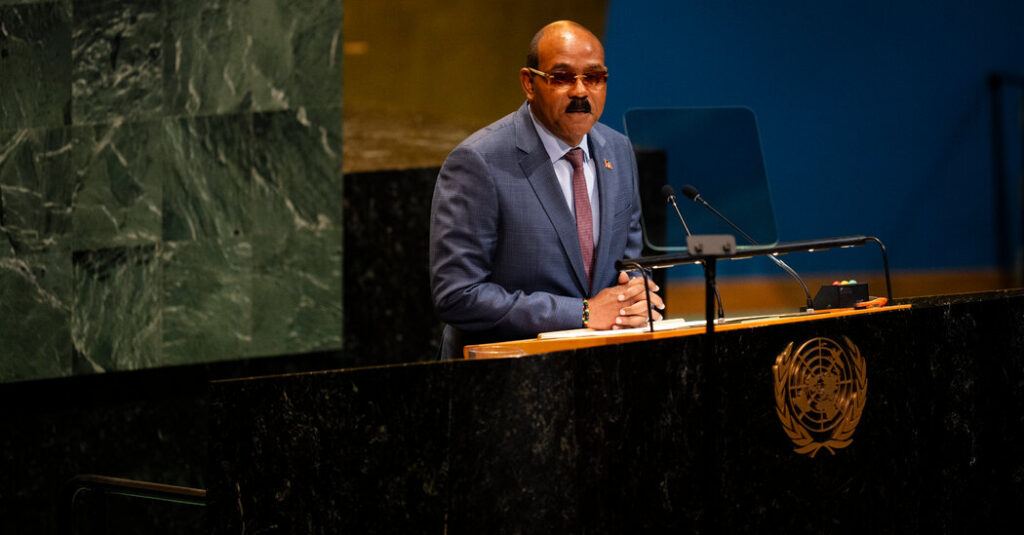
Also on Monday, Prime Minister Gaston Browne of Antigua and Barbuda said on social media that his administration had signed a “nonbinding” memorandum of understanding with the United States to accept “noncriminal refugees,” but with no commitment to specific quotas. He added that the agreement could be terminated “at any time” at his country’s discretion.
The announcements came after the United States imposed travel restrictions and visa bans, which took effect on Jan. 1, on the two countries.
In an email, the State Department said it remained “unwavering in our commitment to end illegal and mass immigration and bolster America’s border security.” But it said it would not discuss “the details of our diplomatic communications with other governments.”
Mr. Browne said that his country would only accept 10 asylum seekers per year. He added that talks were underway with the United States to restore “normal visa issuance and renewals” for his country’s nationals.
Despite the timing of the agreement and the travel restrictions, Mr. Browne said, “This was not a concession, nor an attempt to trade people or curry favor. It was a measured diplomatic gesture.”
In Dominica, some greeted the news of the new deal with the U.S. with skepticism.
“With unemployment and underemployment already challenging many Dominican families, how will these deportees earn a livelihood?” Joshua Francis, the leader of a rising opposition party in the country, said in a statement. “Where will these deportees be accommodated?”
The announcements come at a time of deep divisiveness in the Caribbean over recent U.S. actions, including lethal strikes on boats and the military raid in Venezuela. While some regional leaders have condemned them as extrajudicial, others have openly embraced them.
Both Dominica and Antigua and Barbuda were targeted by the U.S. State Department due to concerns over their so-called Citizenship by Investment programs — or golden passport programs. Through these programs, wealthy individuals can acquire citizenship for a cost, with minimum investments ranging from $200,000 to $250,000, according to Immigrant Invest, a consulting company on Caribbean citizenship programs.
In the Caribbean, specifically, these schemes have become a multibillion dollar industry that funds everything from new hospitals and schools to climate resilience projects. But they have prompted concerns over transparency, corruption and local inflation and housing shortages.
According to President Trump’s order partially suspending visa entry for Dominica and Antigua and Barbuda, similar programs “have been susceptible to several risks,” such as “allowing an individual to conceal his or her identity and assets to circumvent travel restrictions or financial or banking restrictions.”
In 2023, a transnational investigation led by the Organized Crime and Corruption Reporting Project found that Dominica had sold citizenship to thousands of people, including a Turkish millionaire convicted of fraud, Saddam Hussein’s top nuclear scientist and a former Afghan spymaster.
Emiliano Rodríguez Mega is a reporter and researcher for The Times based in Mexico City, covering Mexico, Central America and the Caribbean.
The post 2 Caribbean Nations Agree to Host People Seeking Asylum in U.S. appeared first on New York Times.