Have you heard of Orange County? It’s where the good Republicans go before they die.
It should come as no surprise that Orange County, a beloved county for the grandfather of modern American conservatism, Ronald Reagan, would be the fertile landscape for far-right ideology and white supremacy. Reaganomics aside, the O.C. has long since held a special if not slightly off-putting place, of oceanfront leisure, modern luxury and all-American family entertainment — famed by hit shows (“The Real Housewives of Orange County,” “The O.C.” and “Laguna Beach,” among others). Even crime in Orange County has been sensationalized and glamorized, with themes veneered by opulence, secrecy and illusions of suburban perfection. To Eric Lichtblau, the Pulitzer Prize winner and former Los Angeles Times reporter, the real story is far-right terrorism — and its unspoken grip on the county’s story.
“One of the reasons I decided to focus on Orange County is that it’s not the norm — not what you think of as the Deep South. It’s Disneyland. It’s California,” Lichtblau says. “These are people who are trying to take back America from the shores of Orange County because it’s gotten too brown in their view.”
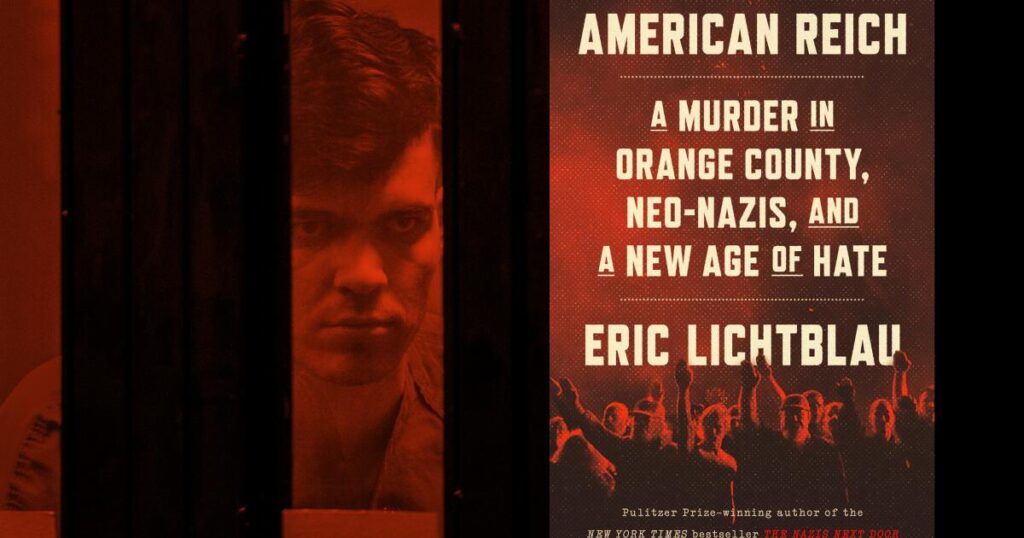
His newest investigative book, “American Reich,” focuses on the 2018 murder of gay Jewish teenager Blaze Bernstein as a lens to examine Orange County and how the hate-driven murder at the hands of a former classmate connects to a national web of white supremacy and terrorism.
I grew up a few miles away from Bernstein, attending a performing arts school similar to his — and Sam Woodward’s. I remember the early discovery of the murder where Woodward became a suspect, followed by the news that the case was being investigated as a hate crime. The murder followed the news cycle for years to come, but in its coverage, there was a lack of continuity in seeing how this event fit into a broader pattern and history ingrained in Orange County. There was a bar down the street from me where an Iranian American man was stabbed just for not being white. The seaside park of Marblehead, where friends and I visited for homecoming photos during sunset, was reported as a morning meet-up spot for neo-Nazis in skeleton masks training for “white unity” combat. These were just some of the myriad events Lichtblau explores as symptoms of something more unsettling than one-offs.
Lichtblau began the book in 2020, in the midst of COVID. He wanted to find a place emblematic of the national epidemic that he, like many others, was witnessing — some of the highest record of anti-Asian attacks, assaults on Black, Latino and LGBTQ+ communities, and rising extremist rhetoric and actions.
“Orange County kind of fit a lot of those boxes,” Lichtblau says. “The horrible tragedy with Blaze Bernstein being killed by one of his high school classmates — who had been radicalized — reflected a growing brazenness of the white supremacy movement we’ve seen as a whole in America in recent years.”
Bernstein’s death had been only two years prior. The Ivy League student had agreed to meet former classmate Woodward one evening during winter break. The two had never been close; Woodward had been a lone wolf during his brief time at the Orange County School of the Arts, before transferring due to the school’s liberalness. On two separate occasions over the years, Woodward had reached out to Bernstein under the pretense of grappling with his own sexuality. Bernstein had no idea he was being baited, or that his former classmate was part of a sprawling underground network of far-right extremists — connected to mass shooters, longtime Charles Manson followers, neo-Nazi camps, and online chains where members bonded over a shared fantasy of harming minorities and starting a white revolution.
“But how is this happening in 2025?”
These networks didn’t appear out of nowhere. They had long been planted in Orange County’s soil, leading back to the early 1900s when the county was home to sprawling orange groves.
Mexican laborers, who formed the backbone of the orange-grove economy (second to oil and generating wealth that even rivaled the Gold Rush), were met with violence when the unionized laborers wanted to strike for better conditions. The Orange County sheriff, also an orange grower, issued an order. “SHOOT TO KILL, SAYS SHERIFF,” the banner headline in the Santa Ana Register read. Chinese immigrants also faced violence. They had played a large role in building the county’s state of governance, but were blamed for a case of leprosy, and at the suggestion of a councilman, had their community of Chinatown torched while the white residents watched.
Leading up to the new millennium brought an onslaught of white power rock coming out of the county’s music scene. Members with shaved heads and Nazi memorabilia would dance to rage-fueled declarations of white supremacy, clashing, if not worse, with non-white members of the community while listening to lyrics like, “When the last white moves out of O.C., the American flag will leave with me… We’ll die for a land that’s yours and mine” (from the band Youngland).
A veteran and member of one of Orange County’s white power bands, Wade Michael Page, later murdered six congregants at at a Sikh temple in Wisconsin in 2012.
“It’s come and gone,” says Lichtblau, who noticed these currents shifting in the early 2000s — and over the years, when Reagandland broke in certain parts to become purple. Even with sights of blue amid red, Trump on the landscape brought a new wave — one that Lichtblau explains was fueled by “claiming their country back” and “capturing the moment that Trump released.”
It can be hard to fathom the reality: that the Orange County of white supremacy exists alongside an Orange County shaped both economically and culturally by its immigrant communities, where since 2004, the majority of its residents are people of color. Then again, to anyone who has spent considerable time there, you’ll notice the strange cognitive dissonance among its cultural landscape.
It’s a peculiar sight to see a MAGA stand selling nativist slogans on a Spanish-named street, or Confederate flags in the back of pickup trucks pulling into the parking lots of neighborhood taquerias or Vietnamese pho shops for a meal. Or some of the families who have lived in the county for generations still employing Latino workers, yet inside their living rooms Fox News will be playing alarmist rhetoric about “Latinos,” alongside Reagan-era memorabilia proudly displayed alongside framed Bible verses. This split reality — a multicultural community and one of the far-right — oddly fills the framework of a county born from a split with its neighbor, L.A., only to develop an aggressive identity against said neighbor’s perceived liberalness.
It’s this cultural rejection that led to “the orange curtain” or the “Orange County bubble,” which suggest these racially-charged ideologies stay contained or, exhaustingly, echo within the county’s sphere. On the contrary, Lichtblau has seen how these white suburban views spill outward. Look no further than the U.S. Capitol insurrection on Jan. 6, also the book’s release date.
While popular belief might assume these insurrectionists came from deeply conservative areas, it was actually the contrary, as Lichtblau explains. “It was from places like Orange County,” he says, “where the voting patterns were seeing the most shift.” Some might argue — adamantly or reluctantly — that Jan. 6 was merely a stop-the-steal protest gone wrong, a momentary lapse or mob mentality. But Lichtblau sees something much larger. “This was white pride on display. There was a lot of neo-Nazi stuff, including a lot of Orange County people stuff.”
As a society, it’s been collectively decided to expect the profile of the lone wolf killer, the outcast, wearing an identity strung from the illusions of a white man’s oppression — the type to rail against unemployment benefits but still cash the check. Someone like Sam Woodward, cut from the vestiges of the once venerable conservative Americana family, the type of God-fearing Christians who, as “American Reich” studies in the Woodward household, teach and bond over ideological hate, and even while entrenched in a murder case, continuously reach out to the victim’s family to the point where the judge has to intervene. The existence of these suburban families is known, as is the slippery hope one will never cross paths with them in this ever-spinning round of American roulette. But neither these individuals nor their hate crimes are random, as Lichtblau discusses, and the lone wolves aren’t as alone as assumed. These underground channels have long been ingrained in the American groundscape like landmines, now reactivated by a far-right digital landscape that connects these members and multiplies their ideologies on a national level. Lichtblau’s new investigation goes beyond the paradigm of Orange County to show a deeper cultural epidemic that’s been taking shape.
Beavin Pappas is an arts and culture writer. Raised in Orange County, he now splits his time between New York and Cairo, where he is at work on his debut book.
The post Yes, Orange County has always had a neo-Nazi problem. A new deeply reported book explains why appeared first on Los Angeles Times.