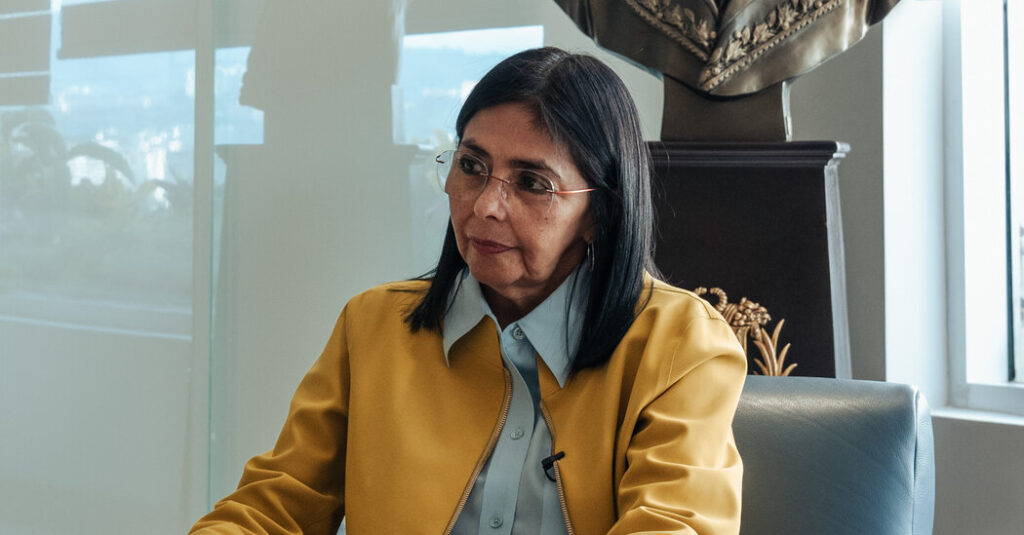
Delcy Rodríguez, a leftist and political confidante to the captured Venezuelan president Nicolás Maduro, has suddenly become the country’s interim leader. She is in a delicate situation, pitted between the Trump administration in Washington, which says it expects Ms. Rodríguez’s cooperation, and a Venezuelan public that deeply distrusts American influence.
She was declared the acting president by the Venezuelan Supreme Court, Vladimir Padrino López, the country’s defense minister, said on Sunday, the day after U.S. forces swept into Caracas, the capital, and seized Mr. Maduro.
A longtime political operator with Marxist roots, Ms. Rodríguez, 56, entered Venezuela’s political sphere after Hugo Chávez, then the president, was nearly ousted from power in a coup in 2002. Although she wasn’t in the country at the time, Ms. Rodríguez and her mother symbolically “took over” the Venezuelan embassy in London, protesting the short-lived rule of Pedro Carmona Estanga, Ms. Rodriguez recalled on an official government podcast last year.
Ms. Rodríguez would soon return to Venezuela, where she began working in the foreign ministry under Mr. Chavez, who had been quickly restored to power.
She rose quickly through the government after Mr. Maduro came to power in 2013 following Mr. Chávez’s death, becoming the country’s communication minister and later its foreign affairs minister. She guided Venezuela amid an economic downturn and fostered a reputation for bridge-building with the country’s economic elites.
She became vice president after Venezuela’s 2018 presidential election, and also took over one of the country’s intelligence services. In 2020, she took on more responsibility over the country’s finances as the economy minister.
Ms. Rodríguez’s economic credentials have earned respect from some corners of the Trump administration. Under her leadership as Mr. Maduro’s vice president, Venezuela’s socialist economy has shifted to a largely free-market capitalist one. Nevertheless, the country has suffered from hyperinflation of over 100 percent.
Ms. Rodríguez has taken special care to protect Venezuela’s coveted oil industry, which has brought in foreign investment and increased production modestly after major struggles during the 2010s.
Her father, Jorge Antonio Rodríguez, was a Marxist who was involved in the kidnapping of William Niehous, an American businessman who was held in Venezuela for three years. Her brother Jorge Rodríguez has been close with Mr. Maduro and is the president of the National Assembly.
The political test ahead is fraught for Ms. Rodríguez. She will need to solidify power and placate an anxious public — many of whom view Mr. Maduro’s reign as illegitimate but also distrust American interference. Separately, she will most likely need to kowtow privately to Mr. Trump, whose support of her interim government remains unclear, and conditional.
In a televised speech this weekend, Ms. Rodríguez issued a fiery threat to those responsible for ousting Mr. Maduro, saying in Spanish that “history and justice will make them pay” and that said the United States had kidnapped him.
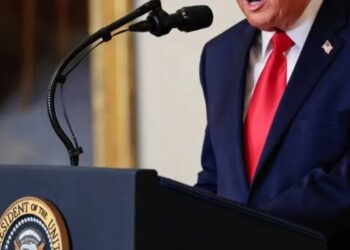
Mr. Trump told The Atlantic: “If she doesn’t do what’s right, she is going to pay a very big price.”
But this political posturing may be more of a public-relations gambit. Both Ms. Rodríguez and Mr. Trump have expressed a desire for a certain level of cooperation between the two countries even amid their aggressive threats.
On Sunday evening, Ms. Rodríguez wrote on social media that “We extend an invitation to the U.S. government to work together on a cooperative agenda, oriented toward shared development, within the framework of international law, and to strengthen lasting community coexistence.”
Ali Watkins covers international news for The Times and is based in Belfast.
The post Who Is Delcy Rodríguez? appeared first on New York Times.