One year ago this week, the Santa Ana winds roared over the Santa Monica Mountains at over 60 miles per hour, gusting up to 100 in some spots in what some people called, loosely, once-in-a-century fire conditions. What followed was a new kind of fire disaster, for which even the fire-wise communities of the American West seem deeply unprepared.
Over 16,000 structures were destroyed by the Palisades and Eaton fires, more than had ever been burned through in any year in the long history of the tinderbox Los Angeles basin. Thirty-one people were killed, more than are known to have perished in any other fire event in Los Angeles County since modern record-keeping began. Entire swaths of neighborhoods were incinerated.
But those fires were not the only ones to begin in the greater Los Angeles area that week. According to Cal Fire records, on Jan. 7 and Jan. 8, at least six others sparked under those same wind and climate conditions, each of which was contained and extinguished without burning more than a handful of structures. And the monstrous Palisades and Eaton fires could themselves be traced to correctable human error: The Palisades fire was a holdover from a smaller burn the Los Angeles Fire Department had visited six days earlier, extinguishing the above-ground flames but leaving the fire to smolder underground even when crews on-site suspected it was still burning; and the Eaton fire in Altadena was, at least according to the Department of Justice, probably sparked by faulty power lines.
One moral of this story: Last January’s catastrophic fire disaster did not have to be a catastrophe at all, only a close call.
Another moral comes from the wisdom repeated to me by firefighters, policymakers and researchers over the past year: that there is more to fire risk than ignitions and fire response, that what can burn will eventually burn, and in a landscape baked by warming in which human structures have been erected in open defiance of known risk, some of those fires will prove catastrophic. “California is built to burn,” the fire historian Stephen Pyne once told me. “It is built to burn explosively.”
Fire has always been a part of life in the American West, with megafire and fire disasters colonizing the entire country’s apocalyptic climate imagination over the last decade. But the Los Angeles fires mark a new phase, and seem to affirm a new consensus among a certain cohort of fire experts, that we have fundamentally misunderstood the nature of the problem and mismanaged fire risk as a result.
Watching from afar, we still reflexively call these disasters “wildfires,” perhaps imagining that they ignite in some distant forest. But there may be little truly “wild” about such fires beyond the ferocity of the burn. Increasingly, disaster strikes almost entirely within an urban envelope, drawing on homes and landscaping for fuel rather than trees and wild brush. These are not forest fires encroaching on human settlement but rather human settlements burning like only forests used to. And stopping them will require something much harder, and more unpopular, than clearing out distant forests of dead wood.
The climate scientist Daniel Swain has called the phenomenon the return of the “urban firestorm,” a throwback to horrors from centuries past, when cities such as Chicago and San Francisco could burn for miles and days on end. By the middle of the 20th century, that kind of urban fire had come to look like an extinct beast.
Then came the next generation of disasters: the Tubbs fire in Santa Rosa, Calif., in 2017 and the Camp fire in Paradise, Calif., in 2018; the Marshall fire in Boulder County, Colo., in 2021 and the 2023 Lahaina fire in Maui, Hawaii, which killed more people than any American fire in over a century.
Probably, the list features your most vivid impressions of our new age of wildfire. But in 2023, a group of researchers reviewed some of the decade’s most nightmarish fires in the Proceedings of the National Academy of Sciences, or PNAS, and declared that “wild-land-urban fire disasters aren’t actually a wildfire problem.” The ignitions weren’t wild, the predominant fuel wasn’t wild, the surrounding landscape wasn’t really wild land and wild-land firefighting wasn’t able to change the outcome, either.
Picture a wildfire and you most likely imagine a forest or a vast grassland with many thousands of acres burning before human communities are threatened. These kinds of fires do still burn prodigiously through the West. But so many recent disasters began within, or only just outside, the urban environment, doing most of their damage within just a few hours, tearing through thousands of homes before anything could be done to stop them. Sometimes, the initial ignition was in a nearby park or adjacent wild area, with a brief burning of vegetation working as a wick to the urban fire. But just as often, it was not. The Lahaina fire was first spotted near a local middle school.
For a decade or more, as fire people have argued about the relative contribution of global warming and fire suppression to the growing crisis, they’ve tended to agree about the best way to mitigate future risk: better management of undeveloped lands, with thinning of brush and forest to reduce wildfire fuel on the landscape through a variety of measures, including more intentional fire.
The problem is often defined almost entirely in terms of forest management, as it was in a 2022 Wildfire Crisis Strategy document prepared by the Department of Agriculture. But federal land increasingly contributes little to disasters in urban and semi-urban settings, said David Calkin, the lead author of the PNAS paper and a pioneering fire-risk scientist who recently left the U.S. Forest Service lamenting its direction under President Trump.
“We know the wild lands need fire,” he said. But we also need to stop pretending that these disasters are wild-land fires. They aren’t. “It’s a different beast,” Calkin said. Instead, we should start thinking about the risks of those disasters primarily in terms of community design: how homes are built, with what materials and in what configuration. Instead of thinning fuels in the wild land, as we’ve struggled to do now for decades, perhaps we need to thin the fuel of the community itself.
This may sound simpler than thinning the American West of ready-to-burn fuel, accumulating decades of fire suppression and warming. In reality, the job is “staggering,” Calkin said.
Ideally, it would involve redrawing property lines and reconstructing houses with fire-hardened materials and fire-smart principles; a much more aggressive program of landscape management and more small-scale prescribed burning; eliminating or at least limiting flammable vegetation; retraining urban firefighting forces to prepare for the new threats; establishing some permanent firebreaks; and perhaps rerouting roads and homes away from natural wind patterns. If we could do all that, we could find our way to a much more comfortable relationship to California fire, probably, even with climatic changes that seem to increase those risks almost year by year.
But there are few places in California or across the West that are doing that with anything like urgency and scale.
“The astonishing thing is not that Los Angeles burns but that so much of its development has enhanced rather than blunted the threat from fire,” Pyne, the fire historian, reflected last January. The city was built with exposed wood and shake-shingle roofing, he pointed out, making homes “maximally primed to burn”; demand for public forests and parks meant, for all their pleasures and beauty, fire risks were mostly preserved within the design of the city itself; suburbs invariably pressed up against brush landscapes, which generate new fuel basically every time it rains.
When you survey the California landscape, with its mix of natural and semi-natural and completely unnatural features, it now looks like a vast expanse of fuel, Michael Wara, who studies wildfire at Stanford, said. Perhaps one kind of person worrying about fire risk to his or her home might look exclusively at the proximity to the natural vegetation on the landscape and how parched it might appear. But increasingly, the built environment, which used to seem like a natural firebreak, now looks like so much fuel ready to burn. “It’s about how much energy is stored in the landscape, not just in plant material but in other features of the environment, where we live and where our kids sleep at night,” he said.
“If I stored explosives in my backyard, and then if they went off someday, no one would say, well, was there an ignition? You’d say, get rid of the bombs.”
Can we? In 2020, California mandated the development of new fire-safe standards in high-risk zones, a bundle of changes called Zone Zero to make yards less flammable by cutting back on vegetation close to homes. Across the state, a patchwork of rules and recommendations govern the structure of the home itself, a suite of policies sometimes called “home hardening” and sometimes “fire-smarting.” Even combined, such measures cannot eliminate fire risk, but by some estimates they might reduce it by half, with the cumulative effect dependent on how many homes around you were up to code, too.
In other words, it’s a test of pro-sociality, like the pandemic emergency: You might not be able to eliminate fire risk from a community, but slow the spread and you give firefighters and homeowners a fighting chance, with fire people often comparing fire-smarting your home to masking.
In 2023, when the deadline to create the Zone Zero regulations arrived, officials had failed to produce them. None had been produced either by last January, when the Pacific Palisades and parts of Altadena and Malibu burned clear through. In the aftermath of those fires, with the smell of vaporized homes and their contents still hanging in the air, a new deadline was established for the end of 2025 — then waived after a series of contentious public hearings, with regulators now set to return to the subject in March. The rules aren’t likely to go into effect before 2029 at the earliest. And on the ground, when community leaders have tried to implement stricter fire rules for homes, they are often met with homeowner resistance.
Consider Brentwood, which sits against Pacific Palisades in the line of canyons that flow south from the Santa Monica Mountains into the Los Angeles basin and which, from the awesome vantage of those flatlands, gives the skyline of the city both its literal and its spiritual twinkle.
Last January, the Palisades fire threatened to begin ravaging Brentwood, too, before firefighters forced the flames back. On their way, navigating narrow streets lined with combustible vegetation, “they were like, I’ve never been through a more terrifying place in my life,” Wara told me. “They were looking at these backyards and going, holy cow, how do I even get out of here if we’re not successful?”
A year later, there is probably no community in the state fighting back against Zone Zero harder than the homeowners of Brentwood. The Los Angeles Times called the neighborhood the “epicenter of the outrage” after an especially confrontational public meeting in September.
The rules require the first five feet of the home to be an “ember-resistant zone.” But there is disagreement over what that means. Homeowners say the rules are too one-size-fits-all. They fear forced removal of trees, which they say give the neighborhood its urban canopy, and insist that hedges running alongside homes not only provide privacy but could also swallow flying embers and stop them from igniting the houses hidden just behind them. Their hedges, they argued, were well hydrated.
Officials highlighted homes where better landscaping may have saved the structures from the recent fires. Homeowners pointed to examples of others where action hadn’t been taken and they still survived. The two sides argued over studies showing that home hardening was more effective against fire than vegetation management was, and homeowners asked why fire risk should require tugging hedges out of the ground but not replacing wooden porches or door frames.
Perhaps some of this sounds reasonable, or perhaps it sounds like fire-safety NIMBYism. But the problems are much larger than Brentwood, with hardly any community in the state seeming to meet the challenge of urban fire at the appropriate scale — which is growing. Above the problem of homeowner resistance you can stack local officials, who are rarely comfortable challenging the preferences of their constituents and the aesthetic sensibilities of the California dream, embodied by non-native and often quite combustible vegetation. Above that, you can stack local planning and zoning, which has often produced communities like the Pacific Palisades where streets can serve as wind tunnels carrying embers from home to home so efficiently that even an initial burst, Calkin said, could ignite as many as a hundred homes almost simultaneously.
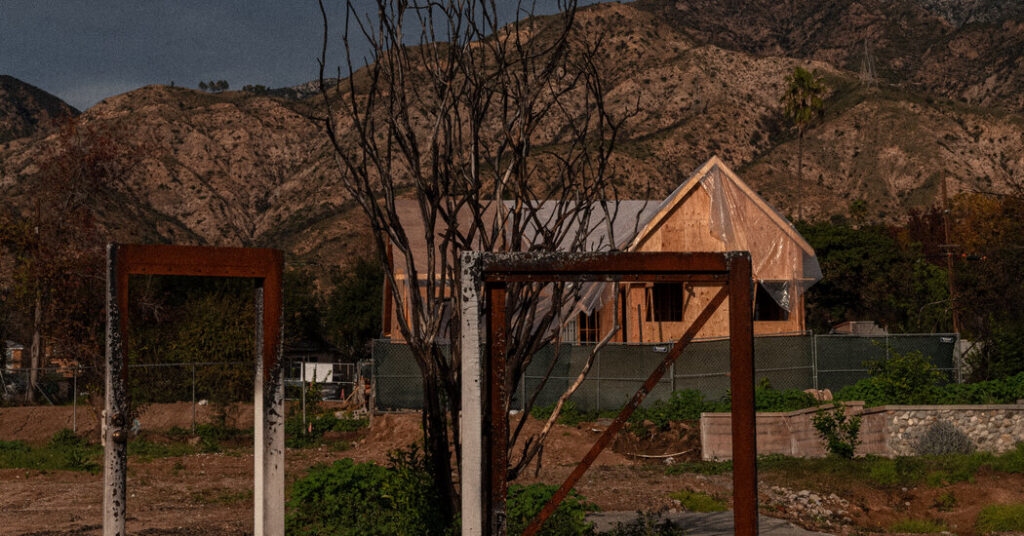
You might hope that a disaster like the fires last January would prompt a reckoning with the way those communities were designed, with property lines perhaps redrawn to better resist future fires. But the interest in rebuilding quickly is too great, from homeowners and investors alike, such that the state has been forced to waive certain building codes to accelerate progress in Palisades, Malibu and Altadena — which have only just barely begun to rebuild.
Fire response remains a problem, too: Urban firefighting forces are unaccustomed to fires burning through dozens of homes at once, and wild-land firefighters who may be called in to help are unaccustomed to fires burning through urban environments. And there are problems of fire oversight. An after-action report prepared by the L.A. Fire Department was watered down, downplaying, for instance, failures in leadership. The original author of the report and the department’s battalion chief, Kenneth Cook, called these edits “highly unprofessional.”
At the state and national level, there’s been inconsistent guidance and erratic implementation concerning fuel reduction in parks and national forests, such that even those places with plans to thin the landscape of brush and other fuels aren’t always effective in doing so. A wildfire management plan prepared by California State Parks just before the fires a year ago called for allowing fires to burn through large parts of Topanga State Park, where the Palisades fire began, so long as they didn’t threaten homes and other “fire exclusion zones.” The plan also outlined several “avoidance areas” where firefighting was meant to be restricted. In the months before the fires, several projects were designed to thin fuel in parts of the Palisades that burned, including one project completed less than 36 hours before the initial fire began.
In the spring, the pyrogeographer and wildfire YouTuber Zeke Lunder embarked on a bike tour with some fire friends of the foothill communities of the Santa Monica Mountains: Bel-Air, Beverly Hills and Beverly Glen. He later released an indelible five-part video series, “Danger in Plain Sight,” documenting the fire-risk conditions there, which he called “exactly the same as in the Palisades.”
“The hazards are ridiculous from a physical geography standpoint,” Lunder told me. “That intersection of canyons that funnel the wind, the intensity of the Santa Anas, the draftiness of those winds, and then this super flammable natural landscape, mingled with a superflammable urban landscape — you couldn’t really make it much worse unless you installed some giant fans.”
“It is just mind-blowing down there on the ground in these neighborhoods.”
In these conditions, Lunder had written just after the January fires began, “it is nearly almost impossible to cut enough brush to make the homes defensible.” And when fires burn from house to house, often sparing trees while transforming modern structures themselves into fuel, the very concept of “defensible space” gets confusing: What is being defended from what, exactly, and how? “I’d love to live here if it wasn’t on fire,” Lunder said. “But the hazards are insane.”
He keeps repeating the word, sometimes throwing in an expletive as he reviews satellite imagery, fire maps and Google maps and GoPro footage with me. “It’s hard to say that there’s nothing that can be done,” he said, but there isn’t much being done.
“I think we’re going to burn up Bel Air and Beverly Hills next, and then I don’t know what’s going to happen,” Lunder went on. “We should rebuild them with concrete or tile and stone. But somehow, we’re still not getting that memo. People are rushing back to build stick-frame houses in Palisades.” He shook his head in disbelief. “The potential in the landscape is always there,” he said, adding, “I think we really have to think more about building hobbit houses.” At the very least, perhaps, start seeing the problem of urban fire clearly for the first time.
David Wallace-Wells (@dwallacewells), a writer for Opinion and a columnist for The New York Times Magazine, is the author of “The Uninhabitable Earth.”
The Times is committed to publishing a diversity of letters to the editor. We’d like to hear what you think about this or any of our articles. Here are some tips. And here’s our email: [email protected].
Follow the New York Times Opinion section on Facebook, Instagram, TikTok, Bluesky, WhatsApp and Threads.
The post Which City Burns Next?