As a 16-year-old apprentice at Douglas Hayward, the fashionable London tailors, Ralph Fitzgerald ran errands and stashed away slivers of knowledge about how to cut a bespoke suit and stitch a buttonhole.
He also had a front-row view during the waning days of a certain British suaveness. Mr. Fitzgerald delivered a suit to Roger Moore, the most raffish of Bonds. (Sir Roger slipped him 50 pounds so he could take a date out.) He shared coffee with the photographer Terry O’Neill, who documented royals and Rolling Stones. Both men died not long after Mr. Fitzgerald met them. Mr. Hayward, who was said to have inspired Michael Caine’s cockney playboy in “Alfie,” died just before Mr. Fitzgerald’s apprenticeship.
“I was kind of young, and I didn’t really appreciate it,” said Mr. Fitzgerald, 32, a hale Londoner with the presence of the best-behaved character in a Guy Ritchie movie. “But now, looking back, he was really the coolest.”
Half his life later, he remains charmed by this period when acquiring a bespoke suit was a life milestone, even a requisite, for a particular type of man. When Douglas Hayward closed its shop on Mount Street in 2014, Mr. Fitzgerald salvaged the paper patterns of famed clients.
Today these brown paper forms are housed in Mr. Fitzgerald’s own tailoring atelier on 60th Street on the Upper East Side of Manhattan. They are keepsakes of a time increasingly gone by. Mr. Fitzgerald tossed them on the table like playing cards: Warren Beatty, David Niven, Tony Curtis, Paul McCartney, Francis Ford Coppola and Ralph Lauren.
“They didn’t know what they had,” he said. The forms were going to be thrown out.
It would be improper to call custom suit-making a dying art, but it is a diminished one. Renowned Savile Row ateliers that once dressed princes and pop stars have closed in the face of creeping casualization. And fewer young people are interested in taking on the sort of plodding, five-day-a-week unpaid apprenticeship that Mr. Fitzgerald did.
“I was kind of in the last wave,” Mr. Fitzgerald said.
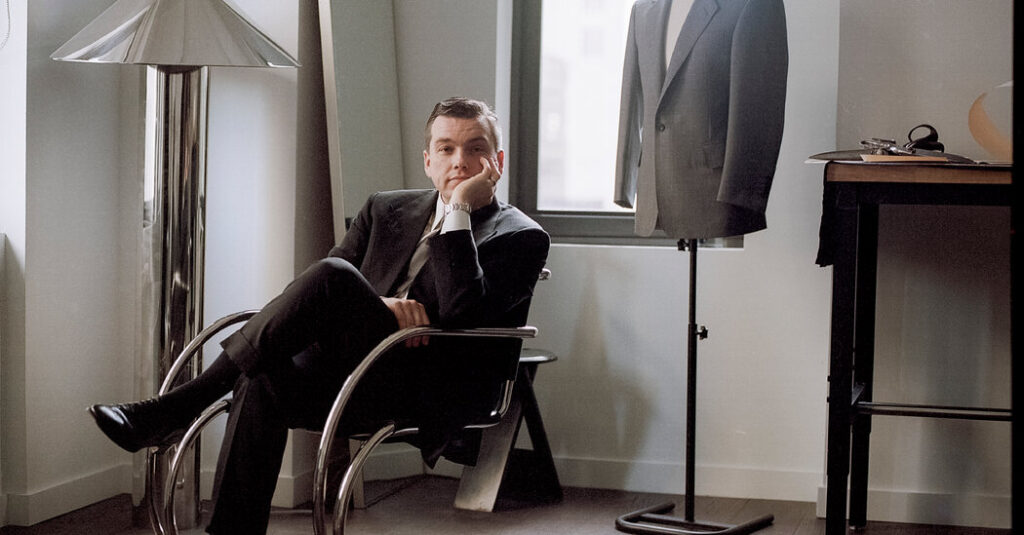
On a December morning at his studio, classical music poured out of a Philippe Starck radio, and sculptures by Wyatt Kahn, a Brooklyn artist and client of Mr. Fitzgerald’s, papered the walls. A mannequin was robed in one of Mr. Fitzgerald’s more outré abstractions: a jacket with lapels configured in a punkish, nearly M-shaped spike.
The tailor, his combed-back hair as tidy as a mowed lawn, was dressed more conservatively. He wore a dark double-breasted suit in what he called his house style. The jacket’s buttons sat low, forming a slight hourglass pinch at the waist, and his shoulders ticked up where the sleeves met the rest of the body. From across the table, it was obvious that the jacket wasn’t heavily padded.
“That’s just what people want,” Mr. Fitzgerald said. “They want lighter-weight garments now.”
Today, Mr. Fitzgerald is part of a community of millennial tailors carrying on the craft of cutting and stitching a suit totally by hand. He works alone, 25 or so blocks from where he lives with his wife and daughter, still cutting suits the way it was done more than a century ago.
Clients tend to favor discretion, if not outright secrecy. This is, in part, because of the cost: Mr. Fitzgerald’s suits start at $6,000. (Tuxedos begin at $6,800.) But to crow about where you got your suit would ruin the “Hey, where’d you get that” mystique. Mr. Fitzgerald’s work is hard to attain — and not only because of the price. He cuts just 10 suits a month, each one taking as much as 10 weeks from first fitting to delivery.
We are in a moment of obvious fashion. Trends are disseminated globally through TikTok — see: quarter-zips and flat-soled sneakers — and money doesn’t unlock exclusivity as it used to. Resale websites are littered with 1 percenter signifiers like Loro Piana sweaters and Zegna sneakers, at relative deals. (Not to mention the proliferation of convincing and cheaper dupes for all these items.) In this climate, a full bespoke suit might be — again, at great expense — the last way to acquire a fashion that’s truly one’s own.
“What is a perfect suit?” Mr. Fitzgerald asked. “Is it what I think is a perfect suit? It’s not. It’s what the client wants.”
Those clients, according to Mr. Fitzgerald, include doctors, actors and lawyers. They tend to be around his age, give or take a decade or so. Half are women.
“Once you go custom, it’s borderline impossible to go back,” said Simon Kim, a restaurateur who said he owns about 12 suits from Mr. Fitzgerald. Those suits largely follow the tailor’s lead: double-breasted, in dark shades. When Mr. Kim opened a Las Vegas location of his Cote steakhouse in October, Mr. Fitzgerald made matching shawl-collared tuxedos for him and his business partner, the rapper Nas.
“I don’t shop anywhere else now,” Mr. Kim said.
Mr. Fitzgerald’s most public client is the fashion designer Marc Jacobs, who pushes the bounds of his sensibility with lapels as wide as a prized trout and dramatic “pagoda” shoulders, like something David Bowie might have worn as Aladdin Sane.
“I have never been able to find a suit like this,” said Mr. Jacobs, who speculates that he now has about a dozen suits cut by Mr. Fitzgerald. “The only way to have that was to find someone who could make that happen, so luckily Ralph and I crossed paths.”
That happened not at Mr. Fitzgerald’s atelier, but at Huntsman, the Savile Row tailor where he worked for eight years. After Douglas Hayward, Mr. Fitzgerald bounced to Kilgour before landing at Huntsman, a 176-year-old British tailoring institution.
Huntsman was, by Mr. Fitzgerald’s own admission, not quite his taste. (“I didn’t grow up hunting or in tweed jackets,” he said.) But it was the job that brought him to the United States. In 2017, Huntsman was expanding to Manhattan, and Mr. Fitzgerald, then 22 years old, had the wide-eyed gumption to move his whole existence. He lived the true Manhattan transplant experience in a “shoe box” of an apartment that faced a brick wall.
The job, he said, “was terrifying for me because I didn’t know anyone here, and the hours were so long.”
But he made it work. From his aerie in a Midtown office building, he became a student of American’s forthright taste in clothes — and robust spending habits.
“In London, clients would buy a suit a season,” he said, whereas at Huntsman, “we’d go to Texas, and people would order 10 suits at a time. And I don’t think I’d ever seen any of them wear suits.”
Mr. Jacobs became a friend and connector for the young tailor. A few years ago, he put him in touch with Aby Rosen, the real estate tycoon who, for a brief blip, owned the Chrysler Building. When Mr. Rosen offered Mr. Fitzgerald a space of his own in the Chrysler Building, he gave notice, moved his drafting table and began Fitzgerald Bespoke. He relocated to 60th Street this year.
“I don’t think I would have started a business by myself if I was still in London,” said Mr. Fitzgerald, who retains his London accent but now simmers with an American entrepreneurial zeal. “Here, you bend over backward for business.”
He does not always bend for clients, though. When they request contrast stitching on their buttonholes or pockets on top of pockets, Mr. Fitzgerald steers them away.
“Those are things that people won’t wear for life,” he said. He is firm in his convictions about what is tasteful and what is tawdry. Alterations, though, are always available. Lately, he has had to take more trousers in at the waist in a sort of Ozempic effect.
“It’s much nicer than the other way around,” he said.
The business, he said, is self-funded, with most clients arriving through word of mouth.
“I’ll have someone in on a Monday, and it doesn’t seem like they particularly like me,” Mr. Fitzgerald said. “And then on Tuesday I’ll get a get phone call saying, ‘Hey, Michael said I need to come in today to buy some suits.’”
Jacob Gallagher is a Times reporter covering fashion and style.
The post When Fashion Designers and Financiers Need a Suit, They Go to Him appeared first on New York Times.