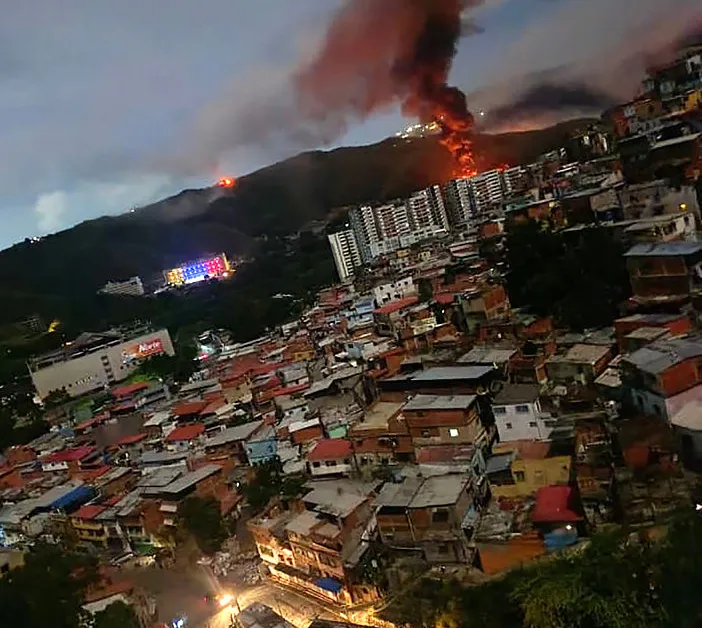
The abduction of Venezuelan President Nicolas Maduro by U.S. forces early Saturday was an unprecedented act of derring-do worthy of a Hollywood spy caper. But experts worry this audacious undertaking risks fraying the last remaining threads of international norms, emboldening autocracies into new acts of aggression without fear of consequences.
[time-brightcove not-tgx=”true”]
Anxiety is especially high that China could now act in similar fashion against regional leaders whom it deems problematic—not least in Taiwan, the self-ruling island that Beijing claims as a renegade province and has repeatedly threatened to invade. Last week, China held enormous war games entirely encircling the island of 23 million in apparent response to a record $11.1 billion American arms package to Taipei.
While China has expressed “grave concern” over Maduro’s capture, calling on the U.S. to release him “at once” and to “resolve issues through dialogue and negotiation,” Chinese netizens were quick to revel in the successful operation, discussion of which topped of the nation’s X-like microblog Weibo late Saturday with some 440 million views. Many commentators urged their leaders to use similar tactics in Taiwan.
“I suggest using the same method to reclaim Taiwan in the future,” posted one Weibo user in a comment that received over 700 likes. “Since the U.S. doesn’t take international law seriously, why should we?” asked another.
Policymakers in Washington expressed similar fears. “If the United States asserts the right to use military force to invade and capture foreign leaders it accuses of criminal conduct, what prevents China from claiming the same authority over Taiwan’s leadership?” Senator Mark Warner, the Democratic vice-chairman of the Senate Intelligence Committee, said in a statement. “Once this line is crossed, the rules that restrain global chaos begin to collapse, and authoritarian regimes will be the first to exploit it.”
China has long pondered surgical strikes against Taiwan’s leadership, though any such move is likely to be self-defeating, given the island is a sustained democracy. Maduro was an autocrat with weak popular backing whose departure has certainly been welcomed by many of Venezuela’s citizens and celebrated by a vibrant diaspora. A similar tactic in Taiwan, by contrast, would likely unite bickering factions in opposition to the Chinese Communist Party.
Indeed, the removal of Maduro could be interpreted as a slap in the face for Beijing, given a high-ranking Chinese delegation was hosted in his Caracas palace just hours earlier. There is also the embarrassment of the advanced Chinese radar and anti-aircraft systems purchased by Venezuela that were supposed to be able to detect U.S. stealth jets but evidently failed.
In addition, Maduro’s capture injects doubts about the potency of Chinese backing. Under pressure from Washington, Maduro had moved closer to Beijing and Moscow in the apparent expectation that this would provide some buffer—in a similar way that Taiwan believes informal U.S. ties can stave off Beijing’s ambitions. Maduro’s fall raises uncomfortable questions for Taipei and other small states betting their autonomy on Great Power backing, says Chong Ja Ian, professor of international relations at the National University of Singapore.
“Countries seem to have a lot less space to maneuver as the major powers are quite willing to go after them,” says Chong. “We’re looking at a world where norms don’t hold as strongly and major powers will try to force their way.”
In echoes of Russia’s invasion of Ukraine, the unilateral U.S. incursion in Venezuela is another example of “might is right” foreign policy that will worry Taiwan. Trump justified his gambit in Venezuela in terms of guarding the U.S. against narco-terrorism, though he has made no secret of coveting the nation’s oil reserves, the planet’s largest proven deposits. It follows a playbook of brazenly targeting countries’ mineral wealth, with U.S. military support for Ukraine being made contingent on a deal for its natural resources and repeated threats to invade mineral-rich Greenland.
“We’re going to be taking out a tremendous amount of wealth out of the ground, and that wealth is going to the people of Venezuela, and people from outside of Venezuela that used to be in Venezuela, and it goes also to the United States of America in the form of reimbursement,” Trump said.
As a central plinth of Trump’s “America First” doctrine was extricating the U.S. from foreign entanglements, the Venezuela intervention is polarizing for his MAGA base. It’s yet to be ascertained whether Trump’s new hawkish posture signals an outright abandonment of his isolationist philosophy or intervention is solely reserved for America’s neighborhood—a more aggressive version of the 1823 Monroe Doctrine of President James Monroe, who warned other powers not to meddle in the Western hemisphere.
In a worrying sign of a possible escalation, Trump has said that Colombian President Gustavo Petro should “watch his ass,” and also told Fox News that “something’s going to have to be done with Mexico.” Havana is also understood to be firmly in Washington’s crosshairs with U.S. Secretary State Marco Rubio of Cuban heritage.
“The Monroe Doctrine is a big deal, but we’ve superseded it by a lot,” Trump said at Mar-a-Lago. “Under our new national security strategy, American dominance in the Western hemisphere will never be questioned again.”
The question is whether assertiveness in America’s backyard is mirrored by a cooling of interest elsewhere. Trump has already proven lukewarm on Ukrainian autonomy and called for Europe to manage its own affairs with respect to Russia. “It could send a statement to Beijing that the U.S. today only cares about policing its Western Hemisphere,” says Wen-ti Sung, a political scientist based in Taiwan for the Australian National University. “If that’s the reading in Beijing, it’s not good news for Taiwan.”
Of course, Trump’s Venezuela gambit is still in its infancy. Despite Trump proclaiming that the U.S. would “run the country” until a “proper and judicious transition” of power takes place, the Maduro regime remains ostensibly in control, with Vice-President Delcy Rodríguez assuming the nation’s leadership. Trump said he wasn’t “afraid of boots on the ground” to achieve his goals in Venezuela.
However, America’s record of regime change and nation-building is atrocious. Aside from defeat in Vietnam, Iraq descended into a bloody catastrophe following the 2003 U.S. invasion, which also gave rise to the Islamic State. In Afghanistan, many billions of dollars were plowed into seeding a democratic government over two decades only for the Taliban to return to power after a chaotic U.S. withdrawal in 2021. Past interventions in Latin America are similarly fraught.
So far, no American blood has been spilt in Venezuela, though the prospect of the U.S. being drawn into yet another quagmire may sap any remaining public appetite for conflict farther afield, such as defending Taiwan.
“The American people don’t want boots on the ground or soldiers getting killed,” says Robert E. Hunter, a U.S. Ambassador to NATO during the Clinton Administration. “No. 2: Congress doesn’t want to open any [military] spending.”
If the U.S. does get drawn into a prolonged intervention, another question is whether a divided and distracted Washington emboldens China to move on Taiwan.
Victor Gao, director of the China National Association of International Studies and an informal Chinese government spokesman, insists “what happens to Taiwan has nothing to do with what the United States did to Venezuela” but is the “completely internal, domestic affair of China.”
Still, Gao does perceive the Venezuela affair as “a very dark moment” that signals “the beginning of the end of Pax Americana,” he says. “This is a freefall from the beacon the United States has claimed itself to be for many decades into the abyss of the law of the jungle.”
The post What Trump’s Venezuela Gambit Means for China and Taiwan appeared first on TIME.