Nicolás Maduro is expected to appear in federal court in New York on Monday after a U.S. operation deposed the Venezuelan president and whisked him and his wife out of Caracas early Saturday.
President Donald Trump has said the United States will “run” Venezuela for an unspecified period of time, a plan that faces significant practical hurdles and drew rebukes from around the world.
Here’s what to know:
Maduro’s legal saga begins
Maduro and his wife, Cilia Flores, are expected to be arraigned at noon Monday in U.S. District Court in Lower Manhattan. Maduro will appear in front of U.S. District Judge Alvin Hellerstein, a 92-year-old veteran of the bench who has handled a number of significant cases.
A four-count indictment against Maduro unsealed Saturday in the Southern District of New York charges the deposed president with narco-terrorism conspiracy, cocaine importation conspiracy, and possession of machine guns and destructive devices. The indictment alleges that Maduro, his wife and their inner circle illegally enriched themselves as they plotted to traffic cocaine to the U.S.
Maduro and his wife are being held in the Metropolitan Detention Center, a Brooklyn jail that commonly holds people awaiting trial in New York City’s federal courts. Former Honduran President Juan Orlando Hernández was held at the facility while on trial for trafficking cocaine into the U.S., which resulted in his conviction and a sentence of 45 years in prison. Trump pardoned and freed Hernández in December.
Experts told The Washington Post that while the Trump administration’s capture of Maduro could violate international law, it is unlikely to affect legal proceedings against him in U.S. court.
The capture was months in the making
The CIA inserted a team into Venezuela in August and used a source within Maduro’s government to track his movement and locations, which the agency fed to the U.S. military, The Post reported. Special Operations troops trained on a mock-up of Maduro’s compound, similar to the preparations for the raid that killed al-Qaeda leader Osama bin Laden, and had been poised to launch the raid for weeks, but waited for optimal weather.
More than 150 aircraft, including fighter jets, planes that specialize in electronic jamming, bombers and helicopters took part in the operation when it launched late Friday night. Caracas was also struck by U.S. cyber operators, who blacked out city lights as the raid began.
Troops from the Army’s elite Delta Force reached Maduro’s compound minutes after U.S. aircraft began striking Caracas. They “bum-rushed” Maduro and his wife and apprehended them without much resistance, Trump said.
There were no U.S. deaths in the operation. An unspecified number of U.S. troops received non-life-threatening injuries, and an unspecified number of Venezuelan security personnel were killed, Trump administration officials said.
Multiple visuals showed explosions at military installations in and around Caracas, The Post reported.
Trump says the U.S. will ‘run’ Venezuela
During a Saturday news conference at his Mar-a-Lago Club in Palm Beach, Florida, Trump told reporters that the U.S. will control Venezuela, which has one of the largest oil reserves in the world, for an unspecified period. U.S. energy giants will move in and boost oil production, he said.
“We’ll run it properly. We’ll run it professionally,” Trump said. “We’re not afraid of boots on the ground.”
“The oil business in Venezuela has been a bust, a total bust for a long period of time,” he added. “We’re going to have our very large United States oil companies — the biggest anywhere in the world — go in, spend billions of dollars, fix the badly broken infrastructure — the oil infrastructure — and start making money for the country.”
It’s unclear which oil companies Trump is referring to. ExxonMobil and ConocoPhillips left Venezuela in the late 2000s after failing to agree to new contract terms with then-president Hugo Chávez’s government. Chevron is the only American company still operating there.
But reviving the oil industry will be challenging, analysts told The Post. It would cost about $100 billion and take a decade to restore peak oil production, barring political instability and security threats, the analysts said. The oil in Venezuela is also difficult to process, made more so by an unstable power grid and weakened infrastructure.
Trump and Maduro’s VP clash
Trump told reporters Saturday that Delcy Rodríguez, who is considered Venezuela’s interim leader and has been seen as more willing to negotiate with Washington than some of her colleagues, had spoken with Secretary of State Marco Rubio.
“She said ‘We’ll do whatever you need,’” Trump said. “I think she was quite gracious. But she really doesn’t have a choice.”
But in a televised address hours after the Mar-a-Lago news conference, Rodríguez slammed the U.S. operation in Caracas as an “illegal kidnapping” and demanded the release of Maduro and his wife, putting her at odds with the Trump administration.
“There is only one president in this country, and his name is Nicolás Maduro,” she said. “If there is something the Venezuelan people will never be again, it is slaves, or the colony of an empire.”
Trump told the Atlantic on Sunday that he would not tolerate Rodríguez’s defiance, saying, “if she doesn’t do what’s right, she is going to pay a very big price, probably bigger than Maduro.”
In a Sunday night statement, Rodríguez offered a cautiously conciliatory message, calling for “peaceful coexistence.”
“President Donald Trump: our peoples and our region deserve peace and dialogue, not war,” Rodríguez said. “That has always been the predicament of President Nicolás Maduro and it is that of all of Venezuela at this moment.”
Venezuela’s future is uncertain
Experts warned that the Trump administration faces a challenge in overseeing the country after removing its leader.
Secretary of State Marco Rubio had long sought the ouster of Maduro and has been tapped to take a lead role in stabilizing Venezuela, officials told The Post. But he will have to navigate a dilapidated country of about 31 million still governed by Maduro’s associates.
A former Senate staffer who remains in touch with Rubio told The Post that they did not think U.S. officials will carry out a formal occupation.
“We’re going to tell them: ‘Hey, this is what you have to do in order for there not to be another strike,’” said the former staffer. “That’s what [Trump] sees as running the country.”
Rubio told ABC on Sunday that the U.S. would use its oil embargo as leverage until “the people who have control over the levers of power in that country make changes that are not just in the interest of the people of Venezuela, but are in the interest of the United States.”
World reacts in shock
The U.S. operation has divided Venezuelans, but many world leaders and international organizations condemned what appeared to be a violation of international law.
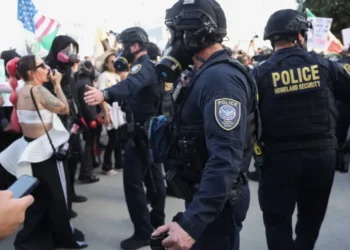
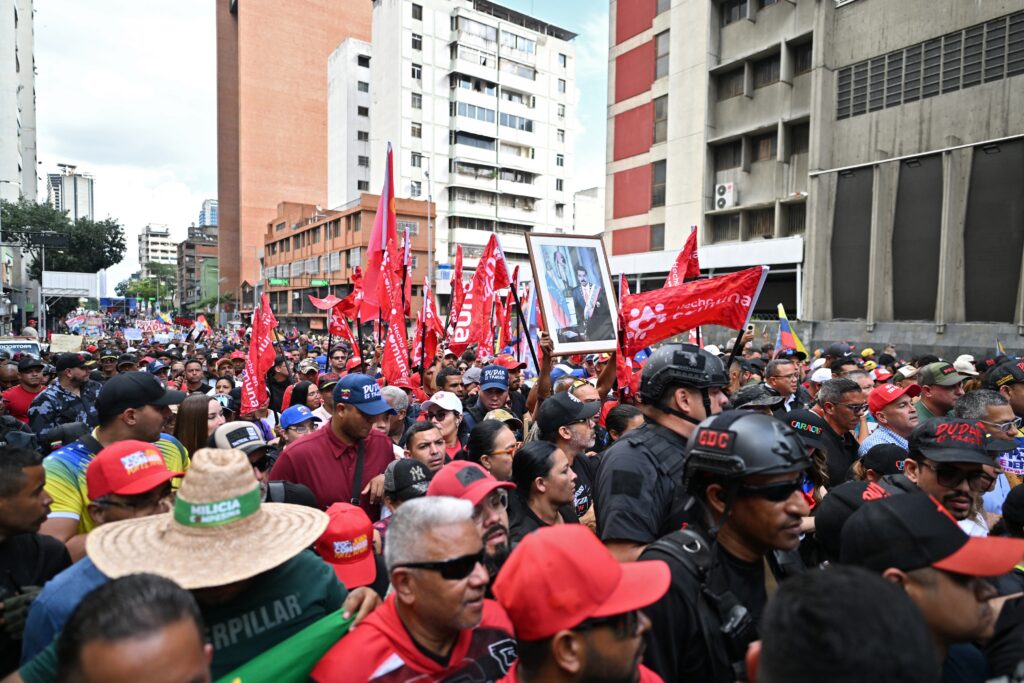
In Caracas, the site of the operation, thousands gathered Sunday at a pro-Maduro rally, yelling slogans and crying. Across the U.S., hundreds of exiled Venezuelans celebrated Maduro’s ouster, dancing and cheering in the streets of South Florida, Texas and New York.
Some Latin American heads of state — including Brazil’s Luiz Inácio Lula da Silva, Colombia’s Gustavo Petro and Mexico’s Claudia Sheinbaum — decried what they called an illegal act of military aggression by the U.S. Cuba’s Foreign Ministry accused Trump and his administration of using the operation as an excuse to gain “unrestricted access to and control over the natural wealth of Venezuela and the region.”
Other leaders more aligned with Trump — namely Javier Milei of Argentina, Daniel Noboa of Ecuador and Nayib Bukele of El Salvador — welcomed the operation.
The Organization of American States, a regional body for the Western Hemisphere, said that it will convene a special session Tuesday on the situation in Venezuela.
Beijing also condemned the U.S. operation, which came hours after a Chinese special envoy met with Maduro to reaffirm the country’s support for his regime.
Foreign officials across Europe, Africa and elsewhere accused the U.S. of violating international law and the United Nations charter, which bars use of force against an independent and sovereign state.
“The UN Charter is not optional — it is our guiding framework, in moments of calm and in times of crisis,” Annalena Baerbock, president of the U.N. General Assembly, wrote on X.
U.S. Ambassador to the United Nations Mike Waltz defended the operation in an interview with Fox News on Sunday, arguing that deposing Maduro fell under the U.S. right to self-defense because he represented a threat. Maduro, Waltz claimed, was “an illegitimate leader indicted in the United States” who was “pumping drugs, thugs and weapons into the United States.”
The post What to know about Maduro, his capture and Trump’s plans for Venezuela appeared first on Washington Post.