As bombs landed on Caracas early Saturday morning, friends and family members told me that their houses seemed to shake. The city is in a valley, so nearly every building has a view—on this January morning, of fires dotting the hills and little, loud aircraft flying in all directions, like a mosquito swarm on a hot night.
Venezuelans have been through a lot in recent decades: the rise of Hugo Chávez, a ruinous revolution that turned democracy into dictatorship, an economic crisis that became a humanitarian one, the emigration of more than one in four inhabitants. Many people are by now familiar with the smell of tear gas and the sound of gunshots. But the sensory experience of bombs falling from the sky was for the most part novel. The Trump administration hit military bases mainly in or near Caracas; at least seven explosions killed dozens of people.
Many Venezuelans welcomed the strikes. Before Saturday, polls showed that a majority of Venezuelans both inside and outside the country favored U.S. military intervention. María Corina Machado, the leader of the opposition movement, issued a statement following the American operation: “Venezuelans, the hour of freedom has arrived!” she said, adding, “Let’s remain vigilant, active, and organized, until the Democratic Transition is fulfilled.”
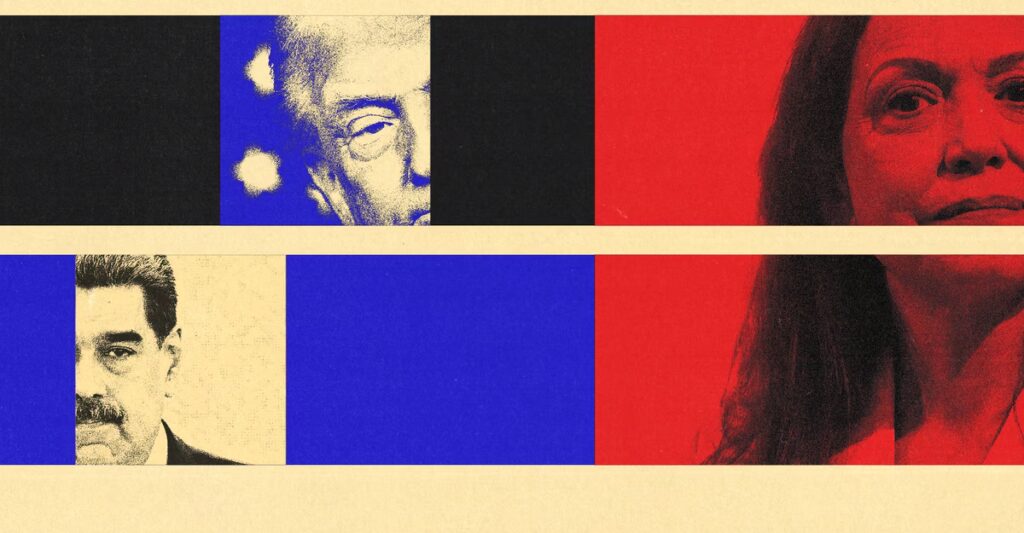
The simplest reason for celebration is that Nicolás Maduro is out. The dictator who imprisoned and tortured Venezuelan politicians, activists, and ordinary people was snatched from his bed and put on an American plane with his wife, Cilia Flores. Photos of him under arrest have already brought catharsis to millions. But there are reasons to be wary too. The dubious legality and shifting rationales behind Donald Trump’s actions raise questions about the administration’s intentions. The New York Times reported last month that some officials have sought a pretext to invoke emergency powers to deport Venezuelans from the United States. And Trump has given no indication of caring about the legitimacy of the regime that will follow Maduro’s.
Machado appears unbothered by these concerns. She has long been close to Secretary of State Marco Rubio, and their friendship may well have influenced the administration’s Venezuela policy. Months before the first Caribbean strike—and before the administration singled out Venezuela as a drug threat—Machado told me that she hoped to see a “big anti-narcotics operation in the Caribbean.” In the spring, she hosted a press conference where she framed the fall of Maduro as “A Trillion-Dollar Opportunity” for American investors. She said that post-Maduro Venezuela would welcome American oil companies—an invitation that Trump officials appear to be seizing on. When she won the Nobel Peace Prize in October, she dedicated her award to Trump.
[Read: Venezuela is open for investment*]
The Trump administration has done exactly what Machado asked of it, but Trump spoke of her dismissively in his press conference on Saturday. It’s not clear whether she will have much of a role in shaping Venezuela’s future. “She is a very nice woman, but she doesn’t have respect within the country,” Trump told a reporter, without so much as naming her. Instead, power will be shared between the American government and Maduro’s vice president, Delcy Rodríguez, at least for the time being. Machado seems to have lost control of the operation she helped set in motion.
Venezuela’s opposition wasn’t always so sanguine about foreign military intervention. Its leaders and activists have tried and failed to bring down the dictatorship by many other means in the nearly 13 years since Maduro succeeded the far more charismatic Chávez as Venezuela’s strongman. Protests erupted across the country in 2014 and again in 2017; Maduro sent tanks into the streets, arrested dissidents, and waited for the heat to subside. In 2019, opposition leaders persuaded the first Trump administration to recognize the politician Juan Guaidó as Venezuela’s legitimate leader. Dozens of countries followed suit. Maduro ramped up repression and did what he does best—waited things out.
During the 2019 debacle, opposition leaders debated what exactly they wanted the United States to do if Maduro refused to relinquish power. Guaidó was himself ambivalent. “If the Americans would propose a military intervention, I would probably accept,” he told an Italian newspaper. Even then, Machado was more decisive. “I want to be very precise,” she told the BBC in 2019. “Maduro will only leave power when he’s faced with a credible, imminent, and severe threat of the use of force.”
Leopoldo López, an opposition leader who spent many years in prison and is now in exile, told me in 2024 that he and Machado were always seen as “more radical” than others in the movement. At a time when some activists worried that calling Venezuelans to demonstrate would only put them at risk, López and Machado favored mass protests.
Machado ran for president against Maduro in 2024, after securing more than 90 percent of the vote in the opposition primary. Maduro barred her candidacy, perhaps calculating that no substitute would accrue the same gravitas. In fact, the substitute Machado chose, Edmundo González, beat Maduro 2–1. And Machado had the tally sheets to prove it, because she’d coordinated volunteer election watchers all over the country. International bodies certified Machado’s counts. World leaders applauded her remarkable victory. Still, Maduro hung on to power.
The electoral fraud left the opposition dejected. “Everything that I always dreamt would happen happened,” Roberto Patiño, an opposition activist, told me in the fall. “We won; presidents backed us; Maduro was offered an exit path. I really thought, This has to work!”
“Maduro is a cockroach,” Ana Milagros Parra, a 28-year-old activist, told me. “He always survives.”
Parra fled Caracas for Bogotá after the election. Then two of her friends nearly died there in what Colombian authorities said might have been an assassination attempt ordered by Caracas, and she fled Bogotá for Buenos Aires. Now she’s a social-media influencer. She told me that she doesn’t like Trump and thought that his justifications for striking boats were bogus, because Venezuela is not a major player in drug trafficking. But, she said, the opposition couldn’t “afford the luxury” of letting this opportunity slide.
I heard a similar line of argument from another opposition influencer, Germania Rodriguez, a freelance journalist. “Listen, what’s going on here is, beggars can’t be choosers,” Rodriguez told me. “And no one but Trump has taken an interest in our crisis.”
One could easily imagine that the fires around Caracas, and the belittling remarks of the U.S. president, would lead those who’d supported the strikes to reconsider their views. But that’s not what I’ve observed. Figures who have long backed the opposition are praising the attacks as a success.
“The operation against Nicolás Maduro is not just any military operation,” Ivan Duque, a former president of Colombia and a longtime friend of Machado’s, told me. “It is a humanitarian operation, because it was about freeing Venezuela from a satrap, a tyrant, a dictator.”
Duque had watched the press conference in which Trump dismissed Machado, but he wasn’t too worried. After all, it was a spontaneous comment, possibly off-script. Duque expressed confidence that Trump was ultimately a “democrat” despite what others might claim about his authoritarian inclinations: “In politics, there are different styles,” he said. “But beyond style, what matters to me are results.”
Genesis Davila, a Venezuelan human-rights lawyer based in Washington, D.C., told me that she had “no reservations” about the way the strikes were carried out. As the founder of a nonprofit called Defiende Venezuela, Davila has worked to hold Maduro accountable under international law. For years, she has documented extrajudicial killings, persecutions, arbitrary detentions, and torture. “What mechanisms were international law and the human-rights system offering to stop Maduro?” she said. “More reports? More condemnations?”
[Read: The price of humiliating Nicolás Maduro]
Not even people on Machado’s team seem to have been discouraged by Trump’s contemptuous remarks. “María Corina Machado’s force is not something that emanates from Trump’s finger,” Milos Alcalay, a career diplomat who advises Machado on international politics, told me; it comes “from the support that Venezuelans have given to her.” Trump’s claim that the United States would “run” Venezuela was “absurd,” Alcalay conceded. But he suggested that the president couldn’t possibly have meant it, that he was just exerting pressure.
I asked him this: What if Trump has just claimed Maduro as a trophy, and nothing else changes in Venezuela?
“I’ve thought about it,” Alcalay said. “But I don’t think that’ll be the case.”
For the moment, however, regime change is far from guaranteed. Political prisoners remain imprisoned. Maduro’s vice president is now interim president and seems keen on preserving the status quo: “In Venezuela, there is only one president,” she said on Saturday in a televised address. “His name is Nicolás Maduro.” Diosdado Cabello and Vladimir Padrino, two of Maduro’s most important ministers, have made a point of speaking publicly many times over the weekend.
Maduro is now at the Metropolitan Detention Center in New York City. His first court appearance could come as soon as today, on counts of “narco-terrorism conspiracy,” “cocaine importation conspiracy,” and weapons offenses—charges that are at once extremely serious and grossly mismatched to the enormity of his record.
Venezuela’s opposition, meanwhile, remains in limbo. Will it pay a price for courting a war based on lies? Right now, those I’ve contacted are ebullient, and the movement seems united in the faith that whatever comes next for Venezuela cannot be as bad as what it has endured under Maduro.
The post What the Venezuelan Opposition Wished For appeared first on The Atlantic.