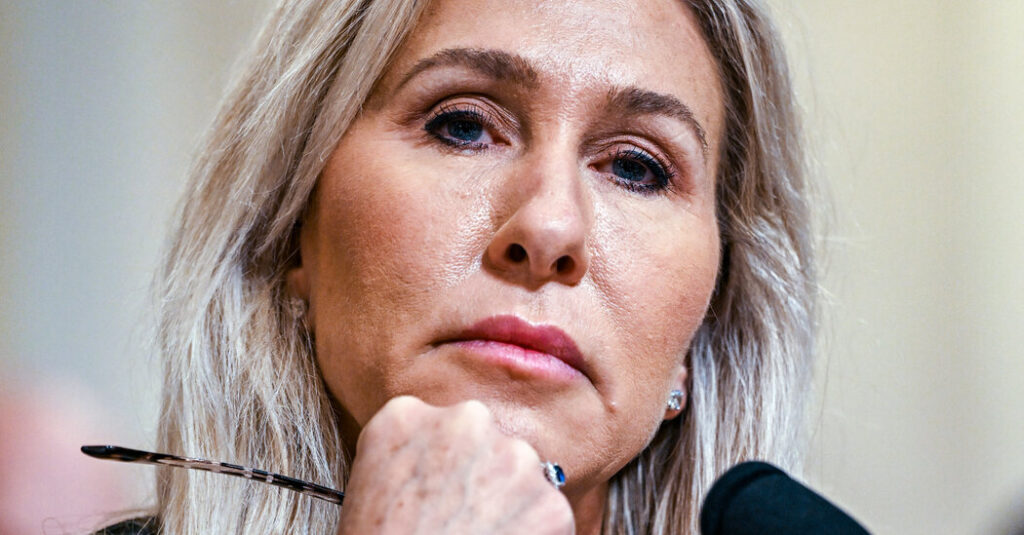
Representative Marjorie Taylor Greene of Georgia, once a fierce ally of President Trump, is set to depart Congress on Monday as a vocal critic of him and his administration. She used her final weekend in office to lament that Mr. Trump’s military intervention in Venezuela was “what many in MAGA thought they voted to end.”
She is far from the only Republican lawmaker to speak in markedly blunter terms about Mr. Trump just as they were leaving Congress or eyeing the exit.
Lawmakers in both parties, of course, tend to be loath to undercut their leaders; it took a catastrophic debate for top Democrats to turn against former President Joseph R. Biden Jr. And some prominent Republican skeptics of Mr. Trump, including Mitt Romney and Jeff Flake, were able to remain in office, at least for a while.
But Mr. Trump’s grip on the Republican Party is so strong that for many of its lawmakers, even mild criticism frequently goes hand in hand with a retirement announcement.
Here’s a look at some of the other Republican members of Congress who have broken ranks with the president on the way out:
Senator Bob Corker
During Mr. Trump’s first term, Senator Bob Corker of Tennessee broke with him over the white nationalist rally in Charlottesville, Va., in 2017, when the president said there were “very fine people on both sides.”
Mr. Corker told reporters that “the president has not yet been able to demonstrate the stability nor some of the competence that he needs to demonstrate in order to be successful.” Mr. Trump responded by attacking Mr. Corker on Twitter, and the senator announced the next month that he would not run for re-election.
Representative Susan Brooks
Representative Susan Brooks of Indiana, who was leading House Republican recruitment efforts for the 2020 election, as the party worked to regain the majority, surprised her colleagues by announcing in June 2019 that she would not run for re-election.
The next month, she was one of four Republicans who voted with Democrats on a resolution to condemn Mr. Trump’s social media posts telling four Democratic congresswomen of color to “go back” to the countries they came from. (In fact, three of the four were born in the United States.)
“I voted to condemn the racially offensive remarks the leader of our country made,” Ms. Brooks wrote on Twitter at the time.
Representative Ryan Costello
Representative Ryan Costello of Pennsylvania announced in March 2018 that he would not run for re-election after a court-ordered redraw of a congressional map made his seat much more difficult to defend.
But he was quick to cite Mr. Trump’s style as a reason he felt compelled to leave. “Whether it’s Stormy Daniels, or passing an omnibus spending bill that the president threatens to veto after promising to sign, it’s very difficult to move forward in a constructive way today,” he told a local newspaper.
He was unfiltered later that year, too, suggesting that Mr. Trump’s mocking of Republicans who lost their re-election bids was like “dancing on somebody’s grave” and was “deeply offensive.”
Representative Dave Reichert
During his time in Congress, Representative Dave Reichert of Washington, a moderate Republican, was not a particular fan of Mr. Trump.
However, it was not until Mr. Reichert announced his retirement in September 2017 that he unleashed a more scathing criticism. In an interview with Vice days later, he mentioned Mr. Trump’s “Access Hollywood” comments about groping women and said he would have felt compelled to take action if Mr. Trump had made them in Seattle when Mr. Reichert was the sheriff.
“If the statute of limitations was still in existence, and he made those comments in King County, and you know it happened in King County, that’s a person that I would have to arrest,” Mr. Reichert said.
Representative David Trott
Representative David A. Trott of Michigan cited Mr. Trump as a factor in his decision to announce his retirement in September 2017. That November, speaking more freely without the restraints of a re-election campaign, Mr. Trott told CNBC, “We have different styles and I sometimes don’t understand some of the things he does and says.”
He added, “It’s a very partisan environment and I think that problem has been exacerbated under President Trump.”
Representative Charles W. Dent
Representative Charles W. Dent of Pennsylvania was a moderate Republican who clashed with Mr. Trump, especially over his efforts to repeal the Affordable Care Act. After conservative activists threatened to support a primary challenge against Mr. Dent, he announced in September 2017 that he would retire.
The next April, Mr. Dent introduced a bill aiming to protect the special counsel Robert S. Mueller III from any attempts by Mr. Trump to remove him as he investigated Russian interference in the 2016 election. Days later, Mr. Dent said he would resign early and leave his seat in a matter of weeks, rather than serve out his term.
“The spontaneity and lack of impulse control are areas of concern for lots of members on both sides of the aisle,” Mr. Dent said of Mr. Trump that month. “Disorder, chaos, instability, uncertainty, intemperate statements are not conservative virtues in my opinion.”
Representative Paul Mitchell
Like Ms. Brooks, Representative Paul Mitchell of Michigan criticized Mr. Trump for his tweets in July 2019 about the four Democratic congresswomen of color. Tagging the president on Twitter, Mr. Mitchell told him “we must be better than comments like these. I share the political frustrations with some members of the other party, but these comments are beneath leaders.”
A week later, Mr. Mitchell said he would not run for re-election, telling Politico that the “rhetoric and vitriol” had become overwhelming. In December 2020, he said he was leaving the Republican Party over its refusal to accept Mr. Trump’s election defeat that year. He died of cancer in 2021.
Representative John Shimkus
Representative John Shimkus of Illinois said in August 2019 that he would not seek re-election. Just over a month later, he went further than many of his colleagues in unloading on Mr. Trump over his decision to reposition U.S. troops in Syria, which opened Kurdish U.S. allies to an attack by Turkey.
“I’m heartbroken,” Mr. Shimkus told a radio station. “In fact, I called my chief of staff in D.C. and said, ‘Pull my name off the “I support Donald Trump” list.’ We have just stabbed our allies in the back.” He added, “This has just shocked, embarrassed and angered me.”
Representative Francis Rooney
Representative Francis Rooney of Florida told reporters in October 2019 that he was not ruling out voting to impeach Mr. Trump over his attempts to pressure Ukraine to investigate his political rivals. “I want to get the facts and do the right thing,” Mr. Rooney said at the time, “because I’ll be looking at my children a lot longer than I’m looking to anybody in this building.”
A day later, he announced his retirement, though he denied that his decision was related to the impeachment comments. (Ultimately, Mr. Rooney voted against impeaching the president, as did the rest of his party.)
Representative Pete Olson
In July 2019, Representative Pete Olson of Texas wrote on Twitter that Mr. Trump’s tweets about the Democratic congresswomen of color were “not reflective of the values of the 1,000,000+ people in Texas 22,” referring to his congressional district.
“I urge our President,” he added, to “immediately disavow his comments.”
Just over a week later, Mr. Olson said he would not run for re-election.
Kellen Browning is a Times political reporter based in San Francisco.
The post Trump’s Harshest Republican Critics? Members Headed for the Exits. appeared first on New York Times.