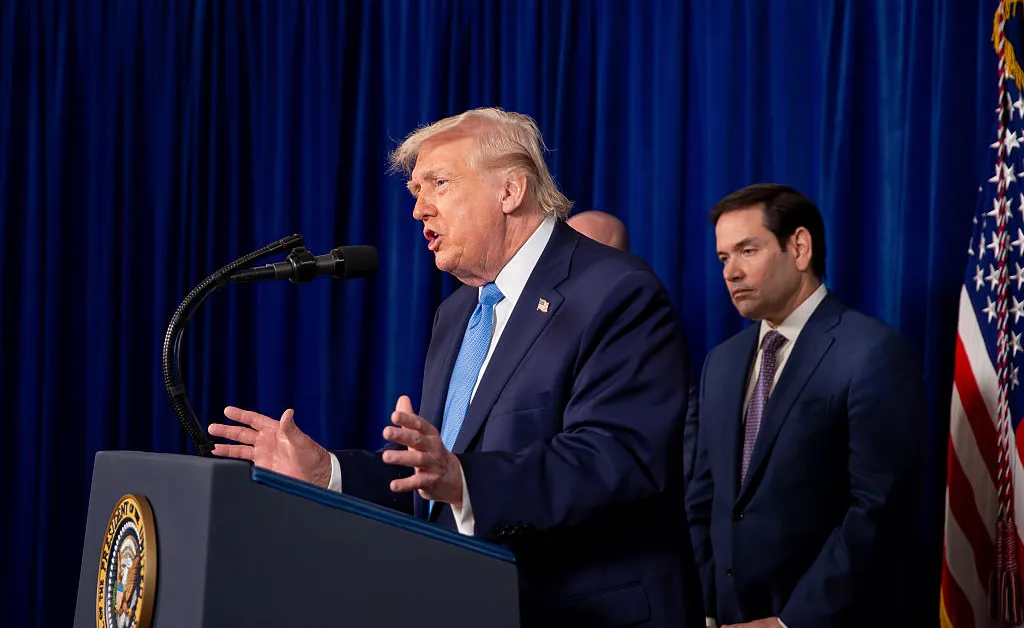
President Donald Trump has been remarkably explicit about the aims of his recent grab-and-go operation in Venezuela. In explaining why U.S. forces went in and out the country to capture Nicolás Maduro, Trump has articulated at least four objectives, all stated with relative clarity. The problem with the president’s goals in Venezuela is not lack of transparency, but a lack of compatibility.
[time-brightcove not-tgx=”true”]
So far, the four stated goals of America’s strike on Venezuela have been: securing greater U.S. access to Venezuelan oil; curbing drug trafficking; halting Venezuelan migration; and democratizing Venezuela. This last goal has received the least emphasis and is perhaps the most dubious. But to be sure, each objective is incompatible with at least one of the others, if not all three. One—or several—will inevitably be sacrificed. In the process, Trump’s true priority will eventually be revealed.
The first stated goal is that the United States entered Venezuela to gain access to its oil. In a way, the oil would “pay for itself.” As Trump put it, this mission is “not going to cost us anything, because the money coming out of the ground is very substantial.”
But the claim that the U.S. went in for the oil is puzzling. Geopolitically, the United States does not currently need additional oil. The U.S. has been an annual net total energy exporter since 2019. The greatest beneficent of American access to Venezuelan oil will not be everyday American consumers, but instead major U.S. oil companies, who provided significant financial support to Trump during his reelection campaign.
Either way, what is striking about this oil-centered hypothesis is how easily it could be accommodated without regime change. Many members of Maduro’s political party, the Chavistas, will remain in power. And even Maduro himself when he was in power showed willingness to trade political or diplomatic concessions for expanded oil access to U.S. companies. If oil is the primary objective, the other goals—counter-narcotics, migration control, and regime change—would not be needed since many authoritarian successors would happily deliver oil access to satisfy Trump’s demands.
But Trump has said his objectives extend beyond oil. He has also emphasized containing drug trafficking. His keenest accusation against Maduro is not human rights abuse or economic mismanagement, but allegedly waging a drug war against the United States. For Trump, replacing Maduro would significantly disrupt drugs from South America.
This view, however, rests on an outdated understanding of narcotrafficking. Trump seems to imagine a hierarchical system dominated by a single capo whose removal collapses the organization—a model rooted in the 1980s. Today’s drug economy is decentralized and fragmented, involving multiple competing actors across different aspects of the business: production, collection, local transport, international shipment, distribution at destination, bribing officials, and deploying violence against challengers. In today’s drug business, many of these activities are outsourced, rather than controlled by one central entity. No single leader can dismantle such a supply-chain system. Removing Maduro would have, at best, marginal effects.
If Trump truly wants to eliminate Venezuela as a node in global narcotrafficking, the United States would need deep involvement in Venezuela’s institutional development. Multiple forms of cooperation with and training of law enforcement officials would be needed. The criminal justice system would need to be revamped, with an emphasis on justice. Courts would need to become independent and professional. Essentially, a new state would need to be re-erected. That requirement would directly contradict Trump’s goal of avoiding nation-building, or at least, paying for it. If Trump wants a cheap and quick solution, rather than a protracted conflict, he will need to sacrifice the goal of containing drug trafficking.
The third objective—curbing migration—has been less explicit but is clearly implied. In his Fox News interview on Jan. 3, Trump blamed Maduro for “sending prisoners and people from mental institutions and drug lords … by the hundreds of thousands” to the United States. Trump seems to be implying that Maduro was waging not just a war with drugs against the United States, but also a war with people. In doing so, he also suggests that many Venezuelan immigrants are delinquent or mentally unfit, a belief that is both misinformed and threatens to insult his supporters.
Regardless, Trump says he wants Venezuela to stop exporting people. The problem is that the most reliable way to stop people from leaving Venezuela is through economic recovery and the rise of human rights. Here again, his objectives collide. If U.S. policy toward Venezuela focuses narrowly on oil extraction for U.S. majors rather than investing in recovery, reconstruction, and institution-building, the drivers of migration will persist. Economic misery will remain. If there is too much emphasis on deploying coercion to stop drug trafficking, human rights conditions likely will not improve immediately, and migration will continue.
Trump’s fourth stated objective in Venezuela is democratization. But on Jan. 3, President Trump declared Venezuela would not be led by María Corina Machado, the undisputed opposition leader since 2024 and recent Nobel Peace Prize winner, but by current Vice President Delcy Rodríguez. Trump spoke not so much of democratization but of “running the country” until “a safe, proper and judicious transition.” Some Trump supporters, including perhaps some senior advisors, might still interpret this as a commitment to establish and strengthen democracy in Venezuela. For this reason, sidestepping Machado, came as a shock to many. When asked about the role that Machado would play, Trump said: “she doesn’t have the support within or respect within the country” needed to govern.
In truth, sidelining Machado is incompatible with democratization. There is no credible path to democracy in Venezuela that excludes her and her party. Machado in 2024 led one of the most successful electoral challenges to an authoritarian regime in modern history—and won. For this effort, Machado was awarded a Nobel Peace Prize in 2025. “Running the country” without placing Machado’s party and allies in charge is tantamount to abandoning democratization altogether. It’s a betrayal of Venezuelan voters and threatens to become another instance in which Trump refuses to recognize an electoral outcome.
The United States cannot simultaneously achieve all four objectives as currently stated. They fundamentally conflict. One—or several—must be abandoned. What the world needs now is not another list of Washington’s goals for Venezuela, but clarity about which of the stated goals the United States is more willing to give up.
The post Trump’s Goals in Venezuela Don’t Add Up appeared first on TIME.