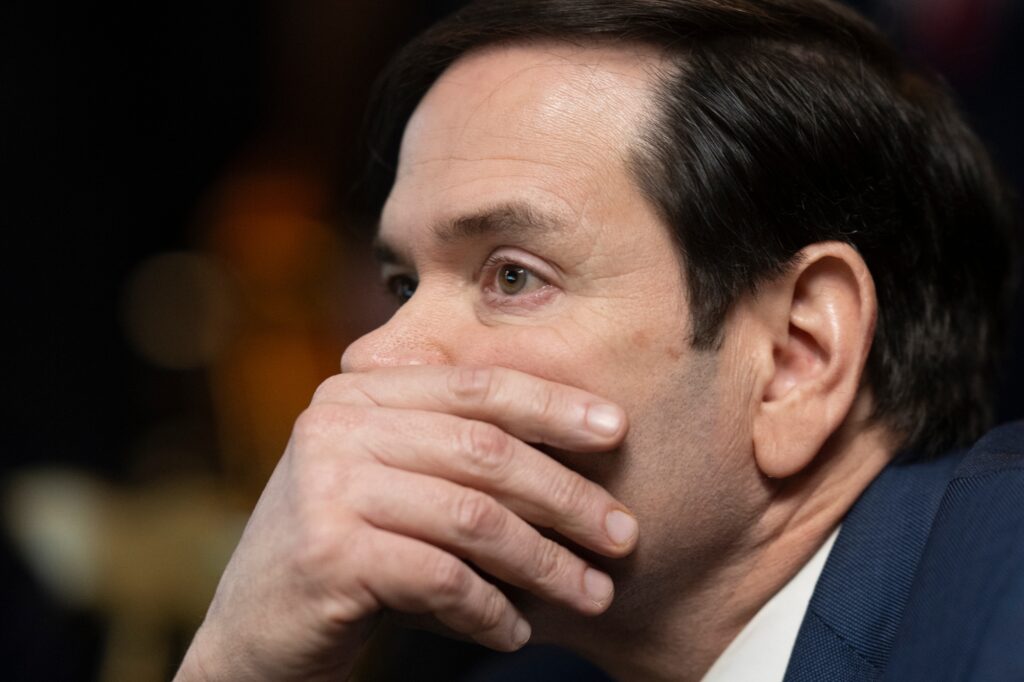
President Donald Trump gave Secretary of State Marco Rubio, who also serves as national security adviser and acting archivist of the United States, another job this weekend: “running” Venezuela. Rubio made the rounds on the Sunday shows, but plenty of questions remain about his unenviable new assignment.
Rubio explained that his priority after the removal of Nicolás Maduro is ensuring that Venezuela acts in U.S. interests. In practice, that means convincing Maduro’s No. 2, Delcy Rodríguez, to halt drug trafficking, remove militant groups and end Venezuela’s cozy relationships with U.S. adversaries. “We are going to judge whoever we’re interacting with moving forward by whether or not those conditions are met,” Rubio said.
Straightforward enough, but will Venezuelan leaders really cooperate with the U.S.? So far, Rodríguez has struck a publicly defiant tone. She is a dyed-in-the-wool Chavista whose radical Marxist father was jailed for his crimes against an American businessman in the 1970s.
It’s possible Rodríguez’s public attacks on the U.S. and demands that Maduro be returned home are directed toward a domestic audience. Washington certainly has plenty of leverage over her, including its continuing naval embargo on oil exports. There is also the threat of a second wave of military action, including Trump’s professed willingness to put U.S. soldiers on the ground. Trump said during his Saturday news conference that Rubio is in touch with her and she is open to U.S. demands, but it would not be the first time Trump’s description of another world leader’s views were more hopeful than accurate.
But Rodríguez isn’t the only powerful person in Caracas. Hard-liners such as Interior Minister Diosdado Cabello Rondón and Defense Minister Vladimir Padrino López face U.S. criminal indictments but control much of the apparatus of the state. For years, Maduro and his cronies have maintained their grip on power by keeping the nation’s well-paid military leaders on their side, as well as the armed gangs that have essentially controlled large swaths of the country in Maduro’s name. What happens to those power structures after Maduro’s capture remains anyone’s guess.
Another unknown: what happens to opposition leaders, such as Nobel Peace Prize winner María Corina Machado. Trump dismissed her chances of taking over the country, at least in the short term, because she does not have the armed forces on her side.
Still, U.S. officials are unwise to prematurely write off Machado’s chances of emerging as president. She has legitimacy with the Venezuelan people, given that her party handily won the country’s 2024 election. She also earned their respect for staying in the country even after the Maduro regime targeted her. Moreover, she has a strong record of standing for democracy and free markets, and she’s committed to doing lucrative business with the U.S. It’s very likely she’d win a national election if allowed to appear on the ballot.
The most difficult question is how long the Venezuelan people at home and abroad will tolerate ambiguous American policy. Millions are celebrating Maduro’s removal from power, and they are cautiously optimistic that freedom is within reach. But those sentiments could turn if they begin to perceive that the U.S. is keeping the remnants of the authoritarian Maduro regime in place while extracting the country’s oil wealth for its own benefit.
The best way forward is for the Trump administration to consistently take the side of the Venezuelan people — and to make clear that the end goal is economic freedom and democracy, whatever messiness comes first.
The post The unknowns in Venezuela are brutally obvious appeared first on Washington Post.