After the inauguration of Andrew Jackson, in 1829, thousands of his supporters poured into the White House to celebrate. The crowd overwhelmed the staff and trashed some of the furniture before the party was relocated to the White House lawn. The episode earned Jackson the nickname “King Mob” and became a symbol of his man-of-the-people persona.
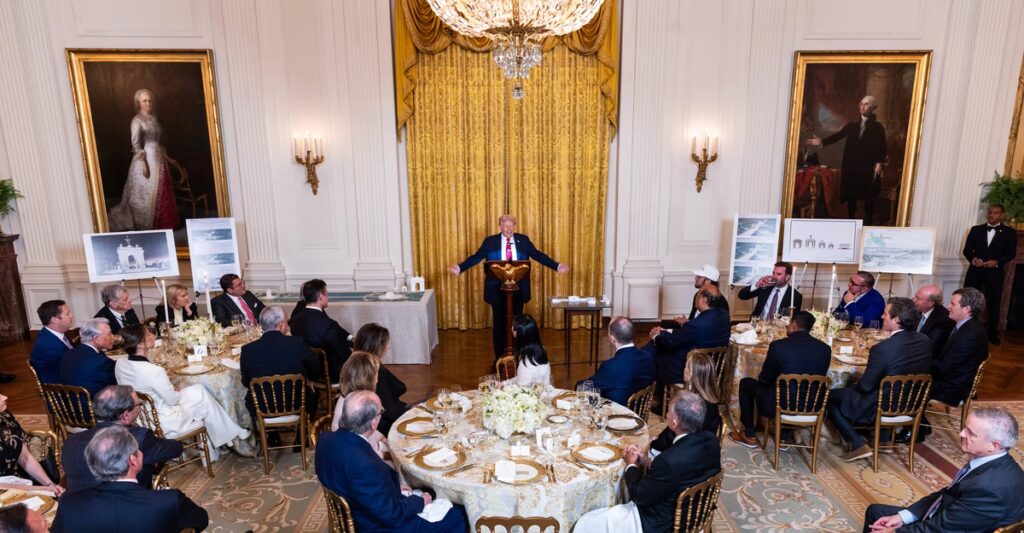
Donald Trump is often compared to Jackson, but the events he has hosted since his second inauguration carry a different sort of symbolism. In May, he held a dinner at one of his golf courses for the 220 people who had spent the most money—$148 million, collectively—to buy his $TRUMP crypto meme coin. In October, he hosted a White House dinner for the rich individuals and corporate executives who had donated to his White House–ballroom project.
For the past decade, Trump has supposedly been on the verge of breaking from the laissez-faire economics of the Reagan GOP—otherwise known as neoliberalism—in favor of pro-worker populism. And in some ways, he really has succeeded in casting out the ghosts of Reaganomics by embracing hands-on market interventions. The New York Times business reporter Andrew Ross Sorkin has called Trumponomics a form of “state-sponsored capitalism.” A recent essay by Scott Lincicome, the vice president of general economics at the libertarian Cato Institute, calls 2025 “the year America went (kinda) socialist,” and describes Trump’s approach as “state corporatism.”
What these accounts leave out is the fact that Trump has simultaneously steered economic policy in an even more pro-business direction than his Republican predecessors, including his own first-term administration. When they aren’t personally being shaken down by the president, corporations and billionaires are being left to do as they please in pursuit of profit. Greed has never been this good.
[Derek Thompson: The era of step-on-a-rake capitalism]
The result is a strange contradiction that the term socialism doesn’t begin to capture. Trump’s economic management combines two theoretically incompatible tendencies. It is at once libertarian, because the state is doing less to protect consumers and workers, and authoritarian, because the government sometimes lawlessly interrupts the workings of the free market in service of the personal and ideological interests of Trump and his allies. This makes MAGA economics a seemingly impossible hybrid: libertarian authoritarianism.
One might have expected Trump’s first term to have put to rest any dreams of a pro-worker GOP policy revolution. With rare exceptions, his economic agenda catered to the super-wealthy, corporate America, and anti-government activists. He passed an enormous tax cut that disproportionately favored corporations and rich individuals. His National Labor Relations Board took positions favored by employers, narrowed workers’ ability to organize, and rolled back a rule expanding eligibility for overtime pay.
Some supporters still insisted that Trump had the common man’s interests at heart. They had an explanation for the disappointments of his first term: Trump had been surrounded by traditional Republican staffers who carried water for Big Business and sabotaged any effort to break from neoliberalism. The likes of Steve Mnuchin weren’t true MAGA. Once Trump had a team of loyal soldiers around him, everything would be different. “We’re done catering to Wall Street,” J. D. Vance declared at the 2024 Republican National Convention.
We now have a year’s worth of data by which to judge the accuracy of such predictions. No one can deny that Trump is doing what he wants, and what he wants is slashing clean-air regulations, rolling back consumer protections (such as a rule requiring airlines to compensate passengers for canceled flights), shutting down the Consumer Financial Protection Bureau, extending corporate tax cuts, attempting to ban state-level AI regulation, pardoning financial scammers, letting the crypto industry run wild (while Trump himself gets in on the action), allowing betting companies to brazenly flout state-level gambling bans, and so on. The NLRB as of this writing doesn’t even have a single member. Trump’s treasury secretary, Scott Bessent, recently argued on cable news that the regulations imposed on the banking sector after the 2008 financial crisis were too strict and must be rolled back. Stacks of earnest pro-worker policy proposals from “New Right” think tanks sit untouched.
What makes things confusing is that Trump is breaking from neoliberalism in many ways—they just have very little to do with economic policy per se, and much more to do with increasing Trump’s personal power. Antitrust is one domain where progressive Democrats and MAGA diehards have found common ground. But under Trump 2.0, enforcement is down (libertarianism) even as the administration seems to steer corporate consolidation in Trump’s favor (authoritarianism). The Federal Communications Commission, for example, didn’t approve Skydance’s acquisition of Paramount until after CBS News, a Paramount subsidiary, agreed to pay $16 million to Trump’s presidential-library fund to settle a personal lawsuit filed by the president. Skydance also committed in writing to various ideological reforms, including appointing an anti-bias ombudsman at the network. More recently, referring to Skydance’s effort to outbid Netflix to acquire Warner Bros., Trump told reporters, “I’ll be involved in that decision.”
Meanwhile, Trump’s Federal Trade Commission has abandoned its defense of a Biden-era rule banning employers from using noncompete clauses, a practice that research has shown suppresses worker wages. At the DOJ, two top antitrust officials were fired after protesting the department’s decision to allow Hewlett Packard Enterprise to acquire one of its biggest competitors. One of those officials, Roger Alford, later gave a speech in which he suggested that America was being governed not by the rule of law but by “the rule of lobbyists”—a nod to accusations that the deal had been pushed through because the parties had paid the right MAGA influencers to push for it.
Another post-neoliberal innovation by Trump 2.0 is the extraction of tribute payments from corporations with business before the government. Trump has required companies including Intel, U.S. Steel, and Nvidia to give the federal government various degrees of ownership stakes in their business, and more such deals are expected. As Lincicome, the Cato vice president, points out, no one has offered any strategic rationale for doing so. “We should take stakes in companies when people need something,” Trump has said. If this is socialism, it is socialism without a proletariat, central planning without a plan.
Even Trump’s massive global tariffs have almost no logical connection to the major critiques of free trade—or, as far as anyone can tell, to any consistent policy objective at all beyond allowing Trump to alpha-dog America’s trading partners. Experts from across the political spectrum have argued that carefully targeted tariffs can bolster key domestic industries, particularly manufacturing, and protect the subset of workers whose jobs are most threatened by cheap imports. Trump instead chose to impose indiscriminate tariffs on almost every country on Earth, for almost every category of import. Economists warned that this approach would hurt domestic manufacturing by raising the price of raw materials. They appear to have been right: Employment in the manufacturing sector has trended down ever since “Liberation Day.”
The counterargument that Trump’s economic-populist defenders fall back on is that the president has kept his pledge to America’s common man where it matters most: immigration. They argue that illegal immigration suppresses wages and job opportunities for native-born workers. Trump’s crackdown is thus a huge blow struck in favor of the American working class, and against corporate overlords who prefer to have a steady supply of cheap labor.
[Scott Lincicome: America’s Perón]
As my colleague Rogé Karma explained last year, however, essentially the entire weight of empirical economic evidence suggests that this theory has never been true in practice. (Immigrants don’t just increase the labor supply; they also increase demand for labor, because they consume goods and services.) And indeed, according to the most recent federal jobs report, the unemployment rate rose from 4.0 percent in January to 4.6 percent in November—the highest jobless rate since September 2021—and was higher year-over-year for native-born workers specifically.
Even if the theory were correct, that wouldn’t explain Trump’s actual policies. Detaining a Turkish graduate student who criticizes Israel does not open up any jobs for native-born construction workers. Neither does shutting down citizenship proceedings for lawful immigrants from 19 countries or restricting the asylum program mostly to white South Africans. Trump’s immigration policies don’t make sense as a pro-worker agenda, but do make sense as a way of silencing dissent and keeping out nonwhite immigrants.
The idea that Trump’s immigration policy is designed to help the American worker would be easier to take seriously were he not simultaneously giving every possible concession to the industry most likely to cause mass job loss in the near future. In a recent Reuters/Ipsos poll, 71 percent of Americans said they worried about AI “putting too many people out of work permanently.” Yet the Trump administration, with its close ties to Silicon Valley centibillionaires, is assiduously removing any obstacles to the growth of the AI sector. After Congress failed to include a moratorium on state-level AI regulation in a spending bill, Trump issued an executive order directing the DOJ to sue states that dare to pass laws protecting their citizens from the technology.
Authoritarianism and libertarianism are commonly thought of as opposites—two poles on a political spectrum. It is a sign of Trump’s distinctive political genius that he has managed to combine the two concepts. By tearing down generally applicable restraints on corporate behavior while selectively exerting direct influence to reward his allies and punish his critics, he has managed to preserve all the flaws of the old Republican economic approach while introducing new ones that are even worse.
The post The Rise of Libertarian Authoritarianism appeared first on The Atlantic.