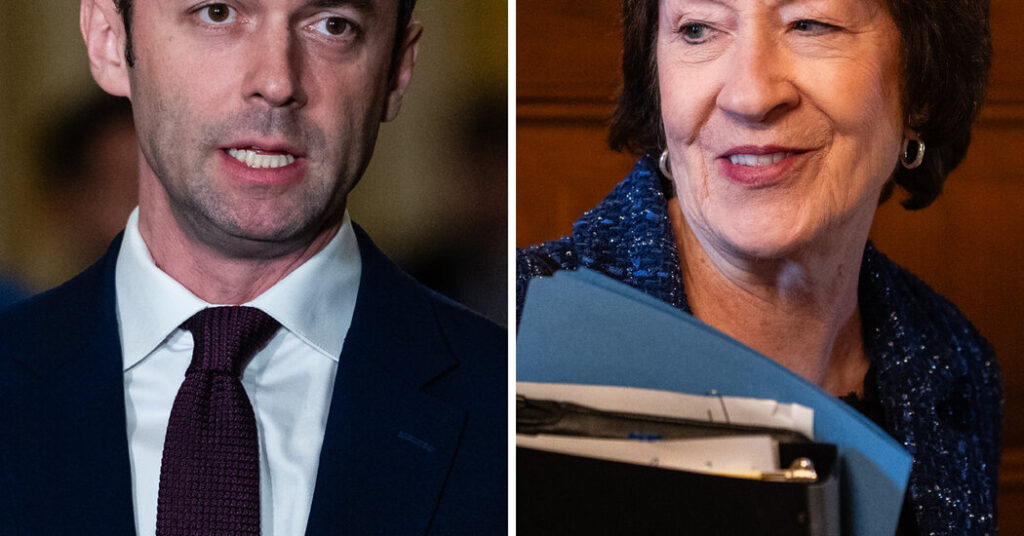
Democrats hoping to regain control of the Senate in this year’s midterm elections face a tough task: They must flip four seats controlled by Republicans, on a map that offers few obvious opportunities.
Midterm elections are traditionally an uphill battle for the party in the White House, and some of President Trump’s unpopular policies could hinder his party’s efforts to maintain a majority in the Senate and continue advancing his agenda. But Democrats control only 47 seats, compared with 53 for Republicans, and they also have to defend vulnerable seats of their own.
Still, Democrats in recent months have had a streak of good luck, recruiting top-tier candidates in some of the most important races.
Here’s a look at the top Senate races to watch in 2026.
Key open seats and vulnerable incumbents
Maine: Senator Susan Collins, the fifth-term lawmaker from Maine, is a top target of Democrats. She is the only Republican senator who represents a state won by former Vice President Kamala Harris in 2024, but she has cultivated a reputation as a moderate pragmatist and has proved extremely tough to oust.
Gov. Janet Mills, the popular and term-limited Democratic governor, jumped into the race in October and appears to be the pick of much of the party establishment. Ms. Mills would be a formidable challenger to Ms. Collins, but she has a primary to get through first.
And Ms. Mills, who would be 79 by the time she was sworn into the Senate, is facing a much younger primary opponent, 41-year-old Graham Platner, who has become a progressive favorite. But Mr. Platner, an oyster farmer and Marine veteran, also faces nagging questions about past controversies, including a tattoo he got years ago that resembles Nazi imagery.
Georgia: Senator Jon Ossoff, a Democrat, will likely have to attract some Trump supporters to earn re-election in Georgia, a battleground that Mr. Trump carried in 2024.
Mr. Ossoff, a strong fund-raiser who won a runoff election in early 2021, will face tough sledding this year. But he caught a break when Gov. Brian Kemp, a popular Republican viewed as Mr. Ossoff’s toughest challenger, said in May that he would not run against him.
Instead, three Republicans have jumped into the primary: Derek Dooley, a former college football coach with close ties to Mr. Kemp, and Representatives Mike Collins and Buddy Carter.
North Carolina: The open seat in North Carolina, a perennial battleground that Mr. Trump has won three times, may be Democrats’ best pickup opportunity. Senator Thom Tillis, a Republican, said in June that he would not run for re-election, after Mr. Trump assailed him for opposing his signature domestic policy bill and threatened to back a primary challenge.
Two high-profile politicians seeking the seat could make the general election an expensive, marquee clash: The popular former Gov. Roy Cooper is running on the Democratic side, and Republicans have Michael Whatley, a favorite of Mr. Trump’s who stepped down from his role as chair of the Republican National Committee to run for the seat.
Michigan: Senator Gary Peters, a Democrat, said at the beginning of last year that he would not run for re-election, setting off a race among Michigan Democrats to replace him and offering Republicans a chance to go on offense in a swing state.
The Democratic primary is a three-way contest. State Senator Mallory McMorrow, a 38-year-old who is one of the party’s leading advocates for generational change, faces Dr. Abdul El-Sayed, 41, a progressive former public health official, and Representative Haley Stevens, 42, a suburban Detroit moderate.
Republicans have coalesced around one candidate: Representative Mike Rogers, 62, who narrowly lost in the general election for Michigan’s other senate seat in 2024.
Where parties need to defend friendly turf
Ohio: Senator Jon Husted, a Republican, was Ohio’s lieutenant governor until January, when he was appointed to fill the Senate seat vacated by Vice President JD Vance. Running in a special election this year to serve out the remainder of Mr. Vance’s term, which would have ended in 2028, Mr. Husted should have had an easy path in a former battleground that has become a safely Republican state.
But Democrats scored a big win in August, when former Senator Sherrod Brown said he would attempt a comeback. Mr. Brown, a mainstay of Ohio politics who lost his re-election bid in 2024, could win over a sizable portion of working-class voters and make the race competitive — though he starts at a disadvantage given the state’s red lean.
Minnesota: Democrats were forced to defend another open seat when Senator Tina Smith of Minnesota said in February that she would retire. Minnesota is a blue state, so the race should tilt Democrats’ way, but both sides have competitive primaries.
Lt. Gov. Peggy Flanagan, who served under Gov. Tim Walz, Ms. Harris’s running mate, will face Representative Angie Craig in the Democratic primary. Republicans have not yet recruited a candidate who appears particularly formidable: Their options so far are former N.B.A. player Royce White, who was the party’s nominee for Senate in 2024, and Adam Schwarze, a former Navy SEAL. Another former N.B.A. player, Willie Burton, has also considered joining the Republican primary.
Iowa: Facing flagging approval ratings and a primary challenger, Senator Joni Ernst, a Republican, said she would not run for re-election in Iowa in August.
Some Democratic challengers had already jumped into the race to defeat her, as the party attempts a comeback in a Republican state that was once a battleground. They include Zach Wahls, a state senator; Josh Turek, a state representative; and Nathan Sage, a Marine veteran and former chamber of commerce president.
Representative Ashley Hinson, a Republican, is the likely favorite to win the seat, given Iowa voters’ conservative bent. Former state senator Jim Carlin is also in the Republican primary.
New Hampshire: Republicans have spied an opportunity in New Hampshire, a former swing state that has trended Democrats’ way at the federal level but has a Republican governor and legislature. Senator Jeanne Shaheen, a Democrat who has held her seat since 2009 and was previously governor of the state, said in March she would not run for re-election.
Representative Chris Pappas, a Democrat, is running to succeed Ms. Shaheen, as is Karishma Manzur, a scientist and progressive. On the Republican side, former Senator John E. Sununu launched a comeback bid in October after representing the state in the early 2000s. And Scott Brown, another former senator who represented neighboring Massachusetts, is also in the Republican primary.
The seats Democrats would like to flip
Alaska: Alaska has not had a Democratic senator since 2014, and with Senator Dan Sullivan, a Republican, running for re-election, that trend is likely to continue. But the solidly red state has an independent streak, and Democrats are hoping they can recruit a candidate who has an outside shot at toppling Mr. Sullivan: former Representative Mary Peltola.
Ms. Peltola is a Democratic star in the state who in 2022 flipped Alaska’s sole House district blue for the first time in decades. She has not said yet whether she will run to reclaim that seat — she lost re-election in 2024 — or for governor or Senate. If she chose to face Mr. Sullivan, she would start the race as an underdog.
Texas: Democrats have long salivated at the possibility of flipping Texas blue, but they have repeatedly fallen short, and Senator John Cornyn, a Republican, would enter a general election as a strong favorite.
Former Representative Colin Allred, a Democrat who lost to Senator Ted Cruz in 2024, bowed out in December, making way for Representative Jasmine Crockett, a high-profile liberal firebrand, to jump in. Ms. Crockett faces James Talarico, a progressive seminarian and rising star in the state legislature, in her primary.
But there is a twist: Mr. Cornyn faces a serious primary challenge from Ken Paxton, the state attorney general who has tied himself closely to Mr. Trump’s base. Mr. Paxton faces several scandals, a weakness that has Democrats hoping he defeats Mr. Cornyn in the Republican primary. Representative Wesley Hunt also entered the primary in October, adding another wrinkle.
Nebraska: Democrats do not usually stand much of a chance in this solidly conservative state. But they would surely prefer the independent candidate Dan Osborn, a former union leader and populist, to Senator Pete Ricketts, a Republican.
Mr. Osborn’s long shot campaign in 2024 against Senator Deb Fischer, the state’s other Republican incumbent, caught her flat-footed and was far more competitive than expected. But Republicans are better prepared for his challenge this time. Democrats are not running a candidate in the race, and the state party’s chair endorsed Mr. Osborn, who remains an underdog to Mr. Ricketts.
Kellen Browning is a Times political reporter based in San Francisco.
The post The Key Senate Races to Watch in 2026 appeared first on New York Times.