In Marco Rubio’s telling, the stunning events in Venezuela on Saturday illustrate an essential truth—possibly the essential truth—about Donald Trump’s presidency: Global leaders cross him at their peril. “I don’t understand yet how they haven’t figured this out,” Trump’s secretary of state told reporters at Mar-a-Lago just hours after the capture of Nicolás Maduro.
World leaders could be forgiven for not understanding the simplicity of the Trump Doctrine, especially those who assume that the world’s dominant superpower still possesses complicated mechanisms for the manufacture of foreign-policy strategies. The country that gave the world the Truman Doctrine and the Reagan Doctrine as well as Trump’s apparent favorite, the Monroe Doctrine, now embraces the plainest and most ostentatiously bellicose of national-security policies: Fuck around and find out. Trump’s own Pentagon chief, the self-styled (until Congress approves the title change) secretary of war, Pete Hegseth, said as much when he told the nation that Maduro “effed around, and he found out.”
If the Fuck Around and Find Out Doctrine doesn’t sound like a concept for a stable and predictable foreign policy—one purpose of Washington’s doctrine-articulation complex—then maybe you can sympathize with those who Rubio says are still struggling to get it. Some experts reject the idea that something this crude even earns the right to be called a doctrine. As John Bolton, currently a Trump nemesis but once one of his first-term national-security advisers, told us, “There is no Trump Doctrine: No matter what he does, there is no grand conceptual framework; it’s whatever suits him at the moment.” Kori Schake, the director of foreign- and defense-policy studies at the American Enterprise Institute, cautioned us that “we shouldn’t ennoble Trump policy by saying there’s a doctrine.”
In the early decades of the 20th century, “America First” was in part a euphemism for U.S. isolation from the ravages of war in Europe. Trump then revived the term, starting in 2016, when he promised to end America’s long post-9/11 conflicts, which cost taxpayers trillions and failed to deliver clear victories. Instead, he would prioritize domestic issues and the well-being of Americans. Yet there he was on Saturday at Mar-a-Lago, vowing to “run Venezuela for the foreseeable future.” And if that involves a bit of nation-building and American boots on the ground, well, so be it. Trump, it turns out, seems to believe that a little foreign adventurism is just fine, as long as he’s the one doing the adventuring. It was a departure from his previous instinct to limit his foreign interventions to short, kinetic bursts of force—an unofficial one-and-done doctrine—visible in his first-term strike on the Iranian military leader Qassem Soleimani and his more recent decision to dispatch U.S. bombers deep into Iran.
“Rebuilding is not a bad thing, in Venezuela’s case; the country has gone to hell,” Trump told our colleague Michael Scherer in an interview yesterday. But when asked why similar actions in Iraq were an abomination, the president punted. “That was Bush,” Trump said. “You’ll have to ask Bush that question, because we should have never gone into Iraq. That started the Middle East disaster.” (In a separate Atlantic interview last year, Trump said that “America First” is whatever he says it is: “Considering that the term wasn’t used until I came along, I think I’m the one that decides that.”)
The White House quickly embraced the newly articulated doctrine, circulating after Saturday’s Mar-a-Lago press conference an image of a determined-looking Trump striding up steps, with the caption—you guessed it—“FAFO.” Another administration publicity push featured Rubio’s warning to foreign nations to not “play games with President Trump,” a politer version of the same idea. “The 47th president of the United States is not a game player,” Rubio said at Mar-a-Lago. “If you don’t know, now you know.” (It’s unclear if Rubio—a self-professed rap fan—was deliberately quoting the Notorious B.I.G., but the White House later posted a video set to the Biggie song.)
It should come as no surprise that Hegseth, with his penchant for scrapping on social media and dressing down generals for being fat, is practically tripping over himself to make FAFO happen. Asked Saturday about where the FAFO policy has applied, Hegseth cited Iran’s nuclear program, Houthi rebels in Yemen, and the southern U.S. border. “There’s been a lot of politicians that want to talk. They want to talk peace. They want to talk diplomacy. They want to talk negotiations. They want to talk globalism and international organizations,” he told CBS News. “President Trump speaks through action.”
So far, Trump appears most willing to take a FAFO approach to the Western Hemisphere. One person close to Trump told us that the president has embraced a different set of criteria for responding to what he sees as irritants in the Americas—such as Maduro—than for those farther afield. “If this were happening in a different part of the globe, none of this would have taken place,” this person said on the condition of anonymity to speak candidly. In other words, Trump views many parts of this hemisphere as a rightful extension of his U.S. sandbox, where he is free to snatch and grab what he pleases. (That glistening Venezuelan oil? The Panama Canal? Mine! That tantalizing slice of Greenland? Also mine!)
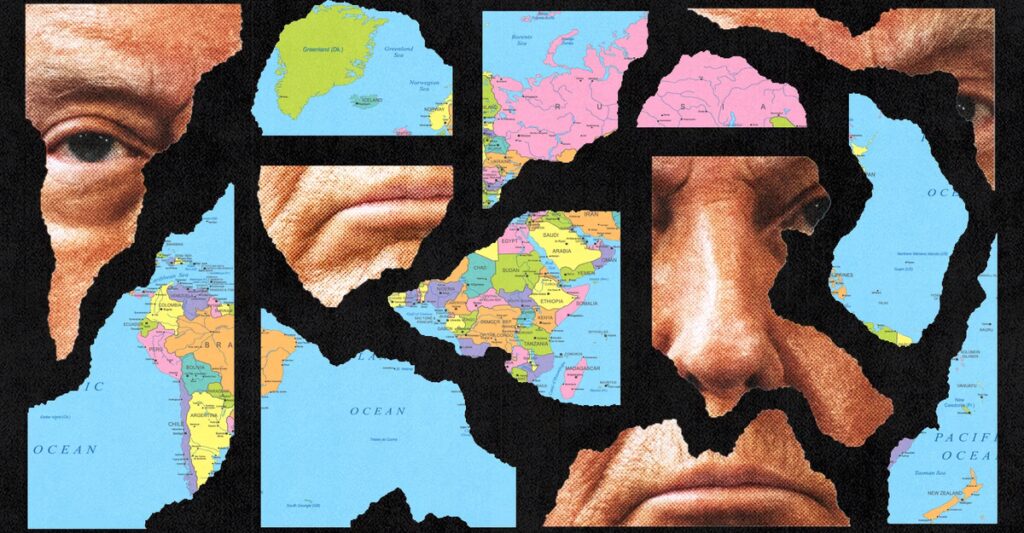
Trump told Scherer that Greenland had not been on his mind when he’d been ousting Maduro—but he then proceeded to offer real-time foreign-policy musings on that very topic, in one of his characteristic verbal weaves. “You know, I wasn’t referring to Greenland at that time, but we do need Greenland, absolutely,” Trump said. “And we need it for defense. You know, it’s surrounded by Russian and Chinese ships. We need Greenland.” (Katie Miller, the wife of the top Trump adviser Stephen Miller, posted an image on social media on Saturday of Greenland covered by an American flag, with the caption: “SOON.” And Denmark’s prime minister, Mette Frederiksen, urged Washington yesterday to end its threats, which she said make “absolutely no sense.”)
Read: [Trump threatens Venezuela’s new leader with a fate worse than Maduro’s]
Kevin Whitaker, who served as U.S. ambassador to Colombia during the Obama and first Trump administrations, told us that the president’s “or else” approach to Venezuela is visible in Trump’s second-term blueprint for global statecraft. The idea behind Trump’s new National Security Strategy, Whitaker said, is that “we’re the hegemon in this hemisphere, and we can do whatever we want, including actions that are of questionable legitimacy.” The manifesto even cites a “Trump corollary” to the Monroe Doctrine, the early-19th-century policy that sought to block European colonial activity in the Americas.
Like his predecessors, however, the U.S. president isn’t just seeking to fend off transatlantic imperialists; he is also laying claim to the hemisphere’s strategic sites and resources. The Maduro ouster is a manifestation of Trump and his senior officials’ belief that powerful countries have the right to dominate their surrounding continents and oceans, an idea uncomfortably close to China’s hegemonic claim to the western Pacific or Russia’s imperial designs on Ukraine and other nations of the former Soviet Union. And U.S. actions, in turn, are designed to signal to those rival powers to stay away. One U.S. official told us that he believes that Russian President Vladimir Putin has been “scared shitless” by the U.S. grabbing Maduro because he knows “not to fuck with the U.S. military.”
Trump, at the Mar-a-Lago press conference on Saturday, blamed past presidents for fighting far-off wars while allowing leftist regimes in America’s vicinity to fester. He alleged that Venezuela has committed a host of offenses, including sending criminals to the United States en masse, running drugs, and stealing American oil. “All of these actions were in gross violation of the core principles of American foreign policy dating back more than two centuries—not anymore,” Trump said. “The Monroe Doctrine is a big deal, but we’ve superseded it by a lot, by a real lot.”
Many Venezuelans, both at home and in the U.S., welcomed Maduro’s ouster after more than a decade of economic mismanagement, corruption, and repression. Trump said at Mar-a-Lago that a group of senior officials, including Rubio and Hegseth, would be part of a group that would “run” Venezuela. But that’s about as far as the planning appears to have gone. On NBC News’s Meet the Press yesterday, when asked whether he and other senior officials were indeed running Venezuela, Rubio responded that U.S. officials were just “running policy” there. He also depicted the capture of Maduro as a law-enforcement operation to apprehend the president and his wife because they face charges in U.S. court. “We are not going to be able to allow in our hemisphere a country that becomes a crossroads for the activities of all of our adversaries around the world,” he said.
Trump told reporters on Air Force One yesterday evening, “This isn’t a country, like, we have to travel 24 hours in an airplane. This is Venezuela. This is our area: the Don-roe Doctrine.” He also managed, in just 37 minutes, to threaten or hint at military action against Colombia, Cuba, Greenland, Iran, Mexico, and Venezuela (again).
Even before he extracted Maduro, Trump was employing the instruments of U.S. power in new, radical, and contradictory ways across the Americas. His administration has threatened to strike cartels in Mexico over its government’s objections, pardoned a former Honduran president convicted in the U.S. on drug-trafficking offenses, and offered a $20 billion line of credit to Argentina.
“There’s example after example of where they treat the Americas differently than they treat involvement elsewhere,” Ricardo Zuniga, who served as a senior official for Latin America during the Biden administration, told us. “They have a very 19th-century view of the world, and they’re proud of that.” The United States’ historic penchant for heavy-handed involvement in Latin America has often had a perversely counterproductive effect, from Nicaragua and Cuba in the early 1900s to Chile in the 1970s: It has given rise to generations of nationalist leaders who railed against Yankee imperialism.
Read: [Even close allies are asking why Trump wants to run Venezuela]
There may be other limits on the FAFO doctrine. The person close to Trump said that the president still has no appetite for a prolonged occupation of a foreign nation. But he is more than willing to use the threat of such action as leverage over the country’s interim leaders. In Venezuela, that is Maduro’s second-in-command, Delcy Rodríguez, who was sworn in as interim president on Saturday. Trump has made clear that there is an “or else” hanging over her head: a second wave of military action should she not comply with U.S. demands. “If she doesn’t do what’s right, she is going to pay a very big price, probably bigger than Maduro,” Trump told Scherer yesterday.
It is all, this person said, part of the plan. “Most presidents would not go out and say, ‘I’m not afraid to put boots on the ground,’ because their base would go, ‘Wait a minute,’” the person told us. “But Trump is willing to be misunderstood in the short term to get what he wants.”
Toluse Olorunnipa and Vivian Salama contributed reporting for this article.
The post The Fuck-Around-and-Find-Out Presidency appeared first on The Atlantic.