A federal court ruling has affirmed the free speech and religious rights of California teachers who want to tell parents about how their child is expressing gender identity at school, a victory for conservatives and parent-rights advocates that stands to rewrite state school policies if upheld.
In his late December decision, U.S. District Judge Roger Benitez concluded that federal law allows school employees to notify parents of “gender incongruence.” School staff members, he wrote, are free to make a personal decision to contact a parent with information about the possible LGBTQ+ identity of their child.
His court order also bars school districts from “misleading” parents related to “their child’s gender presentation at school.” School employees are prohibited from “directly lying to the parent, preventing the parent from accessing educational records of the child, or using a different set of preferred pronouns/names when speaking with the parents than is being used at school.”
“California public schools may be gun-free zones, but they are not First Amendment-free zones,” Benitez wrote in a 52-page ruling that accompanied the court order. “Religious teachers face an unlawful choice between sacrificing their faith and sacrificing their teaching position.”
He added: “Because the State Defendants’ parental exclusion policies … demand that teachers communicate misrepresentations or deceptively avoidant responses to parental questions, which, in turn, violate the constitutional rights of parents, this type of government speech may not be forced upon teachers who conscientiously disagree.”
Critics characterized the outcome as a setback for student privacy and LGBTQ+ protections.
The Dec. 22 ruling undermines California’s long-standing efforts “to help ensure all students feel safe and respected at school, even if they are not ready or able to be out at home or are navigating a less-than-supportive family dynamic,” said Christine Parker, a senior staff attorney for the American Civil Liberties Union.
The state appealed the decision the same day it was issued. The appeals court issued a short-term stay while it considers whether to allow the order to take effect during the appeal process.
What prompted the suit?
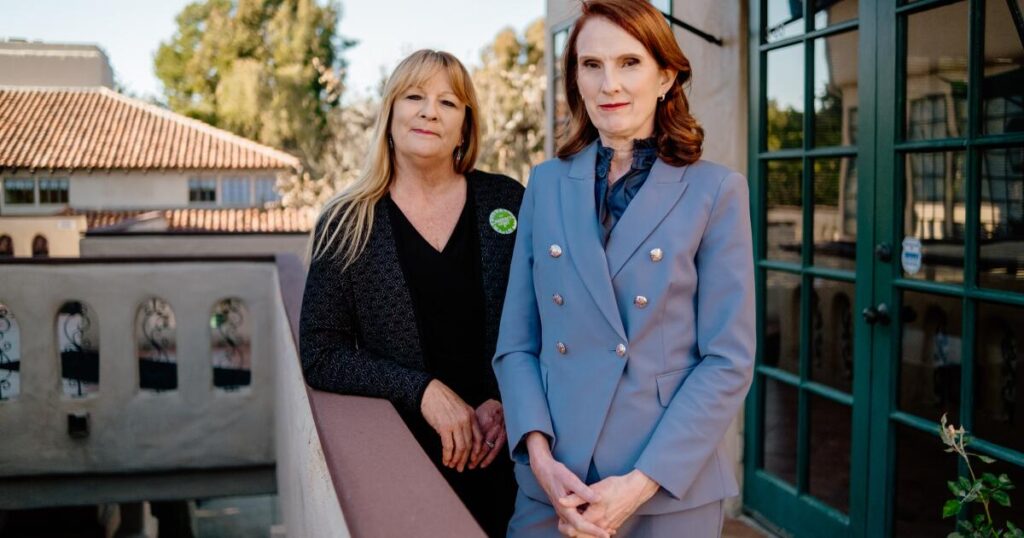
The case was filed in April 2023 on behalf of San Diego County public schoolteachers Elizabeth Mirabelli and Lori Ann West. Mirabelli taught seventh-grade English and West, physical education, at Rincon Middle School in the Escondido Union School District. Each had more than two decades of experience and was a past local “teacher of the year,” according to their complaint.
Both also are devout Roman Catholics who objected to their school district’s policy — based on state guidelines — that barred disclosures related to a student’s gender identity.
The case was championed by the Thomas More Society, a public interest law firm, and allied attorneys. It immediately became a test case on the sometimes conflicting delineation of free speech, religious freedom, student privacy, parental rights and state versus federal law.
The case also is among those at the center of a national debate between advocates for LGBTQ+ rights versus religious conservatives whose positions commonly include a rejection of transgender identity and opposition to same-sex marriage.
The case was ultimately expanded to include other teachers and parents and granted class-action status — which ensured that its outcome would apply statewide.
School districts “will need to revisit their policies on providing transparency to parents and what the process should look like,” said Lance Christensen, vice president of California Policy Center, which applauded the ruling. “If I’m a school board trustee, I would immediately track down our secrecy policies … and fix them immediately to concur with [this] ruling.”
In court papers appealing the ruling, the office of state Atty. Gen. Rob Bonta contends that the ruling suspends enforcement of “longstanding state laws that protect vulnerable transgender and gender nonconforming students” and that it “will create chaos and confusion among students, parents, teachers, and staff at California’s public schools.”
Benitez declined to declare that conflicting state law is unconstitutional.
The state law — which remains in force — bars school districts from requiring parent notification. The law, brought forward in 2024 as Assembly Bill 1955, was in response to actions by a handful of California school districts that passed policies mandating that school employees notify parents of changes related to a student’s gender identity.
The result is that state law protects the rights of school employees to keep students’ gender identity confidential. Meanwhile, according to Benitez’s ruling, federal law protects the rights of school employees to do exactly the opposite.
How school districts should navigate the matter in their policies remains murky, according to some experts. Supporters of the ruling say the path is clear: Schools should simply tell parents about gender-identity issues.
It remains a legally thorny question about “whether prohibiting schools, including teachers and staff, from informing parents violates the right of parents to control the upbringing of their children,” said Erwin Chemerinsky, dean of the UC Berkeley School of Law.
Chemerinsky criticized the ruling and said it should be vulnerable to an appeal. All the same, “the question is how to balance the parents’ rights against the speech interests and autonomy of the children.”
Judge favors parents’ rights
In court documents, Mirabelli and West said they sought a religious accommodation to exempt them from following district policy.
When their school district substantially denied their request, they filed suit.
At issue were state guidelines, which were available online at the time, that stated in part that “the right of transgender students to keep their transgender status private is grounded in California’s anti-discrimination laws as well as federal and state laws.” Disclosing that a student is transgender “without the student’s permission may violate California’s anti-discrimination law by increasing the student’s vulnerability to harassment and may violate the student’s right to privacy,” the guidelines stated.
“With rare exceptions, schools are required to respect the limitations that a student places on the disclosure of their transgender status, including not sharing that information with the student’s parents,” the guidance said.
A teacher, in an anonymous declaration cited in Benitez’s ruling, said: “I believe that God made man and woman in his image, both male and female. I believe that it is impossible to change our sex and that our sex was given to us by God for a reason. I also believe that Scripture teaches that parents have a moral responsibility to guide their children and that children have a moral responsibility to obey their parents. This is a sacred relationship that it is immoral for me to interfere with.”
It soon became apparent that Benitez was sympathetic to the teachers’ claims. In an attempt to avoid an adverse outcome, the state argued in court documents that its guidance was voluntary. Then, the California Department of Education took down the guidance from its website. But the ruling states that similar wording continued to appear in state-sanctioned teacher-training materials, which Benitez cited as a factor in the forcefulness of his decision.
Moving forward, he ruled that such materials would have to include the following statement:
“Parents and guardians have a federal constitutional right to be informed if their public school student child expresses gender incongruence. Teachers and school staff have a federal constitutional right to accurately inform the parent or guardian of their student when the student expresses gender incongruence. These federal constitutional rights are superior to any state or local laws, state or local regulations, or state or local policies to the contrary.”
In addition, under the ruling, school staff cannot use a name or pronoun for a child other than what is in official records if a parent objects to it.
Also, no school worker can be required to use a name or pronoun that does not match the child’s legal name and “natal pronouns.” This provision safeguards an employee’s right to free speech and to exercise their religious belief, Benitez ruled.
Benitez ordered state officials to prove they had complied with the ruling within 20 days.
In his analysis, Benitez relied substantially on the 2024 Supreme Court case of Mahmoud vs. Taylor, which gave parents the right to opt their children out of lessons with pro-LGBTQ+ themes.
Whether these cases can be connected in this way will be one subject of the appeal.
“I think it’s highly likely this issue will eventually make it to the U.S. Supreme Court,” said Kimberly West-Faulcon, who is critical of the ruling and teaches constitutional law at LMU Loyola Law School.
The post Teachers have a right to tell parents if their child might be LGBTQ+, federal judge rules appeared first on Los Angeles Times.