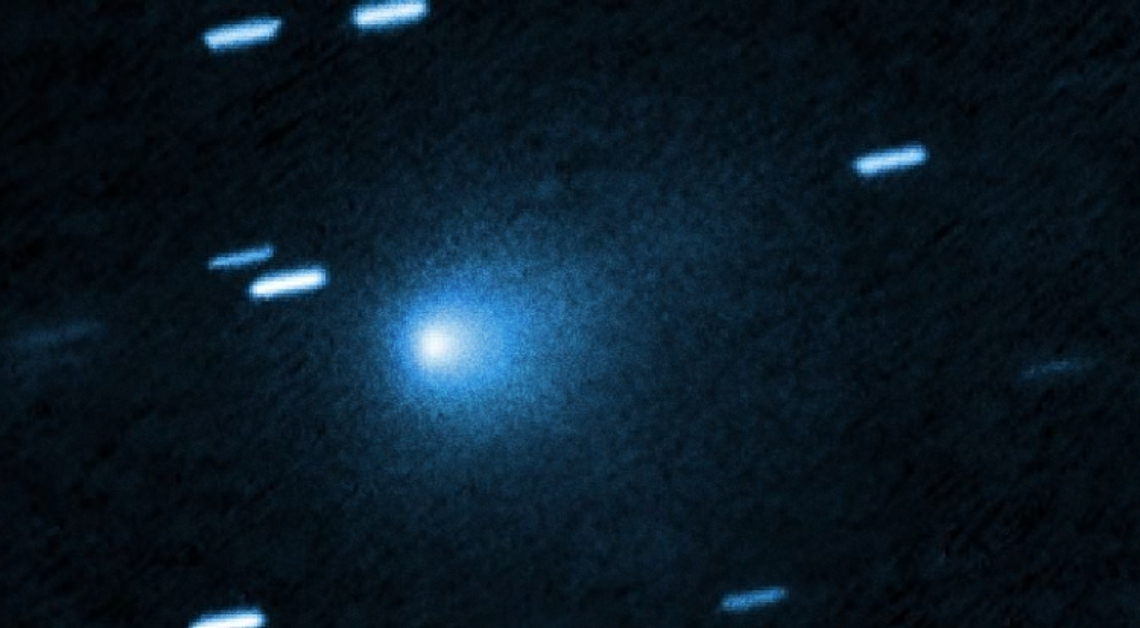
The mysterious interstellar object known as 3I/ATLAS may not be an alien, or even an alien artifact, as was once popularly theorized. That doesn’t mean we shouldn’t double and triple-check just to be sure, which is what researchers did in December.
Using the 100-meter Green Bank Telescope in West Virginia, researchers ran a targeted search for radio signals that might suggest alien technology. What they found will not surprise you in any way unless you are prone to believing in fantasy: there were no alien signals. It was total radio silence. Shocker.
What’s Going on With 3I/ATLAS in 2026?
The Breakthrough Listen Project conducted the search and published its findings on arXiv. The team scanned a wide range of radio frequencies for five hours on December 18. This was about a day before the comet reached perigee, its closest approach to Earth, at roughly 270 million kilometers.
If 3I/ATLAS had been broadcasting anything like a deliberate radio transmission during that window, the telescope would have caught it.
To avoid fooling themselves, the team alternated observations between the comet and nearby patches of sky in a repeating pattern, filtering out background noise. They flagged nine possible signals, only to determine that all of them came from human technology, likely radio interference from Earth, and not a single one from an alien civilization.
Again, this should not have been a surprise; even now, it is fun to imagine a mysterious thing from outside our galaxy was some kind of intergalactic messenger. 3I/ATLAS is and was always demonstrating signs of being a comet, just one that behaved a little strangely, and continues to.
NASA officials have been clear about that since the beginning, while others outside of NASA, like Harvard astrophysicist Avi Loeb, were always playing the “but what if…” game that seemed overly inspired by having read one too many dime-store paperback sci-fi novels.
Really, it can be argued that the discovery of no radio signals emanating from 3I/ATLAS is one of the biggest discoveries so far, since it’s the final nail in the coffin of the whole alien thing, paving the way for researchers to spend their time learning more about this fascinating, ill-behaved rock.
Still, they had to check just to be sure. In the world of serious science of any kind, you can’t rule something out based on a hunch. You need to gather as much data as you can to prove it.
The data has been gathered. Barring any wild unforeseen developments or discoveries, it seems like 3I/ATLAS is just a bit more than just another space rock, but definitely not of alien origin.
The post Scientists Searched 3I/ATLAS for Signs of Aliens. Did They Find Anything? appeared first on VICE.